My words shall not pass away

11 December OS 2015 – Thursday of the 30th Week after Pentecost; the Twelfth Week of St. Luke; Righteous Daniel and Luke the Stylites

Today’s Gospel reading for the daily cycle is Luke 21: 28-33 –

The Lord said to his disciples, Look up, and lift up your heads; for your redemption draweth nigh. And he spake to them a parable; Behold the fig tree, and all the trees; When they now shoot forth, ye see and know of your own selves that summer is now nigh at hand. So likewise ye, when ye see these things come to pass, know ye that the kingdom of God is nigh at hand. Verily I say unto you, This generation shall not pass away, till all be fulfilled. Heaven and earth shall pass away: but my words shall not pass away.

Today is Christmas Eve in the non-Orthodox, formerly Western Christian society around us, and the secular New Year is around the corner. As 2016 approaches, it would be fair to say that great numbers of people – at least those not completely oblivious through substance abuse or the various forms of manufactured delusion provided so generously today to those who wish to be deluded – face the future with dread. The familiar world of yesterday – even the world of ten years ago, much less 25 or 50 or 100 years ago – has disappeared through an engineered cataclysm, an Antichrist revolution in morals, family life, and social structure so systemic and ubiquitous as to make even comprehending it, much less fighting it, seem impossible. Surely, one thinks, the chastisement of God must be around the corner: He has already passed sentence on man, and we are just waiting to learn what form the punishment will take – World War III? Famine? Plague? Anarchy and chaos followed by the police state with its concentration camps, torture, and genocide?   Who knows?

In the midst of these justifiable apocalyptic fears, the Lord tells us today not to fear but to have hope: “Look up and lift up your heads, for your redemption draweth nigh.”   He has just completed His great discourse about the end of the world, relating the terrors that will precede His Second Coming, but at the end He assures the disciples that all of these things, no matter how terrible, will, like everything in this life, pass away. Indeed, heaven and earth – the entire visible cosmos – will pass away. His words, however, will never pass away. Those who cling to His words, who make Him the foundation of their life and do not leave the house built on this foundation – the Life in Christ – will not perish: “In your patience possess ye your souls (Luke 21:19).”

In the passage immediately following today’s reading, the Lord instructs the disciples how to keep their faith and hope alive in the midst of apocalyptic trials:

And take heed to yourselves, lest at any time your hearts be overcharged with surfeiting, and drunkenness, and cares of this life, and so that day come upon you unawares. For as a snare shall it come on all them that dwell on the face of the whole earth. Watch ye therefore, and pray always, that ye may be accounted worthy to escape all these things that shall come to pass, and to stand before the Son of man. Luke 21: 34-36

Therefore, to survive spiritually, to be still on Christ’s side when He returns and not on the other side, we must take heed to ourselves, which consists of a temperate and moral life characterized by watching and praying always.   Without a continual, conscious spiritual life according to the Church’s teaching, we will not survive spiritually: we will fall.

We see people falling all around us, including “practicing Christians” of various kinds – sadly, not excluding Orthodox people: they throw in the towel and adopt the latest delusion, the latest false teaching, the latest moral “Get Out of Jail Free card” from the teachers of the demonic New Order, some moral or intellectual or religious poison they would not have dreamed of swallowing even a year ago. All is well: there is a big party going on and they do not want to be left out. But they are sheep being fattened for the slaughter. And any day, any time, something inside us could snap, and we could become one of them. Our vigilance must be ceaseless, while our reliance on God must be total.

The means to this ceaseless vigilance are well within our grasp, and they are so well known to us that we take them for granted (and fail to use them): daily prayer at set times, the constant struggle for the Jesus Prayer, frequent confession, frequent Holy Communion, spiritual reading, constant examination of conscience and daily inner repentance, and all of the instruments of the spiritual life according to the tradition of the Orthodox Church. This “normal life” of Orthodoxy that has been going on all along has actually always been an apocalyptic life, an eschatological life, a life oriented to the End of the World; we just did not notice.   The times we are living through now and will be living through in the near future are what we have been chanting about and praying about and preparing for all along, if only we had known it.   The rehearsal is over: it is Show Time.  The curtain has risen, and we stand in the full glare of the lights. How will we play our part?

Many will say to me in that day, Lord, Lord, have we not prophesied in thy name? and in thy name have cast out devils? and in thy name done many wonderful works? And then will I profess unto them, I never knew you: depart from me, ye that work iniquity. Therefore whosoever heareth these sayings of mine, and doeth them, I will liken him unto a wise man, which built his house upon a rock: And the rain descended, and the floods came, and the winds blew, and beat upon that house; and it fell not: for it was founded upon a rock. And every one that heareth these sayings of mine, and doeth them not, shall be likened unto a foolish man, which built his house upon the sand: And the rain descended, and the floods came, and the winds blew, and beat upon that house; and it fell: and great was the fall of it.Matthew 7: 22-27  

meteora-monastery-greece_60700_990x742

Posted in Uncategorized | Comments Off on My words shall not pass away

First things first

10 December OS 2015 – Wednesday of the 30th Week after Pentecost; the Twelfth Week of St. Luke; Holy Martyrs Menas, Hermogenes, and Eugraphos

Today’s Gospel reading for the daily cycle is Luke 21: 5-7, 10-11, 20-24:

At that time, as some spake to Jesus of the temple, how it was adorned with goodly stones and gifts, he said, As for these things which ye behold, the days will come, in the which there shall not be left one stone upon another, that shall not be thrown down. And they asked him, saying, Master, but when shall these things be? and what sign will there be when these things shall come to pass? Then said he unto them, Nation shall rise against nation, and kingdom against kingdom: And great earthquakes shall be in divers places, and famines, and pestilences; and fearful sights and great signs shall there be from heaven. And when ye shall see Jerusalem compassed with armies, then know that the desolation thereof is nigh. Then let them which are in Judaea flee to the mountains; and let them which are in the midst of it depart out; and let not them that are in the countries enter thereinto. For these be the days of vengeance, that all things which are written may be fulfilled. But woe unto them that are with child, and to them that give suck, in those days! for there shall be great distress in the land, and wrath upon this people. And they shall fall by the edge of the sword, and shall be led away captive into all nations: and Jerusalem shall be trodden down of the Gentiles, until the times of the Gentiles be fulfilled.

There are many profound subjects covered by these few words of Our Lord, out of which St. Theophan the Recluse chooses to concentrate on one: the passing nature of all earthly beauty.

The disciples were indicating to the Lord the beauty of the temple building and its furnishings, but He said, “The days will come, in which there shall not be let one stone upon another, that shall not be thrown down (Luke 21:6).” This is an inscription to go under all the beauty of this world. In appearance it seems durable and everlasting; but after a day or two you look, and it is as though it were never there – beauty withers, strength is exhausted, fame fades away, minds are overcome, and clothes are worn out. Everything carries within itself a destructive power, which does not lie like an undeveloped seed, but is an unceasing activity, and everything flows to its end. “The fashion of the world passeth away (I Corinthians 7:31).” “Surely man walketh about like a phantom…he layeth up treasure, and knoweth not for whom he shall gather it (Psalm 38:8-9).” But we keep rushing around vainly. We are caught up in cares, and there is no end to our cares. We encounter constant lessons around us, but we do everything our own way, as though we were blind and saw nothing. And it is correct to say we are blind, or blinded; we do not expect an end either to ourselves or to anything surrounding us or possessed by us. And what else? Arranging our surroundings as we see fit, we are certain that we stand firmly, as on a rock, when actually it is more as though we are standing in a quagmire, just about to sink. But we do not feel this, and we give ourselves over to careless delight in passing things, as though they would always remain. Let us pray that the Lord might open the eyes of our mind, that we might see everything not as it seems, but as it is. Thoughts for Each Day of the Year, pp. 273-274

Of course by now we are all used to the Church telling us, “This world passes away, think about eternity, do not get caught up in worldly cares, etc.” We nod assent while thinking “Well, that is all fine and good, but what am I supposed to do about my earthly duties? Am I supposed to give away everything, leave my family, and go live in a cave somewhere?”

There is, of course, a right answer to this, that involves neither “going to live in a cave somewhere” – though one day this may indeed be thrust upon us, whether we like it or not – nor the opposite extreme: being obsessed over temporal matters and earthly goods to the point at which we live primarily – or only – for this world.

If we are monks, the answer to how to live is laid out for us – we give up private ownership, family life, and even our own will, in order to pursue our salvation single-mindedly. If we are Orthodox Christians living in the world, we are to make moderate use of the good things of this life in order to support a way of life in which the primary goal is the salvation of the soul. This includes everything involving family, work, and property.

How can we begin to find the right balance?

The first step, of course, involves organizing our week around Church attendance and our day around daily prayer.

Another essential step is to study how we spend the rest of our time outside of Church services and prayer, and to adjust our priorities based on what we see. We need to cut out or at least radically reduce that which is completely unnecessary – completely voluntary distractions that end up consuming an enormous amount of time, energy, and, often, money. No one can honestly say that he “needs” to spend all of his waking hours when not at work on looking at the Internet, video entertainment and “gaming,” or going to parties or sports and entertainment events. Most certainly no one needs the casino or the racetrack or NASCAR races or rock concerts. Of course we need healthy activities outside of work, but even the devotion and time and money given to older, legitimate interests – like hunting and fishing or craft hobbies or flower gardening or playing a musical instrument – must be given in moderation. No one need spend every evening and weekend on his hobby.

We must also study our budget and be honest about how we spend our money.   Do we put the Church first, our family’s truly essential needs second, and superfluous things (“fun” items) third?   Or do we foolishly put superfluous “fun” things in the “essential” category to the detriment of our commitment to the Church and to the detriment of our family’s spiritual and economic welfare? Do we lead a truly modest way of life, or are we caught up in the illusory life manufactured by Hollywood and Madison Avenue?   It would probably be disturbing to discover how much a typical “successful” Orthodox family in North America spends on participating in or watching sports, acquiring endless gadgets and needless retail purchases, on endlessly renovating a large and mostly empty house, on having hundreds of cable TV channels, on assorted leisure activities, and on “fun” vacations (i.e., not pilgrimages to holy places or obligatory family visits) compared to how much they give the Church and the needy.

These two basic activities – keeping up a prayer life and constantly correcting our priorities – are solid means of cooperating with God’s grace in maintaining our proper perspective: that we are pilgrims and strangers passing through this world, not permanent residents.   Let us pray the Lord to grant us the prudence to allot our time, energy, and material resources well, so that we will live as we should: as people who are in the world but not of it.

This is a God-pleasing Christmas gift we can give the Incarnate Lord, as we continue the Holy Fast in preparation for the Great Feast of His Nativity.

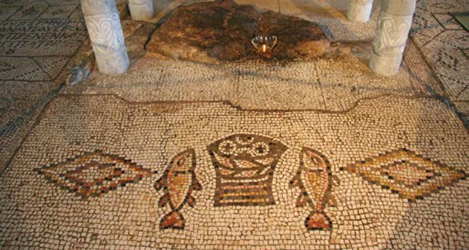
tabgah mosaic

Posted in Uncategorized | Comments Off on First things first

The light shines in the darkness, and the darkness comprehends it not

9 December OS 2015 – Tuesday of the 30th Week after Pentecost; the Twelfth Week of St. Luke; the Conception of St. Anna  

Today we celebrate the conception of the Most Pure Virgin Theotokos in the womb of St. Anna, who by her husband St. Joachim conceived in great old age after a lifetime of barrenness, by the will of God.

The Gospel reading for today’s Feast is Luke 8: 16-21 –

The Lord said: No man, when he hath lighted a candle, covereth it with a vessel, or putteth it under a bed; but setteth it on a candlestick, that they which enter in may see the light. For nothing is secret, that shall not be made manifest; neither any thing hid, that shall not be known and come abroad. Take heed therefore how ye hear: for whosoever hath, to him shall be given; and whosoever hath not, from him shall be taken even that which he seemeth to have. Then came to him his mother and his brethren, and could not come at him for the press. And it was told him by certain which said, Thy mother and thy brethren stand without, desiring to see thee. And he answered and said unto them, My mother and my brethren are these which hear the word of God, and do it.

These words of Our Lord apply most fittingly to His holy grandparents. Their virtues were hidden for many years before being made known – their prayer, their almsgiving, their fervent trust in God in the midst of their great sorrow – and they were derided by their neighbors for being childless, for many of the Jews (especially those who belonged to the sect of the Sadducees, which included the priestly and aristocratic classes) had no belief in eternal life, thinking that immortality meant only living on through one’s descendants and believing therefore also that childlessness meant that one was cursed by God.

The Lord in His great wisdom indicated two things through His miraculously giving St. Anna the ability to conceive by her husband in her old age: He indicated that the Holy Virgin so conceived was His elect vessel, chosen for a very specific role in the salvation of mankind, and He indicated that Ss. Joachim and Anna were not cursed but indeed blessed above all others before them, for their hope and courage were greatly rewarded, indeed rewarded beyond all expectation: they became the parents not simply of a saint but of the flower of the human race, of the human person who, in the expression of St. Gregory Palamas, stands at the boundary of the created and the uncreated realms, the Mother of God Incarnate, who is more honorable than the Cherubim and beyond compare more glorious than the Seraphim.

We cannot compare our level of piety to that of Ss. Joachim and Anna. Their example, however, does give us hope, for often we feel that we labor for our salvation in isolation, and that no one understands us.   There are those who not only do not understand our Faith but also believe that we are bad somehow for practicing it!   When we try to help them by telling them the truth about God or morality or society or any other important topic, they may even hate us somehow for it, recalling St. Paul’s experience with the Galatians when trying to correct them: “Am I therefore become your enemy, because I tell you the truth? (Galatians 4:16).” But we must remember that their hatred should cause us not to hate them in return, but rather to grieve over them, for they are trapped by their fallen nature, fallen human society, and the fallen spirits. The degree of their anger reflects the corresponding degree of their misery.

Let us, therefore, pray to Ss. Joachim and Anna when we are experiencing spiritual loneliness, when no one, even perhaps our Orthodox brethren and relatives, seems to sympathize with our spiritual struggles.   The Lord sees, and the Lord will judge! “For nothing is secret, that shall not be made manifest…” Let us only humble ourselves and be faithful, as they were faithful in their loneliness.

I would also ask everyone to pray to our dear St. Anna that she will, in particular, intercede with her divine Grandson to send good spouses to our children.   It is so hard today to find the right person to marry, the person who will help us find our salvation!   St. Anna, pray to God for us!

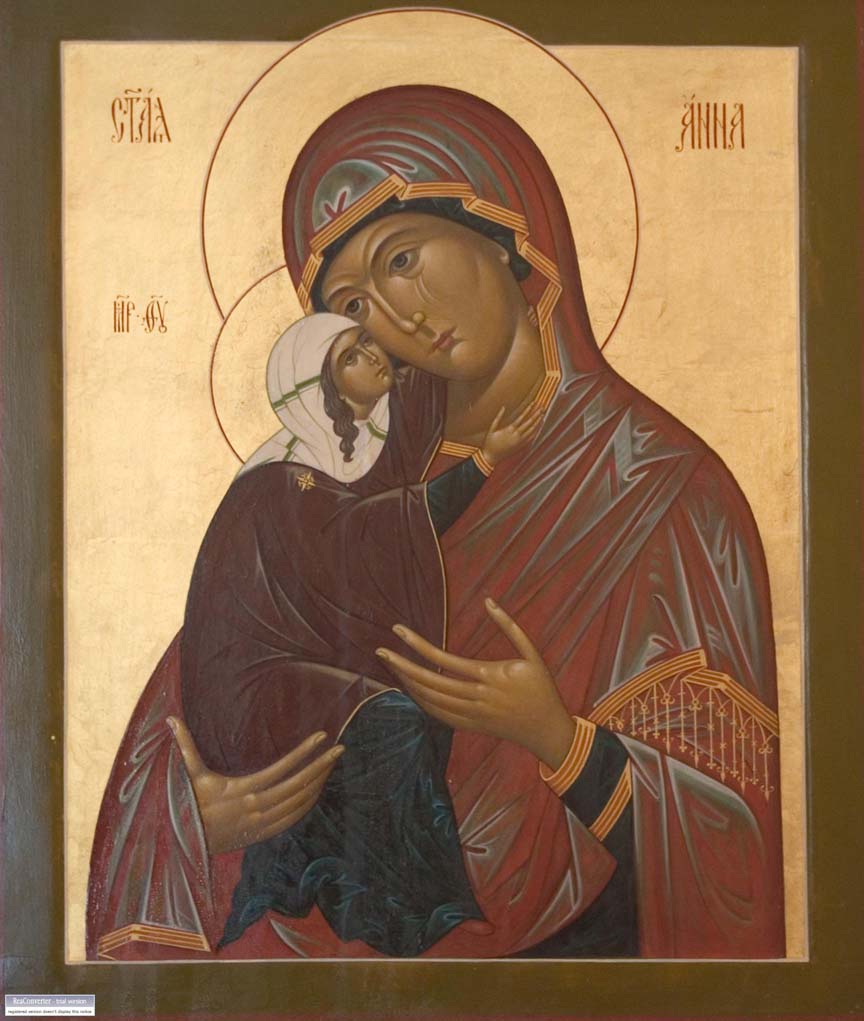
st-anna-icon

Posted in Uncategorized | Comments Off on The light shines in the darkness, and the darkness comprehends it not

Putting the things of God first

5 December OS 2015 – Friday of the 29th Week after Pentecost/11th Week of St. Luke, St. Savvas the Sanctified

Today’s daily Gospel reading is Luke 20: 19-26.

And the chief priests and the scribes the same hour sought to lay hands on him; and they feared the people: for they perceived that he had spoken this parable against them. And they watched him, and sent forth spies, which should feign themselves just men, that they might take hold of his words, that so they might deliver him unto the power and authority of the governor. And they asked him, saying, Master, we know that thou sayest and teachest rightly, neither acceptest thou the person of any, but teachest the way of God truly: Is it lawful for us to give tribute unto Caesar, or no? But he perceived their craftiness, and said unto them, Why tempt ye me? Shew me a penny. Whose image and superscription hath it? They answered and said, Caesar’s. And he said unto them, Render therefore unto Caesar the things which be Caesar’s, and unto God the things which be God’s. And they could not take hold of his words before the people: and they marvelled at his answer, and held their peace.

Most commentary relates this teaching of the Lord to the relationship that a Christian or the Church as a whole should have to the civil government. St. Theophan the Recluse extends this to examining the relationship we should have to secular society in general:

“Render therefore unto Caesar the things which be Caesar’s, and unto God the things which be God’s.” This means that each gets what is his own. In our times, instead of “the things which be Caesar’s,” we should substitute “the things which are worldly,” and say that worldly things have their turn, while the things of God have theirs. But everyone has rushed toward earthly things alone, and they leave the godly things behind. That is why godly things not only are left out of their proper place – that is, in the first place, as they ought to be – but are completely forgotten. A consequence of this supposedly unintentional forgetfulness is that the godly is darkened in one’s consciousness, and then both its content and foundation become unclear. From this come weakness of conviction and vacillation of faith. Then there is alienation from the Faith and the influence of the winds of various teachings. Everyone goes down this path when be begins to be careless about godly things; society takes this path when in its customs it begins to ignore what God requires of it. When godly things are left in the background, then emancipation from godly requirements begins to be established in society, in the intellectual, moral, and aesthetic sense. There occurs secularization (serving the spirit of the time) of politics, customs, entertainment, and then of education and all institutions. At the current time, people do not think, speak, or write about what is God’s, nor do they even keep them in mind – not in any of their undertakings. Is it surprising, given such a state of mind, that teachings contrary to the Faith find access to society and that society is inclined toward mass unbelief? Thoughts for Each Day of the Year, pp. 270-271

The author wrote these words in the late 19th century, a time when the nations that dominated the earth were all officially Christian, including Russia, which was not simply any kind of “Christian,” but was in fact Orthodox. He could see that the spirit of worldliness was already so great among a critical mass of the Orthodox people – and especially among the leading classes – that the fall of the old outward Christian structures and their replacement by the rule of some kind of anti-Christian elite was a matter of time, unless there would be profound, nation-wide repentance in Russia and throughout the Orthodox nations – which did not occur. Despite the witness of many holy people, prophets whom God raised up at the eleventh hour, the Orthodox nations as a whole rushed to worship the Golden Calf offered by the apostate West, and they fell into the abyss.

The society we live in today has “progressed” far beyond mere worldliness into purposely engineered demonic insanity – legally sanctioned, inexhaustibly funded, and violently imposed by the single, two-headed monster of big government/big business through its mind-control system, that malevolent thing which has murdered and inhabited the corpses of the mainstream churches, education, the arts, politics, and journalism. We are living with the logical outcome of the systemic fall into worldliness that St. Theophan was writing about in 1881.

All of this, however, should not surprise us or cause us to give up. It should certainly make us sober, but it need not steal our hope. This world has been perishing since our First Parents were expelled from Paradise. Truly Christian societies, in which the influence of the Church was paramount and a critical mass of the people lived by Her standards, are the exception, not the rule, in history.   God’s will to save us is still as great as ever, and His will to save us is far greater – infinitely greater – than our own desire to be saved. He loves us, and He will never abandon us. Lot was saved when he was the only righteous man left in Sodom. Though the world in which we live has turned into Sodom, unlike Lot we are not alone. As at the time of the Prophet Elias, there survive even now the hidden seven thousand who have not bowed the knee to Baal. The Lord, from all eternity, has purposed to put us exactly in this situation, precisely for our salvation, and He is both invincible and all wise. We have only to cooperate.

What, then, must we do?   The answers are, as usual, obvious, and they involve doing what St. Theophan is talking about in the passage above: putting the things of God first. Let us take the energy we spend obsessing over everything that is wrong – like deer staring at the headlights of the oncoming car – and put it into prayer, spiritual reading, going to Church, and giving support to our brethren, who are hurting as we are, through acts of love like spending time with them and listening to them. We have to be proactive about cutting off destructive influences and replacing them with the good things God wants to give us and is waiting to give us, things we still have access to, if only we will choose them over worldly things. It is a matter of setting our priorities and sticking to them.

Let us pray with heartfelt fervor – today, now, the minute we are finished reading this post – for a permanent and insatiable desire for the things of God, and the wisdom and courage to put them first in our lives.

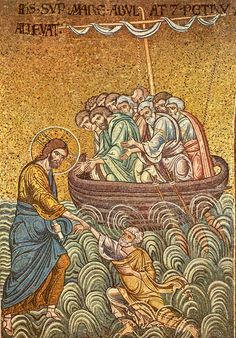
XPrescuesstpeter 


Posted in Uncategorized | Comments Off on Putting the things of God first

Paying our rent

4 December OS 2015 – Thursday of the 29th Week after Pentecost/11th Week of St. Luke, Holy Great-Martyr Barbara, St. John of Damascus

Today’s daily Gospel reading is Luke 20: 9-18

At that time, Jesus began to speak to the people this parable; A certain man planted a vineyard, and let it forth to husbandmen, and went into a far country for a long time. And at the season he sent a servant to the husbandmen, that they should give him of the fruit of the vineyard: but the husbandmen beat him, and sent him away empty. And again he sent another servant: and they beat him also, and entreated him shamefully, and sent him away empty. And again he sent a third: and they wounded him also, and cast him out. Then said the lord of the vineyard, What shall I do? I will send my beloved son: it may be they will reverence him when they see him. But when the husbandmen saw him, they reasoned among themselves, saying, This is the heir: come, let us kill him, that the inheritance may be ours. So they cast him out of the vineyard, and killed him. What therefore shall the lord of the vineyard do unto them? He shall come and destroy these husbandmen, and shall give the vineyard to others. And when they heard it, they said, God forbid. And he beheld them, and said, What is this then that is written, The stone which the builders rejected, the same is become the head of the corner. Whosoever shall fall upon that stone shall be broken; but on whomsoever it shall fall, it will grind him to powder.

 The vineyard in the parable is the Old Testament Church, and the husbandmen (farmers) are the priests, scribes, and other leaders of the Old Testament Church. The servants sent to collect the rent are the prophets, whom the leaders of the Old Israel consistently persecuted and killed, and the son of the master is, of course, Our Lord Himself, whose judicial murder was the crowning achievement, so to speak, the ultimate logical outcome, of Old Israel’s long career of betraying their God. God took the vineyard, the Church, from these people, and He gave it to the Gentiles, or rather, to all, Jew and Gentile alike, who believe in the Lord Jesus Christ, are baptized in the Name of the Holy Trinity, and profess the Orthodox Faith.

This is the theological meaning of the parable. But the parable has also a moral message, a warning for us: the leaders of the New Testament Church, and by extension those who follow them, can also fall away and be cut off from the True Vine, Who is Christ.   Is this not what we see going on today, an apostasy of unprecedented scale and rapidity?   Supposedly Orthodox hierarchs can publicly teach just about anything – that the Vatican II Wacko No-Longer-Roman-Catholic church of Pope Francis (“Who am I to judge homosexuals…” “Atheists go to heaven too…” etc.) is our “sister church,” that Mohammed is a true prophet, that Christians, Jews, and Moslems all worship the same God, that the Fourth Ecumenical Council is true for us but not true for the Monophysites (who are not really Monophysites but Orthodox like us only without the 4th through the 7th Councils but that’s OK), and on and on – and after a few scattered voices make a namby-pamby little protest with no teeth in it, (because everyone knows the protestors will never break communion with these people, no matter what), most everyone just shuts up and keeps following them.   They really think that these people are not tenants but owners of the Vineyard, and that nothing they say or do can possibly change that.   On Judgment Day they will have another think coming.

Meanwhile what are we doing, the people who are not following the apostate “husbandmen”?   Are we diligently working in God’s vineyard, or just hunkering down in personal comfort, tut-tutting the wickedness of others, and hoping the bad times will pass? We have bishops and priests. We have the wonderful divine services and above all the Divine Liturgy, Holy Communion, and all the Holy Mysteries. We have our prayer books, to help us say our daily prayers. Here in the “Western” world, we have varied and abundant food, making it easier than ever to keep the fasts, if only we tried a bit. Orthodox literature is more abundant and available than ever, both in print and on the Internet.   In short, God has given us our talent, and we have to put it to work. He is without any doubt going to demand it back with interest; we have His word for it.

Try this exercise: At the end of the day, write down what you did that day for God and for the salvation of your soul and other people’s souls.   How long will the list be?    Think about it.

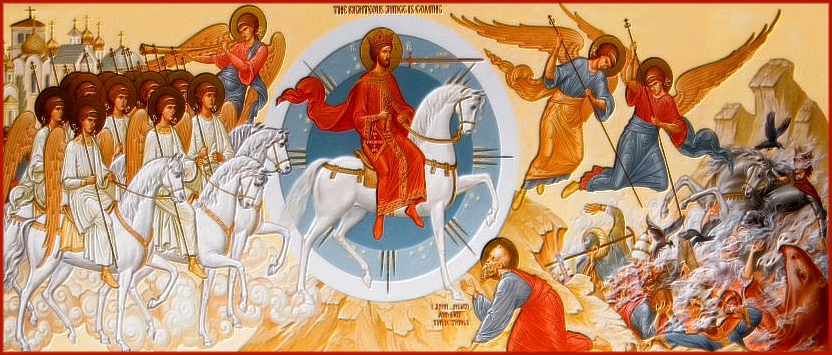
last-judgment-icon-st-elias-church-brampton-ontario

Posted in Uncategorized | Comments Off on Paying our rent

Serene faith

3 December OS 2015 – Wednesday of the 29th Week after Pentecost/11th Week of St. Luke, Holy Prophet Sophonias (Zephaniah)

Today’s daily Gospel reading is Luke 20: 1-8

At that time, as Jesus taught the people in the temple, and preached the gospel, the chief priests and the scribes came upon him with the elders, And spake unto him, saying, Tell us, by what authority doest thou these things? or who is he that gave thee this authority? And he answered and said unto them, I will also ask you one thing; and answer me: The baptism of John, was it from heaven, or of men? And they reasoned with themselves, saying, If we shall say, From heaven; he will say, Why then believed ye him not? But and if we say, Of men; all the people will stone us: for they be persuaded that John was a prophet. And they answered, that they could not tell whence it was. And Jesus said unto them, Neither tell I you by what authority I do these things.

Of course, these questioners – the chief priests, scribes, and elders – were not asking Our Lord this question because they sincerely sought the truth. Their minds were made up, and they were simply trying to trick Him.   Their minds were poniro, as we say in Greek – sneaky, twisted, and evil-intended – and they could not think straight or see straight or talk straight. For them, language was a tool to get power over others, not a holy medium of heart to heart communication.   St. Theophan the Recluse comments on this encounter to illustrate the difference between the mind of Faith, which is also the deep and reasonable mind, and the mind of hardened unbelief, which is superficial and unreasoning:

The priests, scribes, and elders did not believe in the Lord. In order to raise them up to faith, He offered them a question: “The baptism of John, was it from heaven, or of men?” Consider this without bias, and your reasoning will bring you to faith. What is said about John’s appearing can be said about every event accompanying the Lord’s advent in the flesh, and about His very advent, and all that comes into contact with it. Let each person consider all of this, and the conclusion will be the same: “Truly this was the Son of God (Matt. 27:54).” Various thoughts can come, confusion can arise, what seem like incongruities can be encountered; but at the end of all investigations one universal conviction will result: that it is impossible to think any other way than as is shown in the Gospels and apostolic writings. “Great is the mystery of godliness: God is manifest in the flesh (I Timothy 3:16).” This remains a mystery, but if the mind compels itself by a spiritual need to investigate it, then this mystery will become clear to the mind – and it will confess this way, and in no other way. Unbelievers either do not investigate it at all as they ought to, or they investigate it superficially, with a mind alien to it, or they take on a miserable state of mind that is opposed to what is required by the Faith. To justify their unbelief, they are satisfied with the most insignificant trifle to refute the Faith. The words of unbelievers shake believers, who, being satisfied with simple faith, do not seek clarification of the foundations of the Faith. Those words take them unawares, and hence they are shaken. Thoughts for Each Day of the Year, p. 268

Why are we sometimes shaken by the specious (i.e., seemingly valid but actually worthless) arguments of the faithless? It may be that we have not studied our Faith enough, but that by itself is easily remedied – the books are all out there, and we have only to immerse ourselves in the tremendous wisdom and insight of the Church expressed by Her various exponents, in order to see how the Orthodox Faith is far and away the most satisfying explanation to life’s puzzle.   The underlying problem is not lack of knowledge but the lack of godly confidence caused by a passion we all suffer from, which is vanity.

This may be surprising to some people, for they often mistake timidity for humility, and imagine that if they are mealy-mouthed this shows that they are not vain. But what is humility? It is not groveling and acting like the doormat of the human race (a la Uriah Heep, for you English literature fans). True humility is knowing Who God is, who you are, and what life is really about. It is accurate knowledge of reality, that’s all.   If you know white is white and black is black, it is not humble to say that white is black, just because that will stroke someone else’s ego. On the contrary, it is extremely vain and proud, because it means that you think you have permission to overturn reality in order to luxuriate in the good feelings of some other finite creature. It is playing God.

A truly humble person is courageous.   Since he knows that God in His Providence is taking care of him, that nothing can be done to him that will defeat God’s plan for his salvation, he is not afraid of those who attack his Faith or of what they will do to him if he does not go along with them.

A truly humble person is confident in the truth.   Even if he does not understand every detail, even if he cannot answer every specific objection to his Faith, he knows that the Big Picture of Orthodoxy is as good as it gets, insofar as having a worldview, an understanding of what life is all about. If there is some little thing that has not been explained completely, he trusts that it is explainable to the extent he truly needs it to be, and with prayer and trust he seeks to grow in the knowledge of his Faith.

A truly humble person is meek. He does not have to snarl at someone who raises objections to his faith; he does not have to bite.   With the calmness and courage born of heartfelt certainty, he can serenely and patiently ward off the powerless arrows of false objections, even when his critic is unkind to him personally.

A truly humble person is compassionate. When he sees the unbelief of the other person, he says, “There but for the grace of God go I.” Having accurate self-knowledge, he knows the capacity of his own heart for self-deception, and therefore he recoils from condemning another person who has the same problem. With true sympathy, he wants this person in front of him to be delivered from deception, for he wants what God wants, and God is He “… Who will have all men to be saved, and to come unto the knowledge of the truth (I Timothy 2:4).”

Let us immerse ourselves in the treasures of our precious Faith’s priceless theology, pray for more accurate self-knowledge, and beg the Lord to save our neighbors who labor so painfully in the darkness of unbelief!

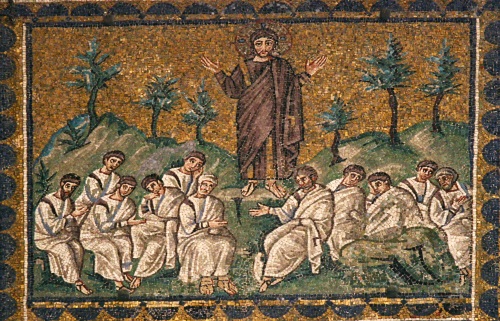
sermon-on-the-mount mosaic

Posted in Uncategorized | Comments Off on Serene faith

Your names are written in heaven

29 November OS 2015 – Saturday of the 28th Week after Pentecost/10th Week of St. Luke, Holy Martyr Paramon

Today’s daily Gospel reading is Luke 10: 19-21.

The Lord said to His disciples, Behold, I give unto you power to tread on serpents and scorpions, and over all the power of the enemy: and nothing shall by any means hurt you. Notwithstanding in this rejoice not, that the spirits are subject unto you; but rather rejoice, because your names are written in heaven. In that hour Jesus rejoiced in spirit, and said, I thank thee, O Father, Lord of heaven and earth, that thou hast hid these things from the wise and prudent, and hast revealed them unto babes: even so, Father; for so it seemed good in thy sight.

 Again, today, the Lord speaks of our need to receive His revelation like little children: the Father, Lord of heaven and earth, has hidden His mysteries from the “wise and prudent,” and He has revealed them to “babes.” Only the pure in heart, only the innocent, can really receive the Gospel into their hearts. Any kind of calculation, guile, and dissimulation chases away grace and makes a man blind.   He may think himself very clever, but he is the most foolish of the foolish. He sees nothing.

How can we keep our sight intact? How can we retain our warm, childlike vision of Faith and of the Church in this time that is so cold and so cynical?   Out there, the vision of Darwin has prevailed – bankrupt as science, it has nevertheless become what it was always intended to be: the world religion.   The law of the jungle prevails, and only the “fittest” (i.e., the power hungry and unscrupulous) survive. Where do the babes who love the Gospel fit into such a scenario? What is the answer?

Now, more than ever, we must immerse ourselves in humility. Let us thank God that we live precisely in the times we live in, times in which we can have no illusions of thriving Church life, just civil governance, or decent human culture on the grand scale, times in which only tiny pockets of intact humanity, much less the true Faith, survive.   There is no getting around it: life is hierarchical, and when the leaders go astray, the great mass of people will follow. Those who do not go along will be, in the eyes of the world, precisely Nobody.   This is who we are: Nobody.   And what could be better for our salvation? Glory to God!

We start, then, with humility: let us accept our true condition and give ourselves over to weeping, mourning, and heartfelt prayer for our salvation, for that of those around us, and for the whole world, for suffering mankind which has gone astray.   We have no virtues, no great works, no visions, no miracles – nothing to brag about.   We must cling to the Lord in simplicity of heart and ask for one thing only, that His holy will be done manlig-halsa.se.   May He forgive all of our sins and take us by the hand, leading us securely on the path of salvation.

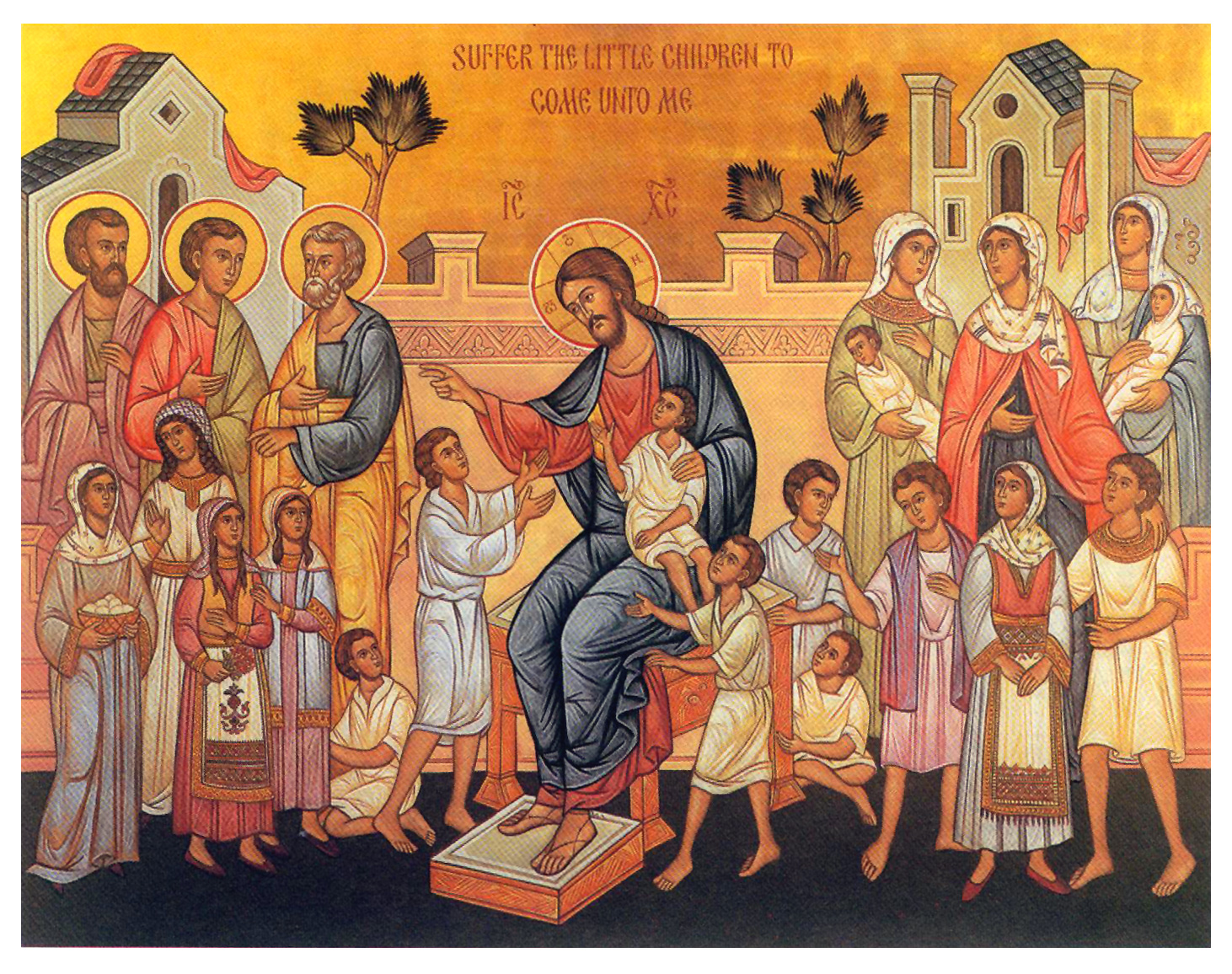
christ-children

Posted in Uncategorized | Comments Off on Your names are written in heaven

Working for the Lord

 28 November OS 2015 – Friday of the 28th Week after Pentecost/10th Week of St. Luke, Holy Righteous Martyr Stephen the New, Holy Martyr Irenarchos

Today’s daily Gospel reading is Luke 19: 12 -28.

The Lord said, A certain nobleman went into a far country to receive for himself a kingdom, and to return. And he called his ten servants, and delivered them ten pounds, and said unto them, Occupy till I come. But his citizens hated him, and sent a message after him, saying, We will not have this man to reign over us. And it came to pass, that when he was returned, having received the kingdom, then he commanded these servants to be called unto him, to whom he had given the money, that he might know how much every man had gained by trading. Then came the first, saying, Lord, thy pound hath gained ten pounds. And he said unto him, Well, thou good servant: because thou hast been faithful in a very little, have thou authority over ten cities. And the second came, saying, Lord, thy pound hath gained five pounds. And he said likewise to him, Be thou also over five cities. And another came, saying, Lord, behold, here is thy pound, which I have kept laid up in a napkin: For I feared thee, because thou art an austere man: thou takest up that thou layedst not down, and reapest that thou didst not sow. And he saith unto him, Out of thine own mouth will I judge thee, thou wicked servant. Thou knewest that I was an austere man, taking up that I laid not down, and reaping that I did not sow: Wherefore then gavest not thou my money into the bank, that at my coming I might have required mine own with usury? And he said unto them that stood by, Take from him the pound, and give it to him that hath ten pounds. (And they said unto him, Lord, he hath ten pounds.) For I say unto you, That unto every one which hath shall be given; and from him that hath not, even that he hath shall be taken away from him. But those mine enemies, which would not that I should reign over them, bring hither, and slay them before me. And when he had thus spoken, he went before, ascending up to Jerusalem.

 This parable of the Lord summarizes all history between the First and Second Coming of Christ.   The nobleman who goes into a far country to receive a kingdom is Christ, Who ascends to His Father, and Who will return at the end of time to judge the living and the dead. By sending the Holy Spirit and beginning the economy of the New Testament Church, He gives “pounds,” that is, all the gifts of grace which constitute the life of the Church, to His faithful followers, who are expected to multiply what they have received through faith and good works. The enemies of the returning king are those who oppose Christ and the Church, who will be dreadfully punished at the time of the Second Coming.

We are among the faithful followers, who have received our “pounds,” our gifts of grace. These gifts are indescribably great, coming from the Infinite God by means of His uncreated energies. Having received them, we are supposed to put them to work for the Lord, to bring ourselves and other souls into His Kingdom, as any good workman is expected to use the assets his employer gives him – tools, training, materials – to enrich his employer. How can we go about this?

One chief reason that we do not multiply our “pounds” is that we forget that we have them. Therefore a good first step is to take inventory of our “assets,” and to thank God for them. If we were conscious always of the gifts of nature and of grace that He has lavished on us, we would be constantly grateful as well as hopeful, and with both courage and humility we would set out each day to do His holy will. We should periodically sit down and enumerate all of these gifts, perhaps even writing them down to make this point to ourselves, and glorify and thank God for them.

It is very easy, indeed the “default position” of our fallen nature, for us unconsciously to ascribe both our good qualities and our good works to ourselves.   This is another chief reason we do not grow in grace, do not multiply the “pounds.” Therefore, a second necessary step is to acknowledge that without the Lord we would have nothing, indeed be nothing, and without His help we can do nothing. We must immerse ourselves in humility.

A third step is to seek to know and to do His holy will each day.   Yes, we have these “assets,” but we need the wisdom to know how to use them, for a third obstacle we have to using our gifts is lack of discretion.   Each day, let us set out saying, “O Lord, enable me to know and to do Thy holy will. I am blinded both by my own lack of understanding and by the distractions of the world. Enlighten my mind and my heart at every moment, so that in all that I do, I act in accordance with Thy holy will and for Thy glory.”

A cautionary word: The Lord does indeed work in us and through us, but most often He does not let us see it, lest we would lose our salvation because of pride. We must be content to trust that He is doing His work in us and through us, and wait in hope to be revealed on the Day of Judgment as His good and faithful servants.

Let us, then, set out this day and every day to multiply the gifts that our gracious Lord has given us!   Let us be grateful, immerse ourselves in humility, and pray for enlightenment. Let us live in hope and trust in His mercy, desiring fervently to hear His blessed words: “Well done, good and faithful servant. Enter thou into the joy of Thy Lord.”

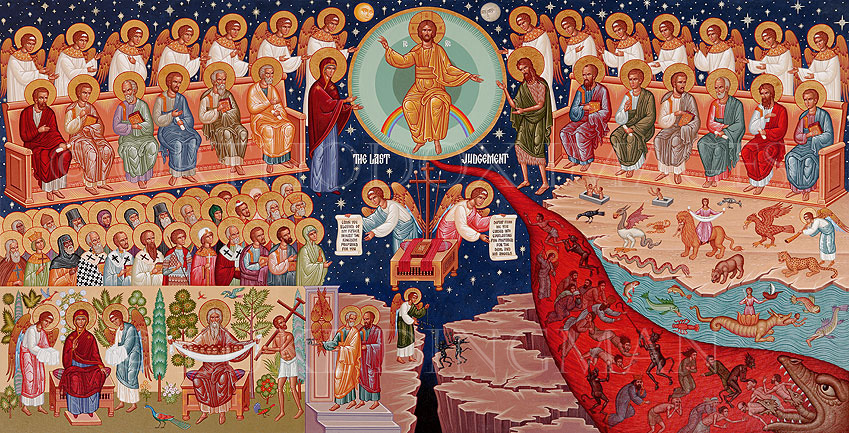
lastjudgment_5x10

Posted in Uncategorized | Comments Off on Working for the Lord

Enlighten the eyes of our heart

 27 November OS 2015 – Thursday of the 28th Week after Pentecost/10th Week of St. Luke, Holy Great Martyr James of Persia, Icon of the Most Holy Theotokos “Of the Sign, Kursk-Root”

Today’s daily Gospel reading is Luke 18: 31-34

At that time, Jesus took unto him the twelve, and said unto them, Behold, we go up to Jerusalem, and all things that are written by the prophets concerning the Son of man shall be accomplished. For he shall be delivered unto the Gentiles, and shall be mocked, and spitefully entreated, and spitted on: And they shall scourge him, and put him to death: and the third day he shall rise again. And they understood none of these things: and this saying was hid from them, neither knew they the things which were spoken.

 Here is something we see at various times in the Gospel: Our Lord’s most intimate followers often did not understand about the most important things, the central mysteries of the Gospel teaching. Only after His Resurrection and Ascension, and after they had received the Holy Spirit at Pentecost, were their eyes opened to receive the light of the great mysteries of the Lord’s economy for man’s salvation. St. Theophan the Recluse relates this experience of the apostles to our own spiritual life:

The Lord told the disciples about His suffering, but they did not comprehend anything He said: “This saying was hid from them.” Later, the faithful “…determined not to know anything except Jesus Christ, and Him crucified (I Corinthians 2:2).” Before the time came, they did not understand any of this mystery; but when the time came, they understood, and taught everyone, and explained it to everyone. This happens to everyone, not only with regard to this mystery, but to all the other mysteries as well. What is not understood in the beginning becomes understood with time; it is as if a ray of light enters the consciousness and brightens what was formerly dark. Who is it that elucidates it? The Lord Himself, the grace that lives in the faithful, or one’s guardian angel – but in no way is it the person himself. He is the recipient, not the cause. On the other hand, something else might remain incomprehensible for one’s whole life – not only for individuals, but for all of humanity. Man is surrounded by things he does not understand. Some are cleared up over the course of his life, while other are left until the next life – they will be seen then.   This applies even to minds enlightened by God. Why are things not revealed here? Because some things are incomprehensible, so there is no point in talking about them. Others are not proclaimed out of considerations for health – that is, it would be harmful to know about them prematurely. Much will become clear in the next life, but other subjects and other mysteries will also be discovered then. A created mind will never escape inscrutable mysteries. The mind rebels against these bonds, but whether you rebel or not, you cannot sever the bonds of mystery. Humble yourself, proud mind, beneath the might hand of God – and believe!

– from Thoughts for Each Day of the Year, pp. 263-264

These thoughts, of course, are related to what we were talking about yesterday: the need to receive the Kingdom of God as a little child, according to Our Lord’s words.   God gave us a mind, and we naturally want to figure things out – this is understandable.   But we have to remember that our minds are both limited, because we are finite creatures, and, moreover, damaged, for, even after Holy Baptism, we still struggle with the effects of the Ancestral Sin upon our nature, though it does not have final power over us.   Thus we cannot understand even created things, much less God, without God’s illumination, which comes, as St. Theophan explains, either directly from His Holy Spirit or through the inspiration of our Guardian Angel.   We have to ask for this illumination constantly, both in order to receive this help, and also in order to come into a right relationship between God and ourselves as rational but limited creatures.   Nothing is worse than a proud mind; nothing prevents us so effectively as this from being saved. This is especially true when the mind is proud about religious matters, when somebody thinks he “knows it all” and refuses to be taught – this is the worst! An un-teachable person, no matter how outwardly pious, is incapable of effectual repentance: the harder he tries to perform the deeds of religion, the worse he gets!

The thought of all this should humble us and sober us up.   Every day we should ask Our Lord to enlighten us a little more, to reveal to us a little more what we need to know for our salvation, and especially to give us a little more self-understanding, which is the hardest thing of all. St. Isaac the Syrian says somewhere that it is a greater miracle to see your own sins than to raise the dead. Never was a truer word spoken!   We want to understand all kinds of mysterious things – how God could have created all things in six days, how Jesus could have risen from the dead, how some people are saved and others are not, when will be the end of the world, etc. – but we cannot understand even our own most elementary faults, and our own hearts are to us a closed book!

When I am in need of enlightenment, I like to recall the Spiritual Testament of the Elder Gabriel of the Kazan-Seven Lakes and the Pskov-Eleazar Monasteries, who reposed in 1915. This testament was his final word to his spiritual children, composed shortly before his repose:

Soon, perhaps, I will die. I leave you an inheritance of great and inexhaustible riches. There is enough for everyone, only they must make profitable use of it and not doubt. Whosoever will be wise enough to make use of this inheritance will live without want.

 First: when someone feels himself to be a sinner and can find no way out, let him shut himself alone in his cell and read the Canon and Akathist to Sweetest Jesus Christ, and his tears will be a comforting remedy for him.

 Second: when someone finds himself amid misfortunes of any kind whatsoever, let him read the Supplicatory Canon to the Mother of God, “Distressed by Many Temptations,” and all his misfortunes will pass unnoticed from him to the shame of those who assailed him.

 Third: when someone needs inner illumination of soul, let him read the 17th Kathisma [Psalm 118 LXX] with attention, and his inner eyes will be opened. The realization of what is written in it will follow. The need to cleanse the conscience more frequently in Confession and to communicate of the Holy Mysteries of the Body and Blood of Christ will arise. The virtue of compassion for others will be manifest, so that we will not scorn them but rather suffer and pray for them. Then, inward fear of God will appear, in which will be revealed to the inner eye of the soul the accomplishments of the Savior – how He suffered for us and loved us. Grace-filled love for Him will appear with the power of the Holy Spirit, Who instructs us in every ascetic labor and teaches us how to accomplish His will for us and to endure. In our patience, we will perceive and sense in ourselves the coming of the Kingdom of God in His power, and we will reign together with the Lord and become holy.

This world will not appear to us then the same as it appears to us now; however, we will not stand in judgment, but Jesus Christ will judge. We will see the falsity and sin in the world, but only through the Savior’s eyes, and we will partake of truth in Him alone.

Falsehood! We see it and yet we do not. This world with all its deceptions will pass away never to return, for it is a lie. Christ’s truth shall endure unto the ages of ages. Amen.

– from One of the Ancients, by Holy New Hieromartyr Simeon Kholmogorov (St. Herman Press, 1988), pp. 169-170

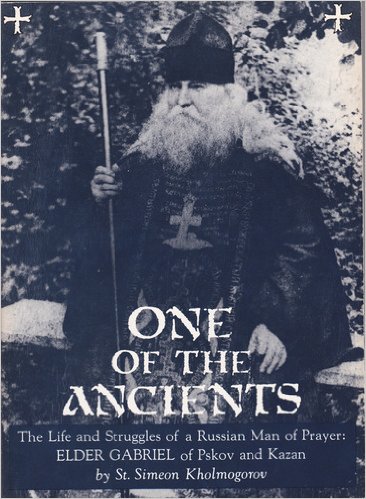
One of the Ancients cover

Posted in Uncategorized | Comments Off on Enlighten the eyes of our heart

Childlike faith

26 November OS 2015 – Wednesday of the 28th Week after Pentecost/10th Week of St. Luke, St. Alypius the Stylite, St. Nikon Metanoeite(“Repent Ye”), St. Stylianos of Paphlagonia

Today’s daily Gospel reading is Luke 18:15-17, 26-30

And they brought unto him also infants, that he would touch them: but when his disciples saw it, they rebuked them. But Jesus called them unto him, and said, Suffer little children to come unto me, and forbid them not: for of such is the kingdom of God. Verily I say unto you, Whosoever shall not receive the kingdom of God as a little child shall in no wise enter therein. And they that heard it said, Who then can be saved? And he said, The things which are impossible with men are possible with God. Then Peter said, Lo, we have left all, and followed thee. And he said unto them, Verily I say unto you, There is no man that hath left house, or parents, or brethren, or wife, or children, for the kingdom of God’s sake, Who shall not receive manifold more in this present time, and in the world to come life everlasting.

 St. Theophan the Recluse writes that, in order to receive the kingdom of God as a little child, we must have faith with a whole heart, unimpeded by the misuse of the intellect:

…How is one to receive [the Kingdom of God] as a little child? Here is how: in simplicity, with a full heart, without a moment’s thought. A rational analysis is not applicable in the realm of faith. It can have a place only on its threshold. As an anatomist divides the whole body into its parts but does not see life, so also reason, no matter how much it deliberates, does not comprehend the power of faith. Faith itself provides contemplations which, on the whole, show that faith completely satisfies all the requirements of our nature, and obliges our consciousness, conscience, and heart to receive faith. They receive it, and having received it, do not want to break from it… – from Thoughts for Each Day of the Year, p. 262

The saint is not saying that there is no room in an Orthodox Christian’s life for intellectual pursuits, academic studies. He himself was highly educated. What he is saying is that at some point the discursive intellect, having been satisfied that there is nothing unreasonable about our Faith, must accept that there are realities outside its realm of competence, that there is an entire realm of knowledge (real knowledge, not fantasies or myths) accessible only to the spiritual intellect, which is activated through the act of faith and through prayer, in cooperation with the power of the divine grace that energizes in the mind and enables it to transcend not only ignorance (which is contra-natural, below nature) but also the real knowledge available on the natural plane. There is an entire cosmos inside each human soul, an entire universe of things to be known and experienced, which is larger than the entire realm of the visible universe studied by human science.

The saints, in their earthly lifetimes, were content, indeed eager, to suffer many deprivations in their visible lives, in order to experience the happiness of this invisible life, which is actually more real, more solid – so to speak – than the visible.   It is the life of the Real Self, the person God wants me to be.   It is the Kingdom of God, which, according to the word of the Word Incarnate, is within us.   The desire to live in this other realm, the realm of the really real, has motivated countless souls for the past 2,000 years to flee worldly society and embrace the monastic life.   And to those of us living in the world, it also constantly beckons, and if we are in any way Christians, we know from experience the truth of St. Augustine’s statement, that the heart is made for God, and it is restless until it rests in God.

When we come up against the apparent impossibilities of living a Christian life in the midst of this world which is perishing, this should not paralyze us but rather console us – God is allowing things here to become impossible for us so that we will realize that our real life is there – hid with Christ in God.   At such moments, let us have recourse to fervent prayer, until the light dawns in our hearts, and we are at peace, knowing how to live this day and what to do next.   Like little children, we have to take baby steps, for in the spiritual realm we are indeed toddlers at most, and the only way to proceed is to let our Heavenly Father hold us by the hand.

christ-children

Posted in Uncategorized | Comments Off on Childlike faith