Beyond Jordan

14 January OS 2016 – Leavetaking (Apodosis) of Theophany; St. Nino of Georgia; St. Savva of Serbia;  St. Hilary of Poitiers

The reading from the Gospel today is John 10:39-42

At that time, the Jews sought again to take Jesus: but he escaped out of their hand, And went away again beyond Jordan into the place where John at first baptized; and there he abode. And many resorted unto him, and said, John did no miracle: but all things that John spake of this man were true. And many believed on him there. 

The daily Gospel readings during the Afterfeast of the Theophany, as might be expected, relate to the Lord’s baptism. Today’s reading from St. John tells us that Christ escaped from “the Jews” (i.e., those who had rejected Him) when they wanted to stone Him after He had made the bold statement, “I and my Father are one (John 10:30),” and He went to the wilderness of Jordan, to the place where John had baptized.

There are several lessons here, of which let us speak of three: one theological, one relating to our spiritual life, and one relating to the mission of the Church.

  1. The Lord “escaped out of their hand,” because His time had not yet come. St. John, more explicitly than the other three Evangelists, makes absolutely clear that the Lord’s Passion and Death were completely voluntary – He always had complete control of the situation.   For example, St. John is the one who records that when the mob approached to arrest Him in Gethsemane, they all fell to the ground simply because He spoke the Divine Name: “I AM” (Ego eimi). He is always Master of human events. He calmly and deliberately goes about His Father’s business, right up to the Cross and Death.
  1. We too, His followers, must calmly and deliberately go about our Father’s business.   All the events surrounding us, no matter how disturbing or frightening, are – whether the perpetrators of evil like or not, or intend it or not – part of God’s plan for the salvation of those who believe in Him.   But following the example of Christ Himself, we must “…go again beyond Jordan…” i.e., we must have constant recourse to the baptismal grace that is within us by retreating into the “wilderness” of prayer and divine study.
  1. Retreating into the wilderness, whether literally or figuratively, does not defeat our mission to “preach the Gospel to every creature (Mark 16:15),” because, if we are living authentic Orthodox Christian lives, “every creature” intended by God to come to us, will come to us. In this passage, the Lord goes beyond Jordan, and yet multitudes go out to seek Him, and “…many believed on Him there.”  We see this over and over again in the history of the Church: God’s saints flee to the wilderness, and other earnest souls follow them without any coercion or persuasion.   They simply want to be near the source of life. In our time, those who come will probably not be multitudes, but they will be those who are responding to God’s call.   The number does not matter.

Let us therefore:

  1. Be absolutely convinced that all is beneath God’s Providence for our salvation.
  1. Establish and constantly re-establish disciplined lives of prayer and spiritual effort, and
  1. Share this life with those who come to us seeking the Fountain of Salvation, Our Lord the God-Man Jesus Christ, Who gives abundantly of His Spirit to those who seek Him in sincerity of heart.

O Christ our God, baptized in Jordan for our sake, glory be to Thee!

Jordan-river1


Posted in Uncategorized | Comments Off on Beyond Jordan

Mercy and truth are met together

16 January OS 2016 – Afterfeast of Theophany; Holy Martyrs Hermylas and Stratonikos; Holy Martyred Fathers of Sinai and Raithu

The reading from the Gospel today is St. Luke’s account of the Temptation of the Lord, Luke 4: 1-15.

And Jesus being full of the Holy Ghost returned from Jordan, and was led by the Spirit into the wilderness, Being forty days tempted of the devil. And in those days he did eat nothing: and when they were ended, he afterward hungered. And the devil said unto him, If thou be the Son of God, command this stone that it be made bread. And Jesus answered him, saying, It is written, That man shall not live by bread alone, but by every word of God. And the devil, taking him up into an high mountain, shewed unto him all the kingdoms of the world in a moment of time. And the devil said unto him, All this power will I give thee, and the glory of them: for that is delivered unto me; and to whomsoever I will I give it. If thou therefore wilt worship me, all shall be thine. And Jesus answered and said unto him, Get thee behind me, Satan: for it is written, Thou shalt worship the Lord thy God, and him only shalt thou serve. And he brought him to Jerusalem, and set him on a pinnacle of the temple, and said unto him, If thou be the Son of God, cast thyself down from hence: For it is written, He shall give his angels charge over thee, to keep thee: And in their hands they shall bear thee up, lest at any time thou dash thy foot against a stone. And Jesus answering said unto him, It is said, Thou shalt not tempt the Lord thy God. And when the devil had ended all the temptation, he departed from him for a season. And Jesus returned in the power of the Spirit into Galilee: and there went out a fame of him through all the region round about. And he taught in their synagogues, being glorified of all.

The Lord Jesus came and took our flesh to do for us, as one of us, what we could not do for ourselves, so that a Man could fix what Man had broken. God did not write man off and forget about him after the Fall, nor did He wave a magic wand and make everything all right. He neither abandoned us to our (deserved) fate nor did He give us a “Get Out of Jail Free” card. He came among us as one of us and said, “Alright, now roll up your sleeves and follow Me; we have work to do.” God’s righteous decree of death and hell upon sinful man could not be overturned without overturning the universe, indeed without denying Who God Is, and yet God’s will to save man was unchanged and unchangeable. Therefore God Himself came and

– fulfilled that which we could not fulfill (the Law)

– endured that which we could not endure (the totality of all the sufferings caused by sin, when He took upon Himself the sins and sufferings of all men that ever have, do, and ever will live, suffering in His most pure soul at every moment of His earthly life, and then making a total Holocaust of Himself, body and soul, in His unspeakable and incomprehensible sufferings in the Sacrifice of the Cross)

– and conquered that which we could not conquer (sin, death, the devil, and hell), so that both Justice and Mercy might be fulfilled in Him, the God-Man.

Thus fulfilled were the words of David in the psalm that we read every day at the Ninth Hour, three in the afternoon, the moment of the death of the Lord: “Mercy and truth are met together, righteousness and peace have kissed each other (Psalm 84:10 LXX).”

In today’s Gospel we see the God-Man in a critical phase of this operation, the point at which the New Adam absolutely rejects Satan’s temptation to sin.   Here the Lord reverses the foolish weakness of our First Parents, who listened to the serpent’s lies and thus fell into his clutches.   There is not a single moment of hesitation here, not the trace of a nanosecond of thinking over the choice being offered. He does not give the tempter the time of day.

To follow Our Lord as His disciples, we have to do the same thing.   The Holy Fathers teach us that temptation and the fall into sin occur in several stages. The first stage is called the prosvoli, “provocation,” in which the thought of the sin comes to us apart from our own will, either from the demons or the outside world or something within ourselves (memory, imagination, involuntary thought processes, bodily sensation, etc.). At this point, there is no sin involved, just the temptation. This is the point at which we have to reject the thought absolutely – not give it the time of day.   We have to say “No!” immediately and turn to prayer right away, asking God and our Guardian Angel and God’s saints to come to our aid. They will, and swiftly, if only we turn to them.

By a constant habit of rejecting sinful suggestions, we acquire firmness of mind and heart, and we can “go from strength to strength,” growing in the Holy Spirit into the spiritual stature the Lord desires for us.   By doing the opposite and frequently playing with the temptations offered us, sometimes we fall and sometimes we do not, and when we fall, we can get up and repent, but this is not Plan A. Plan A is to not think about sinning for one second. By playing games with this, we cloud our minds and weaken our wills, and life becomes one long and often depressing struggle, an exhausting trail of ups and downs. By God’s grace, we can escape the consequences of our oft-repeated foolishness, but this makes everything a lot tougher, bringing our ultimate victory into doubt by tempting us to lose hope in the Lord’s mercy.

The Fathers’ exhortation to reject the sinful thought immediately, without even thinking about it for one second, is tied to their exhortation to pray always, and especially to say the Jesus Prayer: “Lord Jesus Christ, Son of God, have mercy on me the sinner.”   If the sweetest Name of Jesus Christ is always on our lips and in our minds and hearts, we will hate sin and never compromise with it.

Let us begin each day with the Name of Jesus on our lips, in our minds, and in our hearts, and let us carry this Name – which, though a created human name, was invested with infinite divine power by the Incarnation – with us throughout our waking moments, falling asleep with it on our lips. Surely the Lord, Who has already destroyed Satan’s power over us, will give us every good and perfect spiritual gift, and we will become invincible against the foe that strives against us.

O Lord, Who was baptized for our sake, and Who endured temptation as a man for our sake, glory be to Thee!

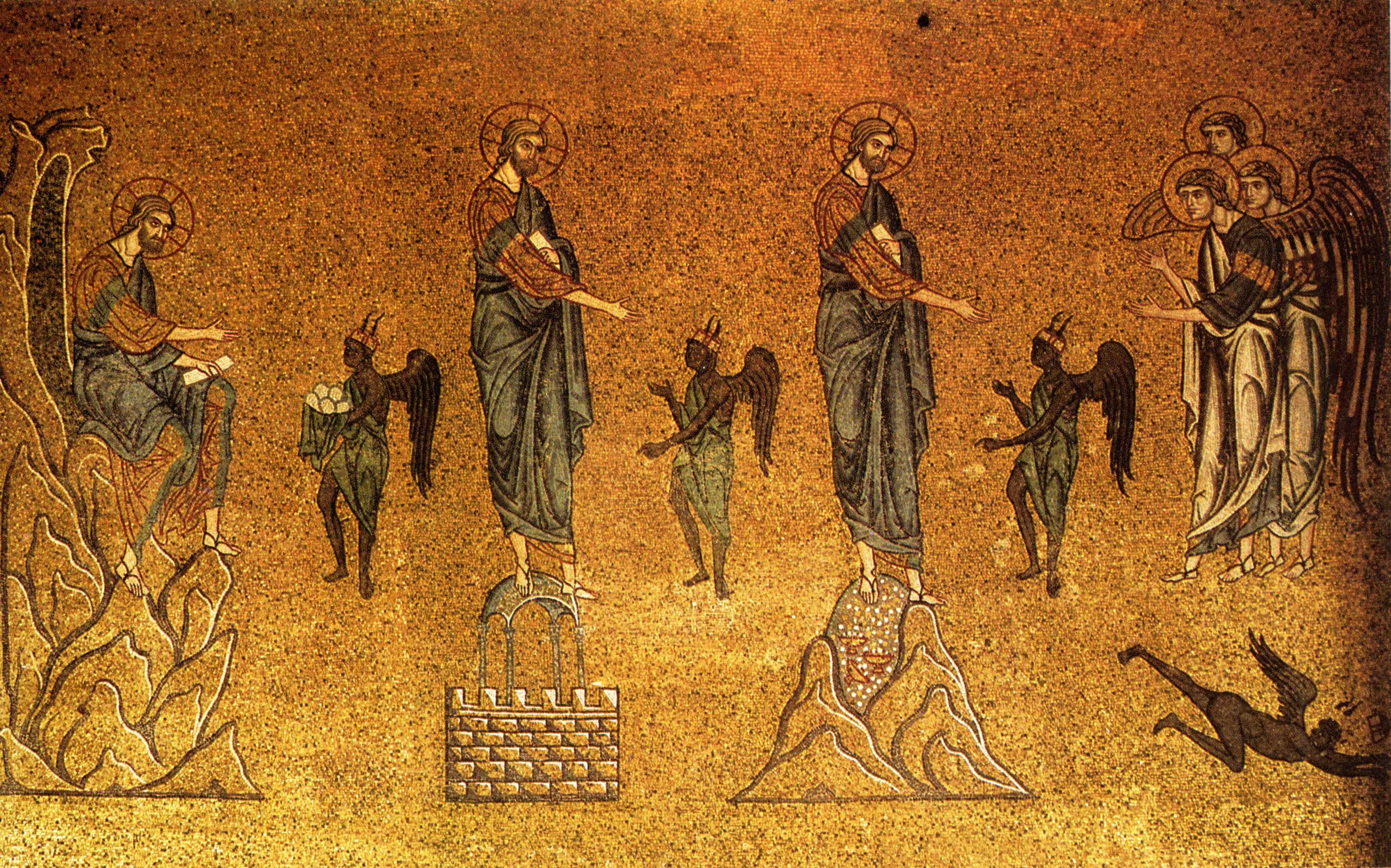
Temptations_of_Christ_(San_Marco)

Posted in Uncategorized | Comments Off on Mercy and truth are met together

In plain words

9 January OS 2016 – Afterfeast of Theophany; Holy Martyr Polyeuctus

The reading from the Gospel today is Mark 1: 9-15.

And it came to pass in those days, that Jesus came from Nazareth of Galilee, and was baptized of John in Jordan. And straightway coming up out of the water, he saw the heavens opened, and the Spirit like a dove descending upon him: And there came a voice from heaven, saying, Thou art my beloved Son, in whom I am well pleased. And immediately the Spirit driveth him into the wilderness. And he was there in the wilderness forty days, tempted of Satan; and was with the wild beasts; and the angels ministered unto him. Now after that John was put in prison, Jesus came into Galilee, preaching the gospel of the kingdom of God, And saying, The time is fulfilled, and the kingdom of God is at hand: repent ye, and believe the gospel.

 The Gospel according to St. Mark is the shortest of the four Gospels – only sixteen short chapters, compared to St. Matthew with 28 chapters, St. Luke with 24 chapters (the longest Gospel, for his chapters are longer than St. Matthew’s), and St. John with 21 chapters.   Its great power lies in plainly reporting the Savior’s mighty deeds.  This Evangelist records few of the Lord’s teachings; Mark is an “action story” – this happens, that happens, this happens, that happens – and this is what it means.  Accept it or not:  which do you choose?

Blessed Theophylact states, in the introduction to his commentary on St. Mark, that the Evangelist wrote his Gospel at Rome, in direct response to the local Christians’ begging him to put his preaching down on paper.  He writes fittingly for an audience of these old West Romans, a plainspoken folk of few words but many deeds.

This directness is plain from the beginning of Mark, which starts not with historical context or genealogy (Matthew and Luke) or a profound theological meditation (John), but with these simple words:  The beginning of the Gospel of Jesus Christ the Son of God.   St. Mark goes on immediately to introduce St. John the Baptist and his ministry, and then, at verse nine of chapter one, he is ready to present the Lord Himself as a full-grown man coming to be baptized.

In seven short verses, today’s reading proclaims great mysteries.

Here is a short list:

Christ appearing straight off as a full-grown man is revealed as the Perfect Man, the New Adam.

Christ is baptized, thus fulfilling the righteousness of the Old Law, which sinful man could not fulfill, and inaugurating the Baptism of the New Law, which is not a foreshadowing of but the very reality of salvation.

All the waters of the world, spoken of as the primordial element of life in the very first verses of Scripture, are sanctified and made the element not only of earthly life but also of eternal life.

The Mystery of the Holy Trinity is plainly manifest:  The Father speaks from heaven, the Son is seen in the Jordan, and the Spirit descends in the form of a dove.

The Lord overcomes Satan in the wilderness, thus reversing man’s relationship with demons:  now man, in the Person of Christ, has power over the devil, whereas before the devil dominated man.

The Lord lives with the wild beasts in the desert and comes to no harm, thus reversing man’s alienation from the creation, caused by sin.   He is the New Adam in the new Paradise of the Kingdom of God.

The angels minister to the Lord, revealing both that He is their God, the King of the Angels, and that as the ultimate and perfect representative of the human race, He has placed Man where God always intended him to be, among the heavenly hosts as the replacement for the fallen angels.

John Baptist ends his ministry by a martyric contest unto death, thus crowning the entire history of the Old Testament with his witness to Christ.  The ministry of the New Testament begins.

The Lord announces that history, as man has known it for 5,000 years, is over:  “The time is fulfilled, and the Kingdom of God is at hand.” With the coming of Christ, God’s Kingdom has broken into time, and from now on God the King will be gathering His own into the eternal Kingdom and casting those Who reject Him into the eternal fire. From now on, everything men say or do till the end of the world will be a response to the Main Event of All Time, which is in essence also the End of Time, which has happened already and is continuing to happen before their eyes. (In other words, for the past 2,000 years, we have been living between Act I and Act II of the End of the World – this puts Christian history into its real perspective).

Having announced the End of All Things, the Lord demands the only sane response to such an announcement:  “…repent ye, and believe in the Gospel.”    In other words, “This is it.  This is what you have been waiting for.  Deal with it.”

Are we with Him or against Him?

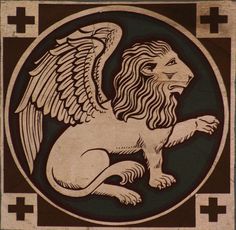
lion of St. Mark

Posted in Uncategorized | Comments Off on In plain words

Attaining our purpose

3 January OS 2016 – Saturday before Theophany; Holy Prophet Malachias (Malachy); Holy Martyr Gordius

The reading from the Gospel today, for the Saturday before Theophany, is Matthew 3: 1-6.

In those days came John the Baptist, preaching in the wilderness of Judaea,And saying, Repent ye: for the kingdom of heaven is at hand. For this is he that was spoken of by the prophet Esaias, saying, The voice of one crying in the wilderness, Prepare ye the way of the Lord, make his paths straight. And the same John had his raiment of camel’s hair, and a leathern girdle about his loins; and his meat was locusts and wild honey. Then went out to him Jerusalem, and all Judaea, and all the region round about Jordan, And were baptized of him in Jordan, confessing their sins.

Repentance is at the heart of the Gospel. Everything begins with it, and ultimately, at the end of a man’s life in this world, everything here ends with it: our hope is precisely to die in repentance.   Our life, then, is, or should be, one of constant repentance. What then is it, and how can we attain it? How can we live a life of repentance?

The Greek word we translate by “repentance” is metanoia, which we need to translate as both “change of mind” and “change of heart” to capture the full meaning, since what the words means is “change of the nous,” the nous being the spiritual intellect, whose entire reality we cannot grasp unless we think of it as the mind joined to the heart. It is the center of one’s personality and existence, the “real me.” One of the Holy Fathers has said that when someone is truly living in grace, the soul becomes “all nous” – in other words, everything about the person becomes spiritual, even in this life.   This state is also what we call theosis.

Even – especially – the greatest saints never stop repenting, even when they are in theosis. How can this be? What do they have to repent of? They keep repenting because they keep on turning their minds to God, and they on keep weeping over their sins and the sins of the whole world, right up to their last breath.

It is in the light of this reality, of what a saint is and how a saint lives, that we can understand what repentance is: the constant turning of the mind and heart back to God, away from the ego (the false self), away from love of this world, and away from demonic thoughts.    The mind, captivated by the divine beauty, desires to think of God always and His holy commandments, by which one lives, using one’s will and energy to inject one’s love of God into one’s daily activities. The heart, desiring God and longing to be united to Him, unites with the mind in prayer and in action, and puts warmth and life into the actions of the mind and will.

When we hear, “Say your prayers! Fast! Do spiritual reading! Go to Confession! Prepare for Holy Communion!” and the rest of the whole list of do’s (and don’ts!) that the Church’s preachers and teachers are always “throwing at us,” it will help us to recall that these activities are not external badges of being “good little boys and girls,” so that others will approve us.   They are indispensable means to attaining the purpose of our entire existence. We have to decide between heaven and hell; we have to decide if we wish to attain our purpose and live forever with God in endless growth in love for Him and for all people and all creation, or if we wish for our minds and hearts to revolve now and for eternity around the idol of the ego, an existence which can be named best and simply by that old-fashioned word – hell.

So when we get up in the morning and say our prayers rather than indulging our fallen nature, we are not merely checking off an item on a list (though checklists are an excellent thing); we are taking a step towards a blessed eternity.   We have turned the mind to God. We have repented.

What then, is repentance? It is the constant turning of the mind and heart to God, and living our lives according to His commandments. How do we do it? Do what the Church says. As they say, “It’s not rocket science.”

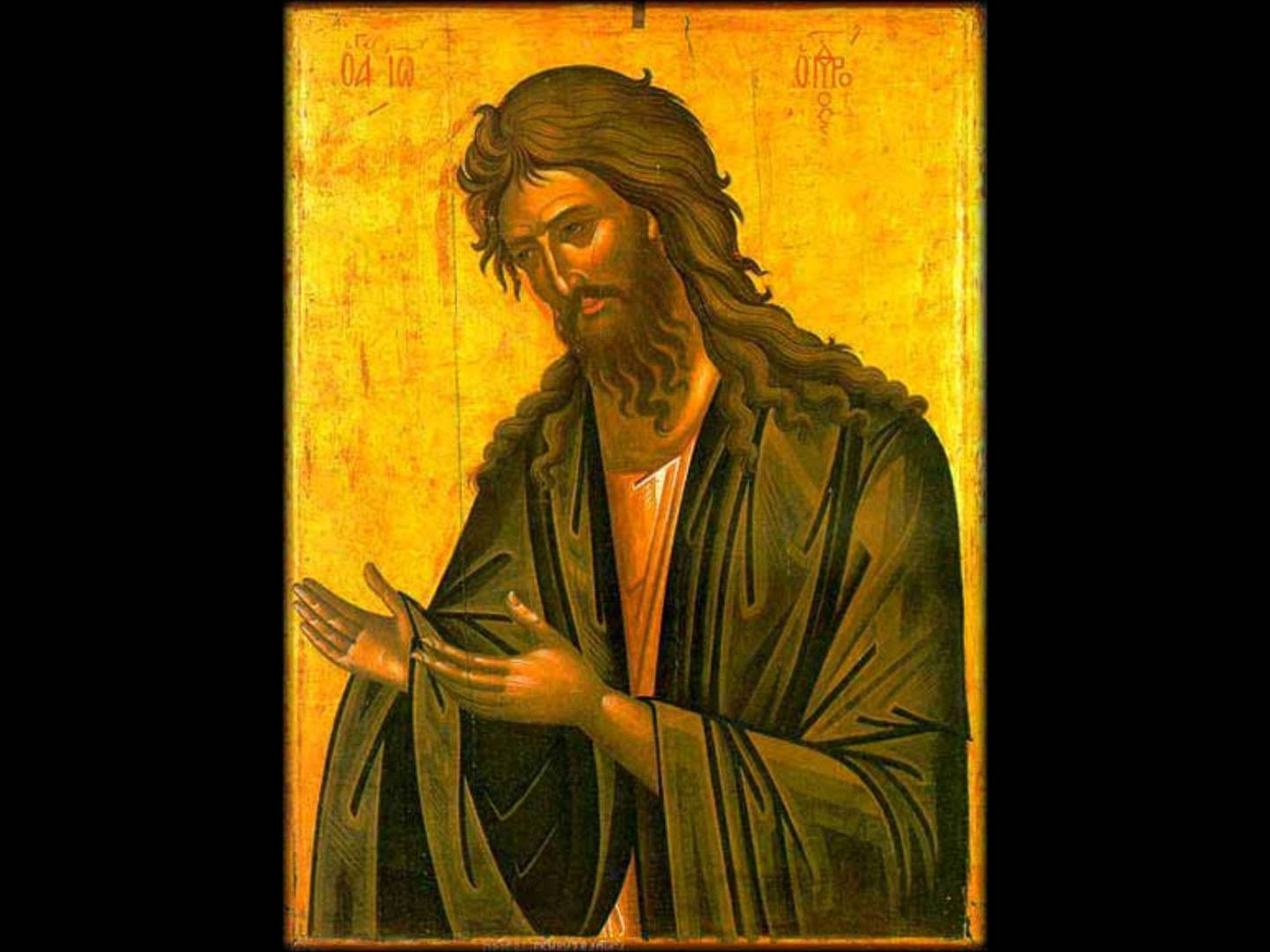
May the prayers of the Holy Forerunner and Baptist John be with us, as we prepare to celebrate the Baptism of the Lord! May this great Mystery renew in us the desire to live according to our baptism and be truly pleasing to God Who is Manifest for our sake.   May we live in repentance.


johnbaptist

Posted in Uncategorized | Comments Off on Attaining our purpose

CliffsNotes on the Philokalia for Dummies

2 January OS 2016 – Forefeast of Theophany; St. Sylvester, Pope of Rome; St. Seraphim, Wonderworker of Sarov

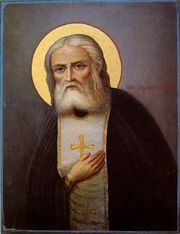
Today, the second of January, is the day of the repose of a great saint of recent times, Seraphim of Sarov, who passed over into the heavenly kingdom on this day in 1833.   You can begin learning about this wonderful saint at http://www.kurskroot.com/st.seraphim_of_sarvo.html, where you will find a short Life followed by many links to sites where you can read more about him.

In recent times, St. Seraphim has played a critical part in converting many non-Orthodox Christians to the Faith, including me.   His Conversation with Motovilov is a short summary of the entire spiritual life from the Orthodox point of view. It tells the “converts” and the non-Orthodox, in a few thousand words, without saying so directly, why everyone should leave Roman Catholicism and Protestantism and just become Orthodox. For “ethnic cradle Orthodox” it tells you in a few thousand words, “Yes, that is why I could never be anything but Orthodox, though I never knew why!”

You might call it “CliffsNotes on the Philokalia for Dummies.” You can find it at http://orthodoxinfo.com/praxis/wonderful.aspx.

So…get out that prayer rope and start using it. That’s a great way to start 2016! 


seraphim_of_sarov

Posted in Uncategorized | Comments Off on CliffsNotes on the Philokalia for Dummies

The circumcision of the heart

1 January OS 2016 – The Circumcision of Our Lord, God, and Savior Jesus Christ; St. Basil the Great, Archbishop of Caesaria in Cappadocia

Though the liturgical New Year is on September 1st, the civil New Year for centuries has been on January 1st.   Today is the civil New Year according to the Orthodox calendar, and on this occasion St. Theophan the Recluse reflects on how we should begin another year of service to the Lord:

Since New Year’s Day is the beginning of the days of the year, we ought to gather in our soul those thoughts, feelings, and dispositions that would direct our affairs throughout the year in a Christian way. We will find these the moment we bring to mind the meaning of New Year’s Day in the spiritual life. In the spiritual life, New Year’s Day is when one who has been living carelessly becomes zealous about salvation and pleasing God. When one makes this resolution, then all is rebuilt afresh both internally and externally, upon new beginnings – the old passes away and all is new. If you have this, renew it; if not acquire it – and for you this will be a New Year’s Day.

 A worthy celebration of the Feast of the Circumcision of the Lord and of the commemoration of St. Basil the Great is also connected with this. The essence of the change we have mentioned is that a person begins from this moment to live solely for his salvation, for God; whereas previously he lived exclusively for himself, preparing destruction for himself. Now he abandons former habits, all comforts, and all in which he found pleasure. He cuts off passions and lustful dispositions and takes on works of strict self-denial. Such a change precisely represents that which, according to the Apostle, the circumcision of the heart should be. The celebration of the Circumcision of the Lord reminds us of this and obligates us to do it, while St. Basil the Great provides us with an example to follow. So all the themes which crowd our consciousness on New Year’s Day come together into one – our inner renewal through the circumcision of the heart. If it pleases the Lord to give someone this mind-set on New Year’s Day – that is, not only to think in such a way, but also to bring all of this into his life – he will celebrate New Year’s Day in a most perfect Christian manner, and will prepare for a Christian passage of the whole year. On the subsequent New Year’s Day he will have only to renew and enliven what he has now taken on. – Thoughts for Each Day of the Year, pp. 25-26

In the secular society in which we live, very few Orthodox of school age or working age are able to take off and go to Church this day, even when one’s parish has divine services for January 1st.   It seems like another regular day, another school day, another workday. But we know that today is indeed the first of January, and we can take some time off today from our duties to go aside and reflect on the words St. Theophan has written above.  

The saint sums up the theme of today in one expression: “circumcision of the heart.” In today’s reading from the Apostolos for the Feast of the Circumcision, St. Paul speaks of this:

Brethren: Beware lest any man spoil you through philosophy and vain deceit, after the tradition of men, after the rudiments of the world, and not after Christ. For in him dwelleth all the fulness of the Godhead bodily. And ye are complete in him, which is the head of all principality and power: In whom also ye are circumcised with the circumcision made without hands, in putting off the body of the sins of the flesh by the circumcision of Christ: Buried with him in baptism, wherein also ye are risen with him through the faith of the operation of God, who hath raised him from the dead. – Colossians 2: 8-12

 In the fleshly circumcision He received on the eighth day of His birth, Our Lord fulfilled the Old Covenant and made way for the New: not a circumcision according to the flesh, but of the heart, of the spirit.   This had always been the real meaning of circumcision anyway, even in the Old Testament. In Deuteronomy, Moses tells the people of the Old Israel,  “Circumcise therefore the foreskin of your heart, and be no more stiffnecked (Deut. 10:16).” And again, “… the LORD thy God will circumcise thine heart, and the heart of thy seed, to love the LORD thy God with all thine heart, and with all thy soul, that thou mayest live (Deut. 30:6).” Later, the Holy Prophet Jeremias warns the people of Judea and Jerusalem, “Circumcise yourselves to the LORD, and take away the foreskins of your heart, ye men of Judah and inhabitants of Jerusalem: lest my fury come forth like fire, and burn that none can quench it, because of the evil of your doing (Jeremiah 4:4).” In other words, mere physical circumcision was never sufficient to make a man the Lord’s true servant. Throughout the Old Testament, we see the Lord commanding, begging, persuading: “Serve Me with all your heart.”

In Acts 15, we read how the Holy Spirit inspired the first council ever held in the Church, the council of the Holy Apostles in Jerusalem, to abrogate the obligation of physical circumcision for the Gentile converts to the Faith.   The Church had a new and far greater initiation into the life of grace: Holy Baptism, which was not for men only but for women as well. But the image and true meaning of the old circumcision still remain: We must cut away our fleshly passions, which enslave us and prevent spiritual life, and we must be totally dedicated to God in body and in soul.   The baptismal grace is always there, but it does not energize in us unless we cooperate. Thus in his meditations for today, St. Theophan exhorts us to examine our lives and to re-dedicate ourselves to doing the Lord’s holy will with all our hearts.

On this day also the Lord received His name, the name above every name, the Name of JESUS, which the archangel had foretold to the Holy Virgin and commanded to be given to the Child by St. Joseph at His circumcision.   We can regard this day, then, also as the day on which the Lord Jesus gives us His name as an invincible weapon against the enemies who fight against us, and re-dedicate ourselves to the Prayer of Jesus.   This is an essential weapon in our struggle to acquire the true circumcision of the heart.

On this day also the Lord Jesus shed His Precious Blood for the first time, foreshadowing His divine Passion for our salvation.   One drop of this Blood is more precious than the whole universe, and yet He did not hesitate to mount the Cross and shed all of His Blood for us. How can we not desire to return such love with all our hearts?

This profound Feast of the Lord coincides by God’s Providence with the day on which St. Basil the Great departed this earthly life at the age of 50, having been a baptized Christian for a mere seventeen years and a bishop for only ten!    In those few years, he fought ceaselessly for the Orthodox Faith against the Arians, Eunomians and other heretics, struggled constantly for the unity of the Church in the East, established monasteries and hospices for the poor, rooted out corruption in the clergy, ordained many worthy bishops and priests, wrote commentaries on Holy Scripture and composed divine services, and, in short, became the perfect model of the bishop, combining the life of intense prayer and extreme fasting with ceaseless activity for the salvation of souls. And throughout this time, he was almost constantly ill: at one point, according to one of his letters, he had a fever continuously for 50 days.   By the age of 45, he had lost all of his teeth. At age 50, utterly worn out by a life of total self-denial, he reposed in the Lord.

As he was dying, did he see “success” crowning his life? By no means.   Many heresies and schisms were still tearing the Eastern Church apart: reposing in 379, he did not live to see the triumph of the Orthodox Faith with the accession of the Emperor Theodosius the Great and the Second Ecumenical Council in 381.   But what was important to him was that he reposed in the grace of Christ, in repentance, in the secure knowledge that he had done everything possible, with all his strength and every last breath, to do God’s holy will. What more could any of us ask for?  

The duty is ours; the consequences are God’s. By the prayers of Great Basil, let us love the Lord with all our hearts and do His holy will. He will take care of the rest.

A blessed 2016 to all!  

st-basil-the-great-3

Posted in Uncategorized | Comments Off on The circumcision of the heart

2016: Let us live in hope

18 December OS 2015 – Thursday of the 31st Week after Pentecost; the Thirteenth Week of St. Luke; Holy Martyr Sebastian

Today is the secular New Year’s Eve, and naturally everyone is thinking about 2016 and what it will bring. This year it happens that this day – 18 December on the real calendar – coincides with the Thursday of the Thirteenth Week of St. Luke in our cycle of daily Gospel readings, and providentially St. Theophan the Recluse, while commenting on today’s reading, offers an insight into our situation as we face a new year.

The Gospel reading is Mark 9: 10-15 –

At that time, the disciples kept that saying with themselves, questioning one with another what the rising from the dead should mean. And they asked him, saying, Why say the scribes that Elias must first come? And he answered and told them, Elias verily cometh first, and restoreth all things; and how it is written of the Son of man, that he must suffer many things, and be set at nought. But I say unto you, That Elias is indeed come, and they have done unto him whatsoever they listed [wanted], as it is written of him. And when he came to his disciples, he saw a great multitude about them, and the scribes questioning with them. And straightway all the people, when they beheld him, were greatly amazed, and running to him saluted him.

When the Lord says that Elias has already come, and “…they have done to him whatsoever they listed…” He is referring to St. John the Baptist. The Baptist came, and the evildoers – Herod and his crowd – did whatever they wanted to him: they imprisoned and murdered him. St. Theophan the Recluse takes this event, along with the sufferings of Christ Himself, as a starting point for a meditation on the place of man’s choices in the flow of history:

History flows on and, it seems, inexorably determines individual events. How many preparations there were to receive the Savior! At last, His closest witness, John, came – but what came of it? “They have done…whatsoever they listed” to John, and the Son of man suffered and was humiliated. The flow of events could not be broken; it took its own course. So the flow of history always draws everything after it. People now ask, “Where is freedom? What would it be, given such an order of events? Nothing but a phantom?” Thus do fatalists usually reason. But this all-determining necessity of the flow of events is only an appearance. In reality all human events, both common and individual, are the fruit of man’s free undertakings. The common [history] flows exactly the way it does because everyone, or a majority, want this. And individual events enter into agreement with common events because someone or other in particular wants this. The proof of this is obvious: in the midst of general good there occur bad elements, and in the midst of general bad there occur good elements. Also, in the midst of a firmly established commonality are born elements which, spreading and becoming stronger and stronger, overpower the former commonality and take its place. But these elements are always a matter of freedom. What did Christianity have in common with the character of the time in which it was conceived? It was sown by several individuals who were not a result of the necessary flow of history; it attracted those who desired it, spread vigorously, and became the common cause of the humanity of the time, yet all the same it was a matter of freedom. The same is true in a bad direction: how did the West become corrupted? It corrupted itself. Instead of learning from the Gospel, they began to learn from pagans and adopt their customs – and they became corrupted. The same will happen with us: we have begun to learn from the West which has fallen from Christ the Lord, and have transferred its spirit to ourselves. It will end with us, like the West forsaking true Christianity. But in all of this there is nothing that necessarily determines the matter of freedom. If we want to, we will drive away the Western darkness. If we do not want to, of course, we will immerse ourselves in it. Thoughts for Each Day of the Year, pp. 280-281

The author was writing in the 1880’s, a time when the intelligentsia in Russia were running after the latest false teachers from Western Europe, including Hegel, Darwin, and Marx, all of whom, in one way or another, taught that history is an impersonal and unstoppable process of evolution, a juggernaut that will crush you if you do not jump on the bandwagon and go along for the ride. Of course, this error was really nothing new – man without Christ, without the revelation found in Holy Scripture, had always believed in Fate.   But in St. Theophan’s time, because Christian Europe had been falling away from the Gospel for several centuries, this old delusion took on new form as a powerful idea gripping everyone’s mind.   It certainly grips everyone’s mind today: How often do we hear that we must go along with the times and there is nothing you can do about it? To a great extent, Christians, including nominally Orthodox Christians, have given up fighting the spirit of the age or have even reached the point at which they cannot recognize that it is diametrically opposed to the Faith.

As we face the new year of 2016, we must decide if we will exercise our freedom to make spiritual and moral choices opposed to the spirit of this age…or not. The good news is that this freedom still exists and that the Lord will give us the grace we need to exercise it. But we have to make the choice to exercise it: He does not force us. We are not “fated” to go one way or the other. What steps should we take? How will we avoid getting crushed by that juggernaut of the times we live in?

The first step is to tear our minds away from the things that the world tells us are the real things.   Perhaps we are content to be captivated by the so-called news from mainstream media, as if it represented reality and were not just a giant brainwashing method. Or perhaps, being a little more discerning, we busy ourselves daily hunting through myriad Internet sites and “alternative media” to find out the “secrets” behind what is “really going on out there.” Either way, we become deer in the headlights – paralyzed by the specter of an omnipotent, unstoppable, and incomprehensible evil which demands that we surrender or be destroyed.   We have to tear ourselves away from this suicidal fascination and feed our minds on God’s Truth.

For there really is no secret to what is going on out there. God is working out His plan in history, and we can freely choose to cooperate with Him or not. There are evil people who seem to have gotten the levers of worldly power into their hands, and they are freely choosing to cooperate with their god, Satan. Their time is short, and they are in a frenzy to accomplish their master’s will before he and they are cast into the lake of fire where they will burn for all eternity.   It will certainly be rough for us while this short-lived frenzy endures, but we are looking forward to a better time, in fact to eternity, where we hope to live with God forever.

This word – hope – is the key. We often hear sermons about Faith and Love, but rarely about Hope. Yet in our time how essential it is to have Hope!   Along with Faith and Love, it is one of the three supernatural virtues, and we must pray for it. But what is it? The supernatural virtue of Hope is linked intimately with the cardinal virtue of Courage (also called Fortitude). It is the grace-filled habit of believing courageously that God will in fact take care of us, that God’s promises are true, that God is to be trusted, that everything will turn out all right, just as He said. Faith is the virtue of believing in God. Hope is the virtue of believing God, trusting in His promises.

Let us choose to be the Church of Philadelphia from the Apocalypse. We are not big people. Let us choose freely to be the little ones who in humility, despite our obvious human weakness, choose the path of faithfulness, of loyalty to God and love for the brethren (philadelphia). Let us live in Hope.

And to the angel of the church in Philadelphia write; These things saith he that is holy, he that is true, he that hath the key of David, he that openeth, and no man shutteth; and shutteth, and no man openeth; I know thy works: behold, I have set before thee an open door, and no man can shut it: for thou hast a little strength, and hast kept my word, and hast not denied my name. Behold, I will make them of the synagogue of Satan, which say they are Jews, and are not, but do lie; behold, I will make them to come and worship before thy feet, and to know that I have loved thee. Because thou hast kept the word of my patience, I also will keep thee from the hour of temptation, which shall come upon all the world, to try them that dwell upon the earth. Behold, I come quickly: hold that fast which thou hast, that no man take thy crown. Him that overcometh will I make a pillar in the temple of my God, and he shall go no more out: and I will write upon him the name of my God, and the name of the city of my God, which is new Jerusalem, which cometh down out of heaven from my God: and I will write upon him my new name. He that hath an ear, let him hear what the Spirit saith unto the churches. Revelation 3: 7 -13  

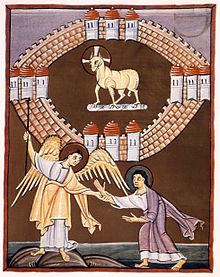
220px-BambergApocalypseFolio055rNew_Jerusalem 

Posted in Uncategorized | Comments Off on 2016: Let us live in hope

A cloud of witnesses

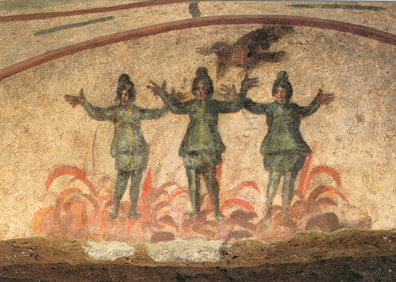
17 December OS 2015 – Wednesday of the 31st Week after Pentecost; the Thirteenth Week of St. Luke; Holy Prophet Daniel, Holy Three Youths Ananias, Azarias, and Misael, St. Dionysios of Zakynthos and Aegina, Holy New Martyr Deacon Avvakum of Serbia

The reading from the Apostolos for December 17th, the feast of the Holy Prophet Daniel and the Three Youths is the great paean to the saints of the Old Testament from Hebrews 11:

Brethren: All the saints through faith subdued kingdoms, wrought righteousness, obtained promises, stopped the mouths of lions, Quenched the violence of fire, escaped the edge of the sword, out of weakness were made strong, waxed valiant in fight, turned to flight the armies of the aliens. Women received their dead raised to life again: and others were tortured, not accepting deliverance; that they might obtain a better resurrection: And others had trial of cruel mockings and scourgings, yea, moreover of bonds and imprisonment: They were stoned, they were sawn asunder, were tempted, were slain with the sword: they wandered about in sheepskins and goatskins; being destitute, afflicted, tormented; (Of whom the world was not worthy:) they wandered in deserts, and in mountains, and in dens and caves of the earth. And these all, having obtained a good report through faith, received not the promise: God having provided some better thing for us, that they without us should not be made perfect.

During this period of the holy Nativity Fast, the Holy Church holds up to us the example of the Old Testament saints on the two Sundays preceding the Nativity as well as on the Menaion feasts of several Old Testament prophets, most notably today’s saints: Prophet Daniel and the Three Youths.   As we await the feast of the birth of the Christ, it is well to remember those who awaited His birth in history, and their great faith and hope.

When we feel alone in our Faith, we should recall that the Old Testament saints kept their Faith despite being always a tiny remnant of perpetually apostate Israel. When we are tempted to give up our Hope in eternal life, we should recall that the Old Testament saints kept their Hope while knowing that at death, no matter how righteous and faithful they had been in life, they would go down into Hades.   When we feel powerless, we should recall that within us lies the infinite power of baptismal grace, while the Old Testament saints had no such help.   When we lose historical perspective and feel trapped in our present circumstances, we should recall century by century, event by event, and saint by saint, all the glorious history of the New Testament Church of the past 2,000 years – and remember that the Old Testament righteous had far less in their past to encourage them. Yet they persevered, strong in their hope, for they believed that God was faithful to His promise.

God has indeed “…provided some better thing for us…”: salvation by Jesus Christ our Lord, Who raised the souls of the righteous of the Old Testament from Hades on that first Great Saturday and perfected them with us by the grace for which they had longed and in which they had hoped.

A good exercise for today would be to re-read (or read!) the Book of Daniel.   Make sure to read the Septuagint version, which contains important sections left out by the rabbinical-minded Protestant editions. If you do not own a translation of the Septuagint (or a King James with “Apocrypha” or a Douay-Rheims translation of the Vulgate), you can read a good translation of the Septuagint version of Daniel at http://orthodoxengland.org.uk/pdf/ot/prophetical.pdf. The Book of Daniel starts at p. 199 of the PDF.

Wherefore seeing we also are compassed about with so great a cloud of witnesses, let us lay aside every weight, and the sin which doth so easily beset us, and let us run with patience the race that is set before us, Looking unto Jesus the author and finisher of our faith; who for the joy that was set before him endured the cross, despising the shame, and is set down at the right hand of the throne of God. – Hebrews 12:1-2

Amen! Holy Prophet Daniel, Holy Three Youths, and all ye righteous of the Old Testament, pray to God for us!

 threeyouthscatacomb

Posted in Uncategorized | Comments Off on A cloud of witnesses

And I meditated on Thy commandments which I have greatly loved

16 December OS 2015 – Tuesday of the 31st Week after Pentecost; the Thirteenth Week of St. Luke; Holy Prophet Aggaios (Haggai), St. Modestos of Jerusalem

Today’s Gospel reading for the daily cycle is Mark 8:22-26 –

And he cometh to Bethsaida; and they bring a blind man unto him, and besought him to touch him. And he took the blind man by the hand, and led him out of the town; and when he had spit on his eyes, and put his hands upon him, he asked him if he saw aught [anything]. And he looked up, and said, I see men as trees, walking. After that he put his hands again upon his eyes, and made him look up: and he was restored, and saw every man clearly. And he sent him away to his house, saying, Neither go into the town, nor tell it to any in the town.

 St. Theophan the Recluse comments on the gradual healing of the man’s sight as an image of the gradual enlightenment of the human race in the Old and New Testaments:

The Lord did not heal the blind man of Bethsaida immediately – He first healed him a little, and then completely, so that he began to see everything clearly. Why the Lord did this is known to Him alone. We can take from this the following thought: if it was considered necessary to heal bodily vision gradually, then even more so is such gradualness indispensable in the enlightenment of the eyes of our mind. That is how it has been. During the period of the [Old Testament] patriarchs, Divinely revealed knowledge was not complicated. During the period under the law it became more complex and detailed. In our Christian period, it is even more detailed and exalted; but is this the end? Do not expect anything higher on the earth, but in the other world there will be [something higher]. Two Holy Apostles assure us of this: Sts. John and Paul. “Now we see everything through a glass, darkly (I Cor. 13:12),” but then we will see everything clearly. But even there, there will be degrees of enlightenment of the mind, for the realm of the knowledge of God is boundless. God’s revelation on earth is already complete; there is no point in dreaming about something higher. We have everything we need; learn it and live by it. Christian revelation does not promise new revelation in the future, but only that the Gospel will be known in the whole world, and that this universality and generality of the knowledge of the Gospel is the limit of the current order of things. After this, faith will weaken, love will dry up, life will become difficult – and God’s goodness will put an end to the world. Thoughts for Each Day of the Year, p. 279

There is a lot for thought here, but three main points are as follows:

1. After the original knowledge of God in Paradise had been lost to man through sin, the Lord gradually, patiently revealed Himself to the human race, not in spectacular announcements to entire populations, but to a few people, His chosen ones before the Law (the patriarchs) and after the Law (the prophets and holy ones of the Old Israel). When He deemed the time was right, He Himself came in the flesh He took from the Virgin, and this is the complete and perfect revelation of Who God is: the God-Man Jesus Christ. When the Holy Spirit came at Pentecost, it was not to give a new revelation, but to enlighten the minds of the Apostles to understand what they had already received.

2. Through the Apostles and the One, Holy, Catholic, and Apostolic Church, we have been given everything we need to know – in the Orthodox Faith.   No new revelations are needed, and none will be given, and we could spend all our lifetimes studying the Faith that has already been revealed and only scratch the surface.   All “new revelations” after the New Testament, such as the Koran and the Book of Mormon, are full of falsehood and deception, coming as they do from the Father of Lies. The true Fathers and Teachers of the Church never claimed to have a new revelation but rather only expounded on what they had received. All that remains is for us to live our Faith and to share it. When it has been shared to the extent possible – according to the foreknowledge and plan of God – God will put an end to this present, temporal order of things, for this world will have served its purpose.

3. In the Kingdom of Heaven, there will be unlimited and eternal progress in the knowledge of God.   God is not only infinite but also infinitely knowable, and He made our minds to know Him.   The nous, the mind, does not perish with death. Between the Particular Judgment and the General Resurrection, the souls of the saved will use their minds to know God more and more, and this will be all the more true after they will have received their immortal bodies at the Resurrection.   Eternity for the blessed will be – is – an infinite progression in the knowledge and love of God.

If we do not like to pray and to do spiritual reading, this is because our fallen nature and the demons fight it, in order to prevent our becoming who we really are and are supposed to become.   We must force ourselves to pray and to study our Faith, and by so doing we will attract God’s grace, by whose power alone we can acquire a steady appetite for spiritual things. If we do not acquire such an appetite before we die, heaven will be quite uninteresting for us – as a matter of fact, we will not want to go there. Think about it.

We are about to celebrate the Birth of Our Lord from the Holy Virgin.   Was she an automaton, a robotic tool of God’s purpose, as many Protestant sectarians seem to think?   Did God merely use her as if she were an uninvolved, indifferent bystander to His plan for the salvation of mankind, some random woman among any number of random women He could have seized upon? By no means – perish the blasphemy!   Quite the opposite is true, as St. Gregory Palamas makes clear in the following passage from his great Second Homily on the Entry of the Theotokos:

Who ever loved God more than she, whom we now extol? What other creature could ever be purer than she, or equal to her in purity, or anywhere near as pure? For this reason, she alone of all mankind throughout the ages was initiated into the highest mysteries by these divine visions, was united in this way with God, and became like Him. She then accomplished the super-human role of intercessor on our behalf, and brought it to perfection by herself, not just acquiring this indescribable exaltation of mind, but using it for the sake of us all, and doing this supremely great deed by means of her boldness towards God. For she did not merely come to resemble God, but she made God in the likeness of man, not just by persuading Him, but by conceiving Him without seed and bearing Him in a way past telling. Having been fashioned by God through grace – which is why she was addressed as “thou that art full of grace” by the Angel – she shaped God in human form – which is why she was given the good tidings with the greeting, “Rejoice” (Luke 1:28). – from Mary the Mother of God, Sermons by Saint Gregory Palamas (Mount Thabor Publishing 2005), pp. 48-49.

In other words, Panagia was incomparably the greatest created person of prayer who ever was and ever will be, the greatest doer of hesychastic prayer. And she is also therefore the greatest theologian, for she used her created mind to the utmost, to do what the mind was made to do: to know God. Through her incomparable purity of soul and mind, she acquired the utmost boldness before God, and she interceded all-powerfully, invincibly, for the salvation of man. In response to this prayer, God came to save us, by becoming a man in her womb.

When we have no appetite for divine things, when we are sluggish and dull, uninterested in prayer and divine study, let us run to the Holy Virgin and beg her to ask her Divine Son to give us that divine eros, that burning desire to know and to love Him, which she possessed to the utmost. Let us push ourselves, as well – we have to do some of the work! – and the Lord, seeing our humble efforts, will graciously give us the divine desire to know Him, not only in His mighty works, but also in His infinite perfections – to love Him not only because of what He has done, but pre-eminently because of Who He Is, because He is worthy of all love.

This is a fitting gift to the Christ-Child at this holy season!

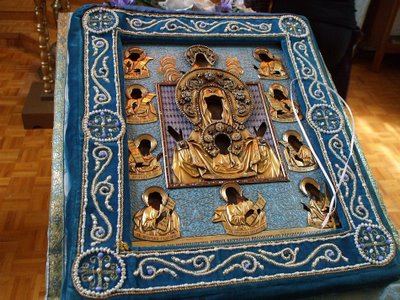
kursk icon


Posted in Uncategorized | Comments Off on And I meditated on Thy commandments which I have greatly loved

Enter in by the narrow gate

13 December OS 2015 – Saturday of the 30th Week after Pentecost; the Twelfth Week of St. Luke; Holy Martyrs Eustratios, Auxentios, Eugene, Mardarios, and Orestes

Today’s Gospel reading for the daily cycle is Luke 13: 18-29 –

The Lord said this parable: Then said he, Unto what is the kingdom of God like? and whereunto shall I resemble it? It is like a grain of mustard seed, which a man took, and cast into his garden; and it grew, and waxed a great tree; and the fowls of the air lodged in the branches of it. And again he said, Whereunto shall I liken the kingdom of God? It is like leaven, which a woman took and hid in three measures of meal, till the whole was leavened. And he went through the cities and villages, teaching, and journeying toward Jerusalem. Then said one unto him, Lord, are there few that be saved? And he said unto them, Strive to enter in at the strait gate: for many, I say unto you, will seek to enter in, and shall not be able. When once the master of the house is risen up, and hath shut to the door, and ye begin to stand without, and to knock at the door, saying, Lord, Lord, open unto us; and he shall answer and say unto you, I know you not whence ye are: Then shall ye begin to say, We have eaten and drunk in thy presence, and thou hast taught in our streets. But he shall say, I tell you, I know you not whence ye are; depart from me, all ye workers of iniquity. There shall be weeping and gnashing of teeth, when ye shall see Abraham, and Isaac, and Jacob, and all the prophets, in the kingdom of God, and you yourselves thrust out. And they shall come from the east, and from the west, and from the north, and from the south, and shall sit down in the kingdom of God. And, behold, there are last which shall be first, and there are first which shall be last.

 Our Lord’s hearers wanted to know, “…are there few that be saved?” He refused to answer Yes or No, as if to say, “Numbers and percentages of other people being saved are not the point.” Instead He told them to pay attention to their own salvation: “…Strive to enter in at the strait [=narrow] gate.” What is the narrow gate? Since we desire to be saved, obviously this is an all-important question.

We may think of the narrow gate in terms of our outer and inner life. In our outer life, the narrow gate is the way of life created by unwavering adherence to the True Faith and by unceasing attempts to live the Way demanded by the Truth, characterized by constant struggles that sometimes bring victories and sometimes bring defeats followed by repentance and renewed struggle. This unremitting warfare must last until death. By the grace of God and His mercy, if we remain on this path we will have a firm hope of our salvation.

Our present circumstances are actually quite favorable to this narrow gate approach to life, because, given what is going on around us, we will find that simply in virtue of not giving up our Faith and not giving up the struggle to live according to the Faith, we will be placed among “the few.” We have to remember that fewer and fewer people – both Orthodox and non-Orthodox – are likely to understand us, and that this does not tell us that we are doing anything wrong, but rather the opposite. They will go their way, and we must go ours.   We must ask the Lord constantly for the humility to accept this and in simplicity of faith to persevere on the path laid out before us without condemning anyone else or being curious about their ultimate fate compared to ours. This quiet life of faithfulness in the midst of spiritual loneliness is our narrow gate.

This brings us to the subject of our inner life. St. Theophylact comments on the protest of the damned, “…and Thou hast taught in our streets,” as follows: “Observe that it is those whom the Lord taught in the streets, that is, who only received the Lord’s teaching in public, who are rejected. But if we receive His teaching, not just in public, but also within the closeness of our contrite and compunctionate heart, then we will not be rejected” (The Explanation of the Holy Gospel According to Luke, c. 13, vss. 23-30).” Here St. Theophylact is not addressing the subject of those who are formally outside the Church but rather of those who “officially” are inside, whether, as in Our Lord’s time, inside the Old Testament Church or, as in St. Theophylact’s (and our) time, inside the New Testament Church. In other words, being a nominal Christian of the Christmas- and-Easter-only variety, or even being a regular churchgoer who does not have an inner life of prayer, does not save.  We must cherish the Lord’s teaching “within the closeness of our contrite and compunctionate heart,” and if we do, then – rejoice! – “…we will not be rejected.”

These two aspects of the Life in Christ – the outer and inner – are intimately joined.   By striving to remain outwardly faithful, we will invite rejection from the world. The ensuing loneliness will drive us either into apostasy (whether formal apostasy or – what is more common nowadays – “lifestyle” apostasy) or to a more intense inner life of prayer. Which way we go is up to us, but that we will go one way or the other is not in doubt.

One piece of good news is that there is more Orthodox literature about the inner life available to us than ever before. In the midst of the cataclysmic destruction of Christian civilization over the past 100 years, there has yet, by God’s loving Providence, been a rebirth of interest precisely in the spiritual life, manifested by an explosion of new editions and translations of the Church services and of spiritual books, as well as the movement to return to traditional iconography and chant.  It is as if the Lord is saying, “I have given you a tough job, living in these times, but I am giving you tools you to deal with it.”   There are in fact so many of these tools that the difficulty is in choosing which ones to use. I cannot recommend which tools to choose and how to use them for each of you who read this  – work with your father confessor on that!   I can recommend to you all to carry a prayer rope around with you constantly and force yourself to say the Jesus Prayer every spare mental moment.

Let us then take heart. The Lord desires our salvation, far more than we do ourselves.   He does not require from us miracles but rather “…to receive His teaching, not just in public but also within the closeness of our contrite and compunctionate heart.”   This each of us can do and by so doing acquire a firm hope of our salvation.

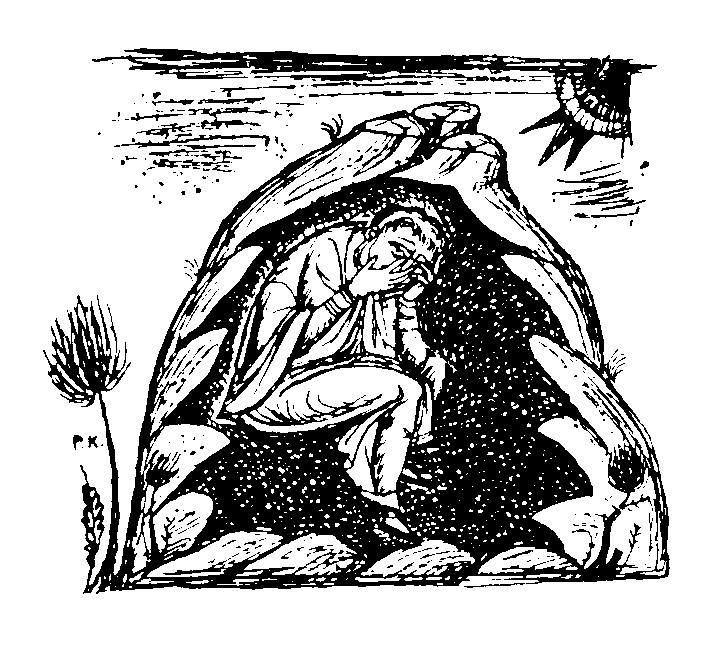
prayer_cave

Posted in Uncategorized | Comments Off on Enter in by the narrow gate