God is with us

6 November OS 2016 – Saturday of the Seventh Week of St. Luke; St. Paul Archbishop of Constantinople the Confessor

In today’s Gospel (Luke 9:1-6), we see the Lord gathering and sending out His Holy Apostles to preach, heal, and cast out demons:

Then he called his twelve disciples together, and gave them power and authority over all devils, and to cure diseases. And he sent them to preach the kingdom of God, and to heal the sick. And he said unto them, Take nothing for your journey, neither staves, nor scrip, neither bread, neither money; neither have two coats apiece. And whatsoever house ye enter into, there abide, and thence depart. And whosoever will not receive you, when ye go out of that city, shake off the very dust from your feet for a testimony against them. And they departed, and went through the towns, preaching the gospel, and healing everywhere.

St. Theophan the Recluse encourages us by reminding us that this very same apostolic preaching is with us, alive and active, to this very day:

“And He sent them to preach the Kingdom of God (Luke 9:2).” Then, it was only throughout Palestine, but later they were sent throughout the whole world. The preaching which was begun then has not ceased to this day. Every day we hear what has been handed down by the Holy Apostles and the Lord Himself as if they were before us, and the power which acted in them acts to this day in the Church of God. The Lord has not deprived any believers of anything: those who are the most recent have everything the first ones had. Thoughts for Each Day of the Year, pp. 246-247

We all know that this is true, but generally we do not feel it to be true in our daily lives.   How do we cure this, how do we once again experience the lively, life-giving joy of Faith we had when we were first converting to the Faith or, in the case of those baptized as infants, when we were first coming to an adult awareness of the power of our Faith and experiencing its power?   We know from past experience that, if only we can have this lively awareness, life is 100% better: no problem seems too great, because we know that the Risen Lord Jesus is walking with us, that the Holy Virgin and our saint and our guardian angel and all the hosts of heaven are with us. Life is bright on the inside even when not on the outside.   But we often fail in this awareness and think about life as if our worldly problems were all that there is, and our Faith is something abstract.

I would like to suggest three activities to help us receive the grace of a lively awareness and happiness that we, no different from the early Christians, have the power of the Apostolic Faith within us:

  1. Gratitude:   We must frequently, daily, force ourselves to glorify the Lord for all that He has done for us. When feeling far from God, we should get down on our knees before the holy icons and start recounting all that He has done for us, from the Creation of the world through all the history of the Old and New Testaments, the Lives of the Saints, and then our own life and all the good things He has given us, and above all the infinite gift of being in His Holy Church.   The fog will lift, and we will “taste and see how good the Lord is.”
  1. Daily Scripture Reading: All right, I have said this a million times, but it is still true. Read your daily Scriptures!   Every day throughout the year Holy Church prescribes two Scripture readings from the New Testament or, during the weekdays of Great Lent, three readings from the Old Testament.   Get a calendar with readings listed for every day (hard copy or online), get out your Bible or New Testament (or, if you are really “with it” liturgically, your Apostolos and Evangelion!), and read. Read standing before the icons, read aloud and slowly, and let the divinely inspired words sink into your ears, your mind, and your heart. They are living and active, and they will act! “For the word of God is quick, and powerful, and sharper than any twoedged sword, piercing even to the dividing asunder of soul and spirit, and of the joints and marrow, and is a discerner of the thoughts and intents of the heart (Hebrews 4:12).” Day by day, the Holy Apostles will preach once again to us, as they did 2,000 years ago. The same truth and the same power are present.
  1. Confession and Holy Communion: Usually we do not feel the Lord’s presence because of our sins. It is really that simple.   We have the solution: to confess our sins, receive His forgiveness, and partake of His Precious Body and Blood. What could be simpler? What could be better?   As they say: “Just do it.”

God is with us.
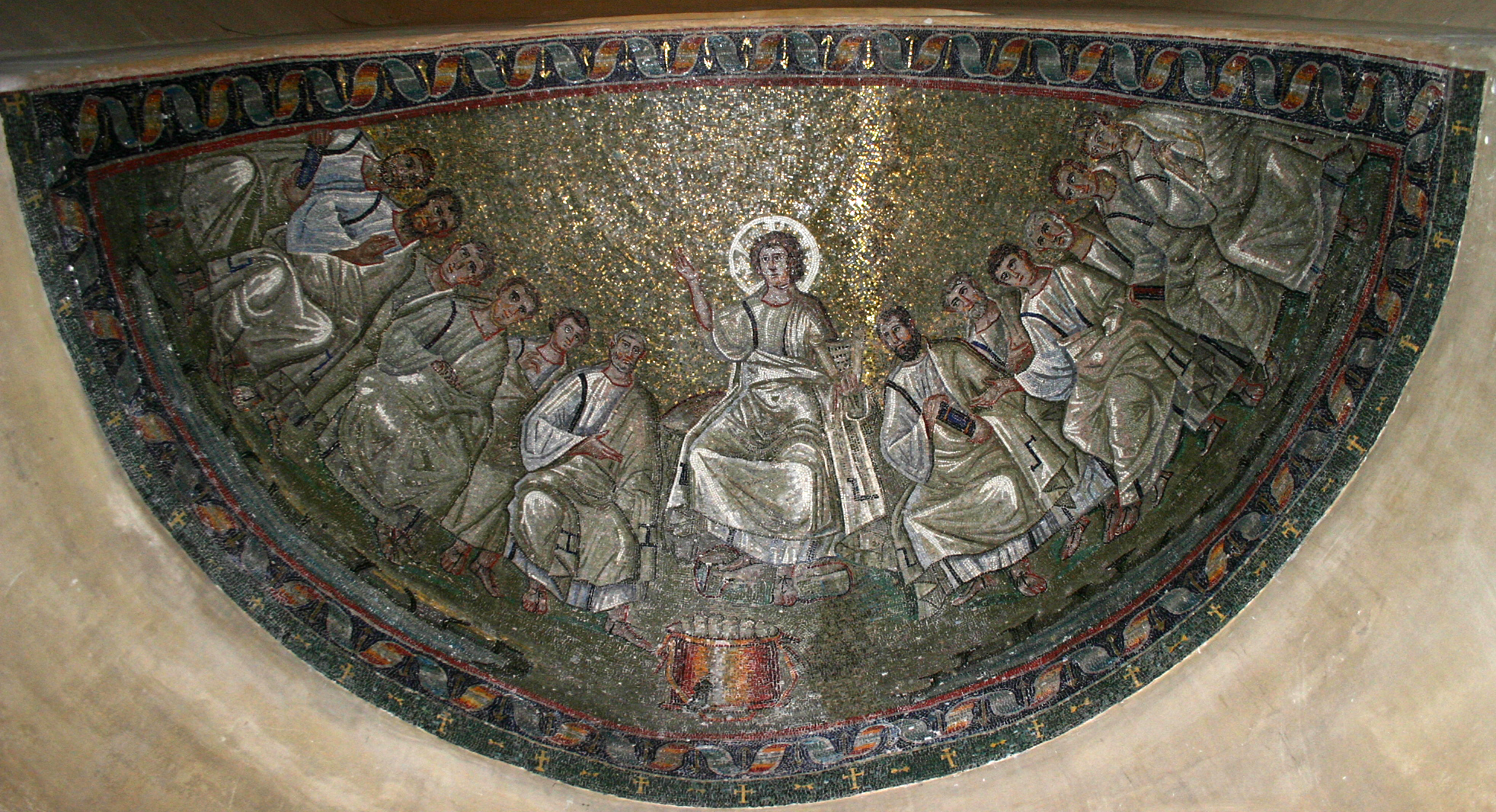
christ-traditio-legis-s-lorenzo


Posted in Uncategorized | Comments Off on God is with us

Whom we should fear

5 November OS 2016 – Friday of the Seventh Week of St. Luke; Holy Martyrs Galaction and Episteme

Today’s Gospel reading is Luke 12:2-12.

The Lord said to His disciples: There is nothing covered, that shall not be revealed; neither hid, that shall not be known. Therefore whatsoever ye have spoken in darkness shall be heard in the light; and that which ye have spoken in the ear in closets shall be proclaimed upon the housetops. And I say unto you my friends, Be not afraid of them that kill the body, and after that have no more that they can do. But I will forewarn you whom ye shall fear: Fear him, which after he hath killed hath power to cast into hell; yea, I say unto you, Fear him. Are not five sparrows sold for two farthings, and not one of them is forgotten before God? But even the very hairs of your head are all numbered. Fear not therefore: ye are of more value than many sparrows. Also I say unto you, Whosoever shall confess me before men, him shall the Son of man also confess before the angels of God: But he that denieth me before men shall be denied before the angels of God. And whosoever shall speak a word against the Son of man, it shall be forgiven him: but unto him that blasphemeth against the Holy Ghost it shall not be forgiven. And when they bring you unto the synagogues, and unto magistrates, and powers, take ye no thought how or what thing ye shall answer, or what ye shall say: For the Holy Ghost shall teach you in the same hour what ye ought to say.

 St. Theophan the Recluse, commenting on the Lord’s words concerning whom we should fear, says this:

…The greatest fear we have is of death. But the Lord says that the fear of God should exceed the fear of death. When circumstances come together in such a way that it is necessary either to lose one’s life or to act against what is suggested by the fear of God, it is better to die rather than to go against the fear of God. For if you go against the fear of God, then after your bodily death, which is in any case inevitable, you will meet another death which is immeasurable worse than all of the mot terrible bodily death. If we always bore this in mind, the fear of God would not weaken in us, and we would perform no deeds contrary to the fear of God… – Thoughts for Each Day of the Year, p. 246

Death, heaven, hell, and God’s judgment are not popular topics today.   Everyone is obsessed with this world, with remaining in it as long as possible, and making it as comfortable as possible.   They have forgotten that this is a fool’s errand: No matter what you do to avoid it, death will some day overtake you. The real question is not how to avoid death but how to prepare for the inevitable.   Since death is the one thing we know, without a doubt, that is going to happen to us, using this life to prepare for it is the most realistic approach to life.

The Lord tells us, today, what is the basis for a life that prepares us for death: to fear God.   The fear of God means not an animal fear, agitating us to run away from God, to hide from Him, because He is going to do something bad to us. It is rather a reverent fear, a deeply-felt desire never to do anything displeasing to Him, never to disobey His holy will, coupled with a lively apprehension that we can, indeed, lose ourselves for all eternity, that we can, indeed, inherit eternal torment after death.

Each day we need to remind ourselves, “I will die for certain!” and ask the Lord, “O Lord, this day enable me to live according to Thy holy will!”

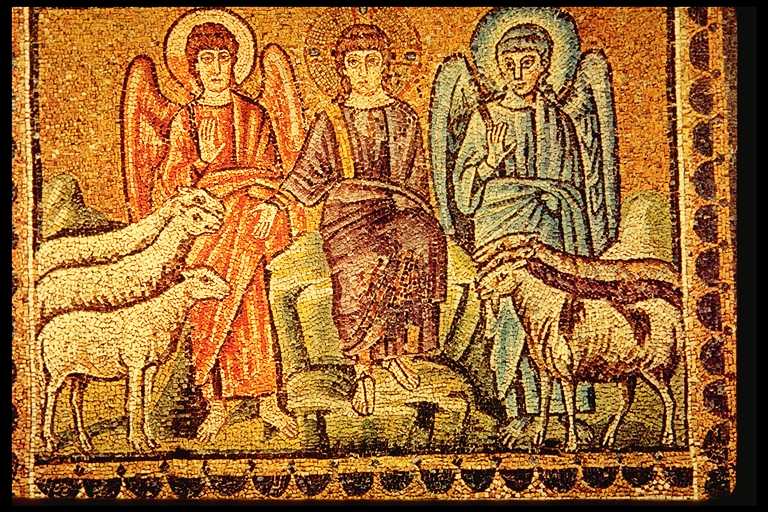
christ-judge-sheep-and-goats

Posted in Uncategorized | Comments Off on Whom we should fear

Mercy and truth are met together; righteousness and peace have kissed each other

3 November OS 2016 – Wednesday of the Seventh Week of St. Luke; Holy Martyr Acepsimas and Companions; Translation of the Relics of the Great Martyr George

In today’s Gospel, the Lord rebukes the egotism of the religious hypocrite:

But woe unto you, Pharisees! for ye tithe mint and rue and all manner of herbs, and pass over judgment and the love of God: these ought ye to have done, and not to leave the other undone. Woe unto you, Pharisees! for ye love the uppermost seats in the synagogues, and greetings in the markets. Woe unto you, scribes and Pharisees, hypocrites! for ye are as graves which appear not, and the men that walk over them are not aware of them. Then answered one of the lawyers, and said unto him, Master, thus saying thou reproachest us also. And he said, Woe unto you also, ye lawyers! for ye lade men with burdens grievous to be borne, and ye yourselves touch not the burdens with one of your fingers. St. Luke 11:42-46

St. Theophan the Recluse points to the real problem with Pharisaism: the absence of righteousness and of love.

The Lord begins to reproach His contemporaries by saying that they “pass over judgment and the love of God.” The drying up of righteousness and love is the root of all disharmony, both in society and in every person. It comes from the pre-dominance of self-love or egoism køb af viagra til kvinder. – Thoughts for Each Day of the Year, p. 244

Judgment – justice – and love are now pitted against each other in the popular mind, due to generations of “progressive” propaganda. But the two are not opposed, but rather are inextricably bound up with one another. There is no love without justice, but only the tolerance of evil masquerading as love, and there is no justice without love, but only the cold calculus of enlightened self-interest.   When one of these two virtues is present, the other is always there. When one is absent, so is the other.

The causes of the absence of both justice and love are the same: sin, sinful passions, and egotism.   St. Theophan, later in the passage quoted above, points out that someone may seem outwardly religious and outwardly law-abiding, and so forth – but inwardly be full of rottenness, like the whited sepulchers the Lord talks about in another place.   It’s not enough to be a “law-abiding, churchgoing citizen” (though it is certainly a good start!). One must struggle against the passions, live in repentance, and acquire holiness. One must love God and neighbor.

But the end of all things is at hand: be ye therefore sober, and watch unto prayer. And above all things have fervent charity among yourselves: for charity shall cover the multitude of sins.I Peter 4:8

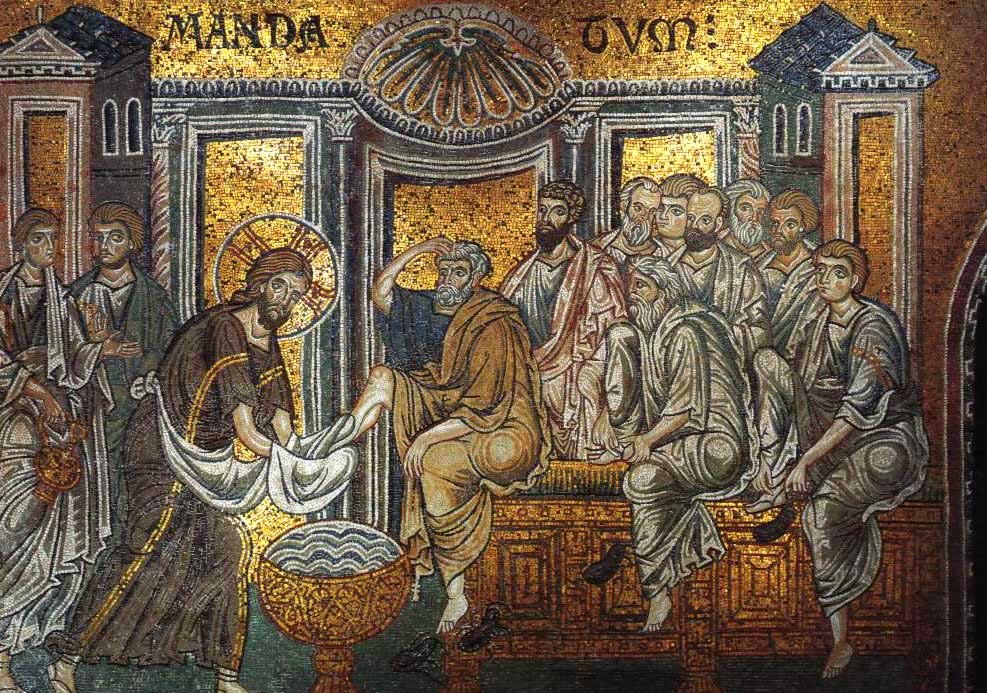
christ_washes_apostles_feet_monreale

Posted in Uncategorized | Comments Off on Mercy and truth are met together; righteousness and peace have kissed each other

Reasons to rejoice

25 October OS 2016 – Monday of the Sixth Week of St. Luke; Holy Martyrs Marcian and Martyrius; St. Tabitha the Merciful

Today in the Holy Gospel, Our Lord instructs the apostles on the infinitely great privilege of being a Christian:

The Lord said to His disciples, All things are delivered to me of my Father: and no man knoweth who the Son is, but the Father; and who the Father is, but the Son, and he to whom the Son will reveal him. And he turned him unto his disciples, and said privately, Blessed are the eyes which see the things that ye see: For I tell you, that many prophets and kings have desired to see those things which ye see, and have not seen them; and to hear those things which ye hear, and have not heard them. – Luke 10: 22-24

Toward the end of his earthly life, St. Seraphim of Sarov said “Christ is Risen!” every day to everyone.   He had completely interiorized the reality of what it means to be an Orthodox Christian.   He knew that a Christian has no excuse to be sad.

In the midst of today’s chaos, in which outward events appear to be spinning out of control with increasing speed daily, it has really become a life-or-death matter to center our minds firmly on ultimate and unchanging reality, or we will lose our minds. The good news is that ultimate and unchanging reality really exists, and that it is not the blind force of Fate or some faceless, crushing Thing that demands that we annihilate our personality to attain peace, but a Person Who loves us, Jesus Christ the Son of God, and Who enables us to remain and to become who we really are.

Just as, in our human relationships, the people we take for granted the most often, and the most unjustly, are those who care most for us, in our spiritual life we take for granted the most caring One of all, to Whom we owe everything, and Who has given us everything, our loving Lord.

Out of totally gratuitous love, He called us from non-being into being. We did not need to exist, and we had no right to exist. He made us.

Out of totally gratuitous love, He became a man and died on the Cross for us, shedding His infinitely Precious Blood to forgive our sins and unite us to God.

Out of totally gratuitous love, in His mysterious Providence He called each of us into His Holy Church, and He gives us every gift of grace and nature needed to attain eternal life, and to help our loved ones to do the same.

When we are troubled and cast down by the utter falseness and unreliability of this world, let us recall, joyfully and with grateful hearts, that our true home is not here, but there, where Christ sits at the right hand of God the Father.  Our eyes have seen, our ears have heard, our hearts have known His love for us. What more do we want?

That which was from the beginning, which we have heard, which we have seen with our eyes, which we have looked upon, and our hands have handled, of the Word of life; (For the life was manifested, and we have seen it, and bear witness, and shew unto you that eternal life, which was with the Father, and was manifested unto us;) That which we have seen and heard declare we unto you, that ye also may have fellowship with us: and truly our fellowship is with the Father, and with his Son Jesus Christ. And these things write we unto you, that your joy may be full. – I John 1: 1-4


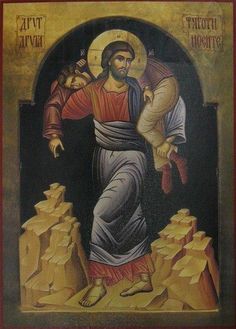
christ-the-good-samaritan

Posted in Uncategorized | Comments Off on Reasons to rejoice

Acting like God

5 October OS 2016 – Tuesday of the Third Week of St. Luke; Holy Martyr Charitina

The reading today for the Holy Gospel, according to the daily cycle, is Luke 6:37-45

The Lord said to His disciples: Judge not, and ye shall not be judged: condemn not, and ye shall not be condemned: forgive, and ye shall be forgiven: Give, and it shall be given unto you; good measure, pressed down, and shaken together, and running over, shall men give into your bosom. For with the same measure that ye mete withal it shall be measured to you again. And he spake a parable unto them, Can the blind lead the blind? shall they not both fall into the ditch? The disciple is not above his master: but every one that is perfect shall be as his master. And why beholdest thou the mote that is in thy brother’s eye, but perceivest not the beam that is in thine own eye? Either how canst thou say to thy brother, Brother, let me pull out the mote that is in thine eye, when thou thyself beholdest not the beam that is in thine own eye? Thou hypocrite, cast out first the beam out of thine own eye, and then shalt thou see clearly to pull out the mote that is in thy brother’s eye. For a good tree bringeth not forth corrupt fruit; neither doth a corrupt tree bring forth good fruit. For every tree is known by his own fruit. For of thorns men do not gather figs, nor of a bramble bush gather they grapes. A good man out of the good treasure of his heart bringeth forth that which is good; and an evil man out of the evil treasure of his heart bringeth forth that which is evil: for of the abundance of the heart his mouth speaketh.

Forgiveness and non-condemnation have been called the “easy way to salvation.” On the one hand, it seems easy, does it not? Do this one thing, and regardless of all your sins, you will find salvation.   On the other hand, we know that it is not easy, that it is perhaps the hardest thing of all.

Before I go on, I want to make clear that I am not talking about “forgiving” or “not judging” people afar off: Disgusting politicians, serial murderers, lying journalists, outrageous perverts, etc.   Too often we rivet our attention on people unrelated to us and events beyond our control, as if ghost-like figures on a screen were more real than the person next to us.  Let us for awhile tear ourselves away from the demonically orchestrated circus of unreality, the “virtual” version of what used to be the public square, and look at how we respond to the people with whom we live.

When dealing with our relatives, fellow Church members, fellow workers, and neighbors who offend us in any way, great or small, it is essential to remember that God does not ask us to excuse them but to forgive them.   If we can excuse them plausibly (which is more often the case than we would like to think), this is all to the better – it makes forgiveness much easier, when we realize that they really did not mean it, or cannot help it, and so forth. But, admittedly, there are cases when the other person, as far as any finite intelligence can discern, is just dead wrong, and only God Himself can see deeply enough into his heart to discover if in fact there is some mitigating factor. This makes it harder to forgive, but remember, we are not being asked to excuse but to forgive, and since forgiveness is the gift of grace, it is not beyond our power if God so wills, for where God so wills, the order of nature is overruled.

St. Gregory the Theologian, in his commentary on the Our Father, when speaking of the words, “Forgive us our debts as we forgive our debtors,” points out that we are never more like God than when we forgive. Judgment and forgiveness are both divine prerogatives; judgment God has reserved for Himself, but the power to forgive He has bestowed also upon us. Let us then be like God!

This grace of forgiveness, so definite a proof of the Church’s divine origin, is seen pre-eminently in the tribunal of confession, where, having accused ourselves, we receive from God neither an excuse nor a condemnation, but forgiveness. We are the servants who have been forgiven the ten thousand talents; let us forgive our brethren the one hundred denarii.

We will never have peace in this life as long as we predicate our happiness on others’ behaving justly and rationally towards us. Yet St. Seraphim of Sarov said that if we acquire the spirit of peace, a thousand souls around us will be saved.   I propose that we take him seriously and acquire the spirit of peace, through forgiveness.

christ-being-led-to-the-crucifixion-monastery-decani-detail

Posted in Uncategorized | Comments Off on Acting like God

Discretion, the guiding virtue

29 September OS 2016 – Wednesday of the Second Week of St. Luke; S. Kyriakos of Palestine

The reading today for the Holy Gospel, according to the daily cycle, is Luke 5:33-39.

At that time, the Pharisees came to Jesus and said unto him, Why do the disciples of John fast often, and make prayers, and likewise the disciples of the Pharisees; but thine eat and drink? And he said unto them, Can ye make the children of the bridechamber fast, while the bridegroom is with them? But the days will come, when the bridegroom shall be taken away from them, and then shall they fast in those days. And he spake also a parable unto them; No man putteth a piece of a new garment upon an old; if otherwise, then both the new maketh a rent, and the piece that was taken out of the new agreeth not with the old. And no man putteth new wine into old bottles; else the new wine will burst the bottles, and be spilled, and the bottles shall perish. But new wine must be put into new bottles; and both are preserved. No man also having drunk old wine straightway desireth new: for he saith, The old is better.

Fasting is good, of course – the Lord does not deny that. But there is a time for fasting, and a time for not fasting. During His time on earth, the disciples did not fast, for He was with them. After His Ascension, they began to fast, to keep watch for His Second Coming. And so we still do today.

St. Theophan the Recluse derives a general lesson for us: that all good works must be practiced with discretion, and in harmony with each other:

It is unbecoming for the children of the bridechamber to fast while the bridegroom is with them, said the Lord, and thus He pronounced the law that even with virtues and spiritual endeavors everything has its place and time. And this is so crucial that an untimely and inappropriate deed loses its value, either entirely, or in part. The Lord arranged everything in visible nature with measure, weight, and number. He also wants everything in the moral realm to be decent and in order (cf. I Cor. 14:40). Inner decency consists in a joining of each virtue with all the virtues in conjunction, or a harmony of virtues, so that none stand out needlessly, but all are in accord, like voices in a choir. Outward decency gives each deed its place, time, and other connections. When all of this is properly arranged, it is like a beautiful lady dressed in beautiful clothes. Virtue which is decent both inwardly and outwardly is desirable. It is Christian good sense that makes it this way. With elders it is discernment acquired through experience and the sensible examination of the Lives of the saints in the light of the word of God. – Thoughts for Each Day of the Year, pp. 215-216

How does one acquire discretion, the ability wisely to order the priorities and activities of one’s life?   Both in the specifically spiritual arena of our life – our prayers, fasting, preparing for confession and Holy Communion, Church attendance, etc. – and in our practical daily lives, we often experience that things are out of joint.   We do not know what to put first, second, and third. We start new projects or activities with enthusiasm and do not finish them.   We emphasize one aspect of life to the exclusion of others, and life becomes unbalanced. And so forth.

There are countless self-help books from secular writers about prioritizing, planning, and organizing. But what we need is deeper: the profound wisdom by which we know intuitively what to do and when to do it; to keep in mind always that which is most important; to be attentive and conscious in our daily activities and not to “go on auto-pilot.” If we are in order inwardly, whatever outward order needed will naturally arise.

The first step in acquiring discretion is the same as the first step in acquiring all spiritual gifts: We must ask for it!   Let us not fail each day to begin our day with prayer, and as part of our prayers, to ask the Lord to give us prudence, discernment, and practical wisdom to order our lives aright inwardly and outwardly. We must ask the Lord to show us the way, to give us the light of understanding His holy will, and the resolve to do His will come what may.

Another simple step is to write down our core duties, first spiritual duties and then practical ones, and ask if we are doing them.   Resolving to say 1000 Jesus Prayers on the prayer rope every day does not make sense if, so far, we have failed to say five minutes of morning prayers in the morning.   Resolving to help the poor in a faraway country does not make sense if we are not helping our relatives and our fellow parishioners. We need to make a short list of the ABC duties of our Orthodox life, resolve to fulfill them, and ask God’s help to do so.

Another simple step is to seek counsel.   There may be ways in which our life is out of balance, in which we are being imprudent, that we cannot see ourselves, but that others who love us and understand us can see. Let us not forget to seek counsel from our priest and from the one or two very trusted and close spiritual friends upon whom we can truly rely.

May Christ, the Wisdom of God, bestow upon us His divine understanding, so that our hearts will sense naturally what to do and when to do it, both inwardly and outwardly.

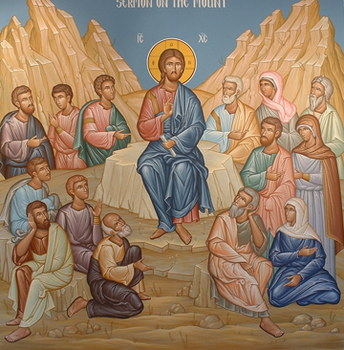
Sermon on the Mount

Posted in Uncategorized | Comments Off on Discretion, the guiding virtue

Becoming acceptable to God

23 September OS 2016 – Thursday of the First Week of Luke; Conception of the Holy Forerunner and Baptist John

In the cycle of the daily readings, today we read once again the Gospel passage that we read on the Church New Year: St. Luke’s account of the Lord’s entering the synagogue at Nazareth and announcing His Messiahship by proclaiming the acceptable year of the Lord.

At that time, Jesus came to Nazareth, where he had been brought up: and, as his custom was, he went into the synagogue on the sabbath day, and stood up for to read. And there was delivered unto him the book of the prophet Esaias. And when he had opened the book, he found the place where it was written, The Spirit of the Lord is upon me, because he hath anointed me to preach the gospel to the poor; he hath sent me to heal the brokenhearted, to preach deliverance to the captives, and recovering of sight to the blind, to set at liberty them that are bruised, To preach the acceptable year of the Lord. And he closed the book, and he gave it again to the minister, and sat down. And the eyes of all them that were in the synagogue were fastened on him. And he began to say unto them, This day is this scripture fulfilled in your ears. And all bare him witness, and wondered at the gracious words which proceeded out of his mouth. And they said, Is not this Joseph’s son? – Luke 4: 16-22

St. Theophan the Recluse points out that, unlike all the prophets before Him, the Lord Jesus Christ not only could preach about the acceptable year of the Lord, He could – and did – make it happen; He brought it with Him.

The Lord not only came “to preach the acceptable year,” but He brought it as well. Where is it? In the souls of believers. The earth will never become a Paradise under the current state of affairs; but it is and will be an arena of preparation for the heavenly life. The rudiments of heavenly life are placed in the soul, and the possibility for this lies in God’s grace – Who brought, consequently, the acceptable year for souls. He who listens to the Lord and fulfills all that is commanded by Him receives grace, and with its power enjoyes the acceptable year within himself. This truly occurs in all who sincerely believe and act according to faith. You will not fill your souls with “acceptableness” by thinking; you must act, and it will enter in on its own.   There might not be any outer peace whatever, just inner peace, yet it cannot be separated from Christ. But it always happens that as soon as inner peace is established, outer disturbances are neither bitter nor heavy. Consequently, the acceptable year is there even in this respect – it only seems like a cold winter on the outside. – Thoughts for Each Day of the Year, pp. 210-211

These brief words of St. Theophan address a spiritual malaise most of us share: sluggish inactivity based on a dreamy desire for a phony paradise both without and within.   The phony external paradise we dream of is an earthly life with no problems, in which everyone is just and kind to us.   The phony internal paradise we dream of is a state of inner purity, calm, and happiness based simply on thinking and not on doing.   The heresies associated with these delusions are, respectively, chiliasm and gnosticism, and the two work together and feed each other.

As St. Theophan rightly points out, this earth will never become a paradise in the present, fallen state of affairs prior to the destruction and re-fashioning of the cosmos into a New Heaven and a New Earth.   This earthly life, rightly understood, is an arena in which we struggle for our salvation, a very short trial in which we choose to do or not do that which is acceptable to the Lord. Chiliasm – derived from the Greek word for “a thousand” – is, strictly speaking, the heresy that teaches that the thousand-year reign of Christ spoken of in the Apocalypse is a future event that will take place here on earth, in the form of an outward, global political order.  But there is also a broader application of the concept: anyone who wants “the Kingdom of God on earth” in the literal sense partakes of the chiliast spirit and the chiliast delusion.   Surely we desire for God’s will to be done on earth as it is in heaven – the Lord Himself told us to pray for this. This takes place, prior to the end of the world, in the lives of those who do God’s will, and certainly there have been families, monasteries, parishes, whole national Churches and kingdoms in which God’s light, the light of Orthodoxy, showed forth more brilliantly than in other places: these people and communities were (and, we pray, will be) little icons of the heavenly kingdom, little foretastes of what is to come in eternity.   But there will never be a time in which Christ will reign on earth as an earthly king, either directly or through a vicar like a pope or emperor, or through a “chosen race.”

The ever-present spirit of chiliasm distracts the pious from what they have control over – struggling for their salvation – by entertaining them endlessly with the demonically orchestrated struggles of financiers, politicians, parties, races, and nations for dominance.   Today this is far truer – quantum leaps truer – than ever.   I say “quantum leaps,” because global communications technology has given worldly powers the ability to distract and delude everyone 24 hours per day in such an addictive fashion, it is a wonder there is anyone left who can think straight. Facing this state of affairs realistically, we must beg God for the grace to re-double our efforts to pray and work in a disciplined fashion, simply to pay attention to that over which we have control, and deal with it. We must remember, always: this life is short, death is certain, and judgment is eternal.   Seen in this light, promises of an earthly paradise will not entrap us in the cycle of excitement, failure, disappointment, and despair.

When one despairs over the phony, chiliast earthly paradise, then one is tempted to retreat within selfishly, give up on the moral struggle, and desire a phony, gnostic internal paradise.

Gnosticism is the idea that if you have a certain secret knowledge about “what’s really going on behind the scenes,” you are among the elect.   A gnostic does not have to be moral or receive God’s forgiveness or even try to do anything good. He just has to sit around smugly and say to himself, “I know what’s really going on, unlike all those suckers out there.” And with this he is content. We are not going to join sects and secret societies that offer such a bogus salvation, but, as with the chiliast temptation, we all have the gnostic temptation: to try to think our way to salvation instead of seeking and doing God’s holy will. We can spend endless hours on websites to “find out what is really going on” and thereby feel secure through our “knowledge.” We can turn Orthodoxy into a kind of gnosticism in which, despite the manifest reality that we are enslaved to various passions, we read books on spiritual life and, instead of being brought to repentance, we imagine that we are thinking or feeling the thoughts and feelings of the saints, or in which we read the canons and derive satisfaction from knowing that so-and-so over there is breaking them, and since we are not (or think we are not), we are the good guys. All the while, we are wasting time, skipping prayers, fasting poorly, gossiping, not supporting our parish, neglecting our family, spending money on stupid things, and looking at some kind of screen x hours per day far in excess of what is necessary.

Being “in the know” does not save. The Lord said that the truth will set us free, but this comes true only if, having learned the truth, we obey it.   “If you love Me, keep My commandments (John 14:15).” St. James says that the demons believe – and tremble (James 2:19). Knowledge without repentance, without humility, without morality, without the spiritual and corporal works of mercy, is demonic.

Therefore, with the ever-present help of the divine grace so abundant in the Church, let us make a short list of our real, daily spiritual and earthly duties, and do them, praying always.   Let us heed the admonition of our Venerable Father Herman of Alaska, and if God be with us, we cannot fail:

“For our good, for our happiness, let us at least make ourselves a vow: that from this day, from this hour, from this minute, we shall strive to love God above all and do His commandments!” – from “Little Russian Philokalia,” Vol. III, St. Herman, St. Herman Press, 1989, p. 108

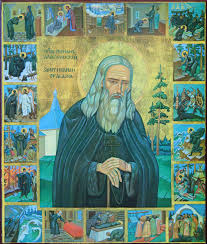
st-herman

Posted in Uncategorized | Comments Off on Becoming acceptable to God

Serving the Lord of the harvest

21 September OS 2016 – Tuesday of the First Week of Luke; Leavetaking of the Exaltation of the Cross; Holy Apostle Codratus

Today we take leave of the Great Feast of the Exaltation of the Precious Cross. St. Theophan the Recluse offers this meditation on this solemn feast of September, an autumn echo of Great Lent and Holy Week:

The honorable Cross is brought out for veneration in the middle of Great Lent in order to inspire those who toil in fasting to patiently bear to the end the yoke they have taken. Why is this also done in September? Is it accidental? But there are no accidents for the Providential Wisdom that arranges all things. This is why: The harvest is taken from the field in September…And so, in order that some Christians might not feel too satisfied and say, “Soul, thou hast much goods laid up for many years; take thine ease, eat, drink, and be merry! (Luke 12:19), and so that others might not become fainthearted because of scarcity, the elevated Cross is brought before all. It reminds the former that the support of well-being is not in possessions, but in their bearing of the cross in a Christian way, if God’s goodness should bring external plenitude; and it inspires the latter to possess their souls in patience, through the certainty that they will go from the cross directly to heaven. Therefore, may some endure, knowing that they are traveling a smooth path to the Heavenly Kingdom; and may the others enjoy outward comforts with fear, not sealing the entrance to heaven against themselves.   – Thoughts for Each Day of the Year, p. 209

Harvest time, for our ancestors who lived on the land, was a time of good news or bad news: In some years, they could look forward confidently to the rigors of winter with plenty of food stored up, enough to survive, and in some years even an excess, perhaps, with which to enjoy the Christmas season and the time of merrymaking before Great Lent. In other years, the harvest was poor, and they had to tighten their belts and place all their trust in God that they would live till Pascha. In either case, the Feast of the Cross during harvest time was a reminder: In case of poverty, to cling willingly to the cross of involuntary hunger, and in the case of plenty, to partake of God’s good gifts with humble gratitude, moderation of enjoyment, and saving fear.   The Lord alone knew what was truly good for them, and He arranged all things wisely, both the good and the bad, for their salvation.

So in our lives today, there are seasons of plenty and seasons of want, times when things go well for us in the outer world, and times when everything seems to come crashing down on us. Usually preachers and spiritual writers have a great deal to say about patience in suffering, but what about times when things really are going well? Very few of us suffer lives of unrelieved sorrow; for most, life does offer days and seasons of earthly happiness that counterbalance the times when nothing seems to go well.  Whether we are rich or poor, however, healthy or ill, loved or rejected, we must see that God arranges all things wisely for our salvation, and we must respond appropriately to the situation in which we find ourselves. What is the saving response to prosperity and success?

When life is going well outwardly, consider undertaking these spiritual labors, asking the Lord for the grace to perform them:

  1. Continuous gratitude with humility: Remind yourself hour by hour that you do not deserve happiness but rather every temporal and eternal punishment, and that God has given His good gifts not to puff you up but to console and strengthen you, to show His great love for you, and to enable you to help others. Glorify Him and thank Him at every moment, and ask Him to preserve you in humility and give you wisdom to use your earthly prosperity unto salvation.
  1. Cheerfulness: To force oneself to be cheerful constantly is, except for that tiny minority with an invincibly sunny disposition, a serious ascetical feat. Cheerfulness is linked intimately with gratitude and follows from gratitude, and it also is linked intimately with being other-centered and not self-centered. When things really are going well for you, there is even less reason than usual to be gloomy or sad.   Take advantage of times of ease to root out every impulse for self-pity, and consciously think, “How is my disposition and outward bearing affecting others? How can I cheer other people up?”   If we practice cheerfulness in times of happiness, we are more likely to carry the habit into times of sorrow.
  1. Almsgiving: If our earthly success is material, we must share. Ask the Lord for discretion, to know how and how much to share your earthly goods.   If our earthly success is simply that of health and a sense of wellbeing, we must share our energy and labors, for the good of others. Again, ask the Lord for discretion to know whom and how much to help. We must put ourselves out, inconvenience ourselves voluntarily, in the good times when the Lord has given us energy, health, and happiness.
  1. Watchfulness: It is almost impossible for a man to resist complacency and self-congratulation when things are going well, to resist forgetting God in the heart and replacing Him with the idol of self-sufficiency. In times of good fortune, it is more imperative than ever to recall death, God’s judgment, heaven and hell; to practice rigorous examination of conscience and frequent confession; and to ask the Lord to show one the extent of one’s pride and how hateful it is in His sight. This will give peace of soul and the calm joy that comes from hope in God, far more satisfying than the chimerical and feverish vision of perpetual earthly happiness that temporary success engenders in the untrained soul.

May the Lord of the harvest, the Giver of every good gift, give us discretion and strength to make wise use of happiness and sorrow, both the good times and the bad.

Glory to Thy Precious Cross, O Lord! Glory be to Thee!


the_angelus

Posted in Uncategorized | Comments Off on Serving the Lord of the harvest

It is I; be not afraid

17 September OS 2016 – Friday of the Fifteenth Week of St. Matthew; Afterfeast of the Exaltation of the Cross; Holy Martyrs Sophia and Her Daughters Faith, Hope, and Charity

In the Gospel today, the Lord tells us, along with the Apostles, “Be of good cheer: it is I; be not afraid!”

At that time, Jesus constrained his disciples to get into the ship, and to go to the other side before unto Bethsaida, while he sent away the people. And when he had sent them away, he departed into a mountain to pray. And when even was come, the ship was in the midst of the sea, and he alone on the land. And he saw them toiling in rowing; for the wind was contrary unto them: and about the fourth watch of the night he cometh unto them, walking upon the sea, and would have passed by them. But when they saw him walking upon the sea, they supposed it had been a spirit, and cried out: For they all saw him, and were troubled. And immediately he talked with them, and saith unto them, Be of good cheer: it is I; be not afraid. And he went up unto them into the ship; and the wind ceased: and they were sore amazed in themselves beyond measure, and wondered. For they considered not the miracle of the loaves: for their heart was hardened. And when they had passed over, they came into the land of Gennesaret, and drew to the shore. –Mark 6:30-45

St. Theophan the Recluse exhorts the reader to abide peacefully in the Lord within, even when the seas of life threaten to overwhelm him:

“Be of good cheer: it is I; be not afraid.” Here is the pillar of our hope! Whatever misfortune or sorrow there might be, remember that the Lord is near, and be inspired through courageous patience. As He then suddenly appeared before the Apostles who were in danger on the sea, so will he show His help and protection suddenly to you when you are in danger. He is everywhere and is always ready with His protection. Only stand with Him or before Him in faith, prayer, hope, and devotion to His holy will. Your spirit will be joined to the Lord, and from this comes every good thing. However, this does not mean that there will immediately be dignity, glory, and honor, and other such things. External things might remain as they are, and but there will arise a courageous and placid abiding in the order of event which it pleases the Lord to arrange for a person. And this is the main thing that everyone in danger should seek: happiness on the inside, not the outside. Inner blessedness always exists among those who are in a living union with the Lord. Thoughts for Each Day of the Year, pp. 193-194

Years ago, when I was a much younger priest, our deacon’s wife told me of an encounter with a visitor to our little parish church. A neighbor was walking by one day and noticed that the church was open, and the diakonissa welcomed her to come inside and look around.   She did so, and then she remarked as she left, “You know, I have walked by this church hundreds of times, and I always thought it small. But now I see that the inside is larger than the outside.”

One secret the saints understand is that what is inside of us is bigger than what is outside of us. No saint would be moved by the late Carl Sagan’s appeal to “billions and billions of stars” as evidence that man’s existence is an arbitrary and meaningless accident of evolutionary history.  The sheer quantity of material things in the universe says nothing, one way or the other, about the existence of that which cannot be seen, the life of the soul.

One reason we have such trouble becoming saints is that the world has boondoggled us by its constant harping on quantity and mass, on making and buying and having and enjoying and worrying about more and more and more stuff until one cannot think straight.  The powers that be want to reduce our entire education to some of kind of training that makes us better robots to produce and consume the material stuff out there, and the parents who want their children to “succeed” increasingly agree with this goal as the ultimate purpose of life. Poor children.

People who think and live like this regard St. Theophan’s words as essentially meaningless. What is the sense of abiding placidly on the inside if there is no inside, if life is simply a constant stream of sense impressions, of pleasure and pain?

We are Orthodox Christians, and we believe that the spiritual life is real, but to the extent of our immersion in the busyness of the materialist society, we do not experience or live by this belief. Our real life is, in fact, going on deep inside of us, all the time, but all too often it is untended, undirected, un-purified, and frankly, for the most part, unknown. It is a very real, indeed our permanently real life, but it is likely heading off into a very bad direction, indeed to an ultimate disaster of eternal dimensions. Meanwhile we check our text messages, post videos on Facebook, and feel constrained, even morally obliged, to entertain countless opinions offered by the ignorant about meaningless events orchestrated by the demonized people in charge and served up as the “latest news.”

The good news is that this is not necessary.   We simply have to withdraw our attention, at least periodically, from the show going on out there, and pay attention to what is going on inside of us, to the life of the soul. The Church offers us many helps to do so, a vast treasure trove of spiritual reading, prayer books, service books, visual aids such as icons, auditory aids in the form of Church chant, you name it. We all know what these things are, and currently it is considered fashionable to admire them.   But they are not there primarily to be admired, because they are tools – they are there to be used.

When the winds and waves of life overwhelm us, we will abide placidly in happiness if we will have prepared ourselves for the crisis by a conscious spiritual life, by a conscious struggle to live according to the commandments of Christ. Saying daily prayers, the struggle to cleanse the conscience, to repent of sins of thought, word, and deed – the entire active effort of Christian life – yes, these things are difficult for our fallen nature, but they are not impossible. Indeed, they are most possible, because God gives us the power to do them. And, furthermore, when we do them, we acquire a happiness that the world cannot give and cannot take away.

This is not an impersonal self-help program to attain a static inner peace; it is active friendship with a Person Who is showing us the way, giving us the strength for the job, and Who is the goal of our efforts, Who comes to us and says, “Be of good cheer:  it is I; be not afraid.”

christandpeterintheseamosaic

Posted in Uncategorized | Comments Off on It is I; be not afraid

God and Caesar

4 September OS 2016 – Saturday of the Thirteenth Week of St. Matthew; Holy Prophets Moses and Aaron, Holy Hieromartyr Babylas

In the Gospel today, we read the Lord’s well-known command to “Render unto Caesar the things that are Caesar’s and unto God the things that are God’s.” How can we fulfill His holy command today?

At that time, went the Pharisees, and took counsel how they might entangle him in his talk. And they sent out unto him their disciples with the Herodians, saying, Master, we know that thou art true, and teachest the way of God in truth, neither carest thou for any man: for thou regardest not the person of men. Tell us therefore, What thinkest thou? Is it lawful to give tribute unto Caesar, or not? But Jesus perceived their wickedness, and said, Why tempt ye me, ye hypocrites? Shew me the tribute money. And they brought unto him a penny. And he saith unto them, Whose is this image and superscription?
They say unto him, Caesar’s. Then saith he unto them, Render therefore unto Caesar the things which are Caesar’s; and unto God the things that are God’s.
When they had heard these words, they marvelled, and left him, and went their way.
– Matthew 22: 15-22

The Pharisees and Herodians wanted to trick the Lord into saying that a Jew should not pay tax to the Romans, so that they could accuse him to the Roman governor and have Him arrested as a rebel.   Various phony messiahs appeared among the Jews in the period immediately before and after Jesus Christ, and they usually combined their supposed messiahship with political and military revolt against the Romans. They taught a worldly and carnal view of the Kingdom of God, an idea that somehow the Messiah would inaugurate an endless reign of the Jewish people over all races and nations, beginning with the defeat of the Roman conqueror.   Our Lord, by contrast, the true Messiah and Savior of the world, says quietly to Pilate, the representative of earthly authority, “My Kingdom is not of this world.”

Our Lord’s command in today’s Gospel is, then, both simple and comprehensible: We are to render to God what is God’s – that is, our faith in Him and the commitment to fulfill our Baptismal vows, to live according to His holy commandments. We must render to Caesar what is Caesar’s: We must submit to the laws of man that do not directly violate the law of God. Our Lord Himself says to Pilate: “You would have no authority unless it were given you from above.” This word of the Lord is a sword cutting two ways: It means both that lawful governments do have authority from God – and thus Orthodox Christians are not anarchists – but also that the legitimacy of a government’s authority is measured by its conformity to the will of Him Who granted its authority, by its laws’ – and the administration of its laws – conforming to the Law of God.   In the history of governments, both Christian and non-Christian, we see over and over again that as their behavior becomes more ungodly, God’s favor is withdrawn, and ultimately they fall.   It is not a matter of “if” but “when.”

How are we Orthodox Christians in the United States supposed to deal with our current “Caesar,” seemingly all-powerful and brazenly anti-Christian – indeed, anti-human – a tiny foreign oligarchy of finance and corporate power-mongers who believe that they will answer to no one but their father the devil, who shamelessly manipulate the ever-expanding coercive apparatus of our formerly constitutional government to impose their will on an increasingly enslaved population? Our Holy Mother the Church, who is “ever ancient, ever new,” still has the answers for our lives, no less than She did when our fathers lived under Christian kings who protected Her and fostered Her children with just laws and the spread of true religion.

Striving as best I can to convey Her holy teachings, I would like to offer a few thoughts:

First of all, we must be convinced that the All-Good God, Who desires our salvation more than we do, has placed each of us in this situation precisely for our salvation. He is both All-Wise and All-Powerful, as well as All-Good, and in His wisdom, He will use even the evil deeds of evil men to save those who love Him and desire to do His holy will.   What does Jesus Christ say? “In your patience possess ye your souls.” “He that endures to the end shall be saved.” If we believe resolutely that the Lord is working for our salvation precisely in the midst of our actual circumstances, and if we focus on our salvation and that of those we love, this gives us firm hope in the midst of the darkness of our age, and helpless rage against the agents of Satan is transformed into the quiet determination this day, this hour, to love God above all and do His holy will. As St. Paul writes, “If God be for us, who can be against us? (Romans 8:31).”

Second, we must recall that we are primarily in a spiritual warfare, that the outer struggles we witness are but the “tip of the iceberg,” the visible signs of a vast, invisible conflict. We Orthodox Christians, a tiny and obscure minority in America, are in fact – if only we could see it – at the front line of the real conflict, for we are those tasked with the warfare against Satan, and we are the ones who have the weapons to engage in it. St. Paul says,

Put on the whole armor of God, that ye may be able to stand against the wiles of the devil. For we wrestle not against flesh and blood, but against principalities, against powers, against the rulers of the darkness of this world, against spiritual wickedness in high places. Wherefore take unto you the whole armor of God, that ye may be able to withstand in the evil day, and having done all, to stand (Ephesians 6: 11-13).

The “whole armor of God” includes all the gifts of Faith and grace, and the entire moral-ascetical tradition of the Orthodox Church. We possess an enormous trove of defensive armor and offensive weapons to choose from.

St. Theophylact of Ochrid, in his commentary on today’s passage, says that, besides referring to the visible earthly ruler, the image of “Caesar” can also represent an invisible, evil “Caesar” – the devil: “…each one of us must render to Caesar that which is Caesar’s, namely we must throw to the demon who rules below the things which belong to him. As for example, when you have anger that comes from Caesar [i.e., the devil], throw it back at him, get angry at him. Then you will also be able to render to God the things that are God’s (The Explanation by Blessed Theophylact of the Holy Gospel According to St. Matthew, Chrysostom Press 2008, p. 190).”   We must struggle courageously and daily against the passions and demons, in a conscious spiritual life undertaken by the grace of God and under the direction of the Orthodox Church and Her divine wisdom. This is our first line of defense against the evils which beset us, and it is the most important. If the devil has no power over us, what can man do to us?

Third, let us resolve to love our neighbor.   Our Divine Savior says that in the last times, the love of the many will grow cold.   Let us postpone the last times by warming our hearts with the divine love, the true charity that is of God – not a sentimental warmth masking tolerance of evil, but a militant desire for our neighbor’s salvation. Our neighbor is just that – the person next to us, family, friends, fellow parishioners. The global elite uses its brainwashing apparatus to distract and paralyze us by stirring up loves and hatreds of things and people not related to us, far away and beyond our power to affect. Let us turn off the brainwashing, quietly reckon up a list of those whose lives we can realistically affect, and do each day what is truly for their true good, “…committing ourselves, one another, and all our life to Christ our God.”

May God the King of the Ages, the only true Ruler of Heaven and Earth, work His holy will in our lives today and forever!

“Thy will be done on earth, as it is in heaven!”

“Thy Kingdom come!”

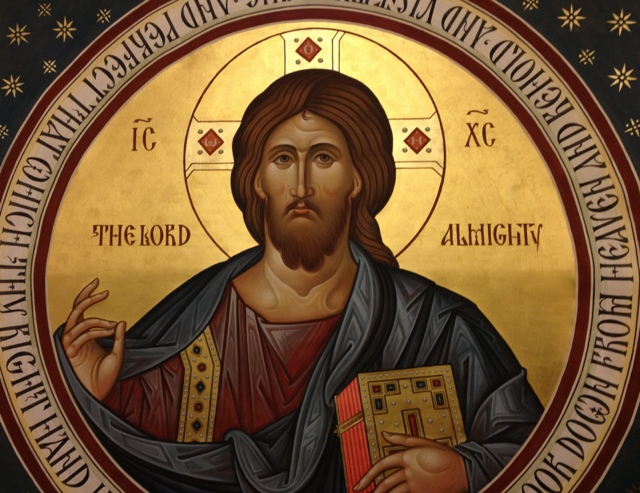
pantocrator2


Posted in Uncategorized | Comments Off on God and Caesar