Quiet witness

18 October OS 2017 – Tuesday of the 5th Week of St. Luke; Holy Apostle and Evangelist Luke

On this day in 2015, I penned these thoughts about the daily Gospel reading: 

In today’s Gospel, the Lord calls upon us to confess Him before men:

The Lord said to His disciples: If any man will come after me, let him deny himself, and take up his cross daily, and follow me. For whosoever will save his life shall lose it: but whosoever will lose his life for my sake, the same shall save it. For what is a man advantaged, if he gain the whole world, and lose himself, or be cast away? For whosoever shall be ashamed of me and of my words, of him shall the Son of man be ashamed, when he shall come in his own glory, and in his Father’s, and of the holy angels. But I tell you of a truth, there be some standing here, which shall not taste of death, till they see the kingdom of God. Luke 9: 23-27

If we desire to follow Christ, we have to take up our cross – daily, as St. Luke records the Lord saying – and follow Him. Part of this daily cross is not to be ashamed of Jesus Christ and His Gospel before other people, which is actually a tall order, because we are very prone to cringing before the opinion of society – we want others to like us, or at least we want to avoid conflict with them.   But if we are to be true Christians, conflict is inevitable, for the world is at war with God.

St. Theophan the Recluse laments over the fact that no one talked about God or salvation in the fashionable Russian society of his day:

Do not be ashamed to confess the Lord Jesus Christ as the Incarnate Son of God, Who redeemed us through His death on the Cross, Who through His Resurrection and Ascension opened for us the entrance into the Kingdom of Heaven. If you are ashamed, then He will be ashamed of you “…when He shall come in His own glory, and in His Father’s, and of the holy angels.” Now it has become fashionable in society not to talk at all about the Lord and about salvation, whereas in the beginning these precious subjects were all that people talked about. One’s talk more readily flows from the place where the heart abides. Can it really be that people’s hearts abide less with the Lord? Judging from the talk, this must be the case. Some do not know Him at all, and others are cold toward Him. Fearing encounters with such people, even those who are warm toward the Lord do not direct conversation toward Him, and the priesthood is silent. These days, discussion about the Lord and Savior and about our main concern – salvation – is excluded from the range of conversation acceptable in society. “What?” you say, “Is that really all we’re supposed to talk about? Why only about that?” It is possible to talk about anything, but it must be done in a way that is underscored by the spirit of Christ. Then it would be possible to guess whether the speaker is a Christian or pagan. Now, however, it is impossible to guess what they are, either by their talk or by their writings. Look through all the periodicals – what don’t they write about? But no one wants to make Christian conversation. Strange times! Thoughts for Each Day of the Year, pp. 231-232

In our own experience in American life, of course, we do meet people who want to “talk religion,” but usually their ideas are so inadequate, strange, or even blasphemous that it is painful to talk with them; we feel that we are casting our pearls before swine. What to do?   I think that what is left to us is the constant struggle for prayer, so that we are ready to say a good word in season when the occasion arises.   If we always are abiding in the Lord, then the people in front of us will, as St. Theophan says, be able to discern that we are Christians, and they will respond to us accordingly. It may be that people with a genuine thirsting spirit, with the fear of God, will cross our path, and that we must be ready to respond to them. May God grant!

If in our inevitable run-ins with unbelievers and freethinkers, someone says a blatant untruth about God, about the Christian faith, we simply have to say, “That is not true.” We do not have to engage in argument, but simply confess our faith: “I believe in the Holy Trinity, in Christ, in the Orthodox Faith, and in everything the Church teaches.” If they want you to explain, and you do not feel up to the task, give them your priest’s email address or telephone number.   If they are serious, they will contact him.   When they see that you are serious, they will respect you for sticking to your guns.

The important thing is not to be skilled apologists but to be courageous confessors. This takes few words but much faith, with peace of heart. The world is going its way: let it go!   We must go our way. This thought should give us peace in the midst of the turmoil and spiritual barrenness of contemporary life.

Posted in Uncategorized | Comments Off on Quiet witness

Orthodox Survival Course, Class 6

Orthodox Survival Course

St. Irene Orthodox Church

Rochester Hills, Michigan

2017-2018

Pre-Class 6 – Corrigenda, a Clarification, and an Amplification

As we go along, when I notice mistakes or lack of clarity in earlier notes or recordings, or something glossed over that I would like to expand on a bit, I will try to correct mistakes and clear things up.

In the Class 2 recording, I mistakenly said that the English historian Christopher Dawson was a “theologian.” He is not, not even in the modern sense. I actually meant to say “historian,” and “theologian” was a slip of the tongue. By the way, Dawson’s work is an excellent example, perhaps the best written in English in modern times, of “meta-history.” But his outlook is Roman Catholic, not Orthodox, and therefore you have to take that into account when reading him.

In the Class 3 recording, I called the quote from St. John Cassian’s Conference of Abba Moses one of the “locus classici.” Well, first of all, it’s either a locus classicus or one of the loci classici, to get the grammar straight. What this term signifies is a place in the literature of a topic where you find a key statement that makes a point or reveals a truth or some information that thereafter defined the consensus understanding of the topic at hand or marks a great turning point of some kind or that is considered permanently authoritative.

Last week I mentioned that the Parthenon became a Christian church for many centuries, but then went on to say the the Church did not use the pagan temples for churches, but rather chose the basilica form. In general, that is true, but there exceptions, and the Parthenon is perhaps the most striking. It is true, however, that the foundations or fragments of pagan temples were often used in new Christian constructions.

One of our quotes last week was from Pitirim Sorokin, who talked about “ideational” art, the category into which he would put all truly sacred art, such as Byzantine art. This category is part of an entire scheme for understanding history and cultures developed by Sorokin, a Russian emigre who founded the sociology department at Harvard University in the 1930’s. I hope to spend more time on his thought later on in our course, as a tool for understanding the course of our civilization in relation to the West’s departure from Orthodoxy.

One thing I want to clarify in advance is our use of Wikipedia sites in tonight’s class. Of course, I do not advocate Wikipedia as an authoritative or complete source by which to study a subject. It was just a handy place to go to start our exploration of photographs of some of the artefacts and buildings I wanted to talk about. Naturally, if you want to learn more, you need to do more research, but you could start with the links provided in the Wikipedia article. For example, the article on Hosios Loukas gives a link to another collection of photos of the art in the church.

Class 6 – The Church of the Romans: Topic 3, Sacred Art – B. Examples

Introduction – Last week we discussed the history and the principles of true Orthodox sacred art. This week, we shall look at examples. Before going on, however, let us briefly review the characteristics of this sacred art.

The Characteristics of Genuine Christian Sacred Art

Recall our first class, on the Early Church, whose character we described as eschatological, otherworldly, martyric, and ascetical. The insights we discussed in our later two classes, regarding the Church’s true spiritual school and true theological method lead us in the same direction, which is to conclude that a genuine sacred art must lead the believer into purification of the senses, cleansing from the passions, and pure prayer in this life, and thus to the Heavenly Kingdom in the next life, which Kingdom he will already have experienced through mysteriological and prayerful communion with God. It is anagogical – Its purpose is not to “celebrate the world,” but to lead the soul upwards to union with God.

This anagogical function necessitates that true sacred art must be hierarchical and hieratic. The forms and images here below are part of a great hierarchy of forms which extend downward from the heavenly archetypes to their earthly representations, as explained by St. Dionysios. This art is hieratic, that is, priestly, in that it has a specific priestly function, which is to offer to the believer the sacred mystery and then transform the believer so that he may offer his heart – himself – as a spiritual sacrifice to the Father Who reigns at the height of this cosmic and super-cosmic hierarchy, He Who sacrificed the Lamb of God before the ages for us.

The techniques of this art, in all of its media, must therefore produce a certain transparency, for its function is not to call attention to itself but to lead up, beyond itself, to that which is truly real. It is also an art that is anonymous, both because the artist is working as a member of a community, not on his own, and because he is performing his work as an act of worship to God, not for personal aggrandizement.

Tonight we will look at good examples of Orthodox sacred art from the first millennium, which exhibit some or all of these characteristics.

The Art of the Early Church – Recall that last week we pointed out that the art of the Church of the first three centuries was very simple and undeveloped, due in some part to the Faith’s frequently illegal status inhibiting the building of churches and the elaborate development of outward forms. Christian art in this period was either purely symbolic (e.g., the fish anagram) or consisted of childlike paintings of Scriptural scenes and images. There are, however, a few instances of Late Antique Christian sculpture.

Let’s start with the Wikipedia article (where else?), which actually has some excellent images of illustrative examples from the catacombs in Rome: https://en.wikipedia.org/wiki/Early_Christian_art_and_architecture. This article takes us also into the 4th and 5th centuries, and therefore the first great basilicas, illustrated here by St. Sabina in Rome.

The Church of Dura Europos in Syria is a remarkably complete example of the early house-church type. https://en.wikipedia.org/wiki/Dura-Europos. Providentially, the frescoes were removed carefully and are now on exhibit at Yale University. The village itself, the site of numerous, extremely valuable architectural sites, was destroyed recently by ISIS.

Early Christian sculpture usually took the form of bas relief, usually executed on sarcophagi. Completely three-dimensional sculpture was very rare. https://en.wikipedia.org/wiki/Early_Christian_sarcophagi

Art historians, though they agree with church historians that the Early Church period, in most respects, ended with the Peace of the Church at the beginning of the fourth century, consider the period of Early Christian/Late Antique art to extend in places as late as the seventh century, because it took that long for the transition from one form to another to take place. This Late Antique art, though not strictly speaking sacred in character, already has the character of formality and serenity that suited it very well to taking on the characteristics of sacred art we delineate above.

Late Antique Portraiture – The Fayum Portraits

There is one surviving trove of Late Antique portraiture, the famous Fayum mummy portraits from Egypt, which date from the late 1st through the 3rd century. Remember that Egypt had been Hellenized for three centuries, and part of the Roman Empire for one century, before this time. This art is almost certainly representative of Greco-Roman portraiture at this period. The depictions are realistic but, again, formal and serene. There is liveliness and warmth in the depth of the faces, but no violent emotion or any pathological disturbance. https://en.wikipedia.org/wiki/Fayum_mummy_portraits

It is easy to see how this school of art lent itself to being transformed by the Church into a school providing the tools for a truly sacred iconography.

The Basilica – Recall that, when choosing a form for its church architecture, the Church chose not the pagan temple but the basilica, a large, rectangular building used originally for public gatherings. https://en.wikipedia.org/wiki/Basilica . Let’s look at the outline of a basilica as shown in the article, and photographs of Santa Sabina, a basilica in Rome that has retained its original form to a remarkable degree.   

Two Microcosms Illustrating our Subject: Ravenna and Mount Sinai

There are two simply wonderful places that are microcosms of early Christian architecture and art, living “visual aids” to our study of this wonderful subject: The larger is the city of Ravenna, where one finds a large number of sacred buildings from the fifth and sixth centuries. The other is the Monastery of St. Catherine (or more anciently, of the Burning Bush and the Transfiguration) at the foot of Mt. Sinai. Both places offer examples of the basilica form of church architecture, and both contain iconography – mosaics at Mt. Sinai and Ravenna, and three famous panel icons at Mt. Sinai – which illustrate beautifully the transitional period when Late Antique Art became Byzantine art.

Ravenna also offers the earliest great example of the round or octagonal church – San Vitale, which by a few years predates Hagia Sophia in Constantinople. (That is, the earliest great example built from scratch as a church. The Pantheon in Rome is several centuries older but not designed as a church, for originally it was a pagan temple. It is completely round, not a dome set on a cross, as are Hagia Sophia and San Vitale). San Vitale is not nearly the achievement that Hagia Sophia was, but both its architecture and especially its extant mosaics are enormously important in our understanding of early Byzantine art.

One exercise that will help you to see the transition from Late Antique to early Byzantine art is to look carefully at the decoration of the Mausoleum of Galla Placidia, which dates from the fifth century, and then look carefully at the mosaics from San Vitale and Sant’ Apollinare in Classe, which date from the sixth century, and the great apse mosaic of the Transfiguration at Mt. Sinai, also from the sixth century.

https://en.wikipedia.org/wiki/Ravenna

https://en.wikipedia.org/wiki/Saint_Catherine%27s_Monastery

Fully Developed Byzantine Art

There are two extant ensembles of high Byzantine art in Greece, the catholicon of Hosios Loukas monastery in Boetia (10th century), and the church at Daphne near Athens (11th century), which illustrate the full development of Byzantine art after the restoration of the icons following the end of of iconoclasm in 843. Notice that by this time all of the naturalistic elements of Late Antique art have been highly spiritualized, and the elements of hierarchy and hieraticism are developed to the highest degree:

https://en.wikipedia.org/wiki/Hosios_Loukas

https://en.wikipedia.org/wiki/Daphni_Monastery

Sacred Art after the Schism

Later we will be looking at Byzantine art in the later middle ages, at the time when the Latins have already separated from the Church, to contrast it to the newfangled style of religious art in the West, which marks a transition from the truly sacred art of the Church in the strict sense to the humanistic art of the Renaissance. 

You can listen to a podcast recording of this class at   

 spreaker.com/user/youngfaithradio/survivalcourse-class6_2


Posted in Uncategorized | Comments Off on Orthodox Survival Course, Class 6

The saving pain of loving the Truth

13 October OS 2017 – Thursday of the Twentieth Week after Pentecost/4th Week of St. Luke;  Holy Martyrs Carpus and Companions 

In 2015, I penned these thoughts on today’s Gospel: 

 In today’s Gospel, Herod exhibits the vain curiosity of those who want to “talk religion” but do not want to live according to the demands of truth:

At that time: Herod the tetrarch heard of all that was done by him: and he was perplexed, because that it was said of some, that John was risen from the dead; And of some, that Elias had appeared; and of others, that one of the old prophets was risen again. And Herod said, John have I beheaded: but who is this, of whom I hear such things? And he desired to see him. And the apostles, when they were returned, told him all that they had done. And he took them, and went aside privately into a desert place belonging to the city called Bethsaida. And the people, when they knew it, followed him: and he received them, and spake unto them of the kingdom of God, and healed them that had need of healing. – Luke 9: 7-11

St. Theophan the Recluse comments on the mindset of Herod:

Hearing about the works of Christ the Savior, Herod said, “John have I beheaded; but Who is this?” And he desired to see Him. He desired to see Him and sought an opportunity for this, but was not made worthy, because he sought not unto faith and salvation, but out of empty curiosity. Inquisitiveness is the tickling of the mind. Truth is not dear to inquisitiveness, but news is, especially sensational news. That is why it is not satisfied with the truth itself, but seeks something extraordinary in it. When it has contrived something extraordinary, it stops there and attracts other people to it.   Thoughts for Each Day of the Year, p. 227

There is a great difference between the desire for truth and empty curiosity. The desire for truth is a profound longing planted in the soul by God, and it is inseparable from the longing for justice, for the good, for doing God’s will: I seek the truth because knowing truth is a moral imperative, because remaining ignorant of truth is a sin, is displeasing to God, is a socio-pathological state which hurts my neighbor, is a destruction of my soul and my eternal destiny.   Knowing truth is what God made my mind for: it is pleasing to Him and enables me to love Him and love my neighbor as well as to attain my earthly purpose and my eternal happiness.

Pilate’s retort to Truth Incarnate when He stood before him – “What is truth?” (i.e., one cannot know the truth, truth is relative) – excuses the speaker from the task of being human.   Judas knew Who Christ was and betrayed Him. Pilate does not even get around to betraying Christ, because he does not even bother to find out Who He is.   Judas goes out with a bang, Pilate with a whimper – the result is the same.

Today everyone excuses his own and everyone else’s ignorance: no one is going to hell because, well, “He does not know any better.”   Everyone has forgotten that there is such a thing as culpable ignorance, the guilty ignorance chosen by the man who does not care to find the truth, or, having an inkling of the truth, does not want to follow it up.   The same person may be like Herod in today’s reading – he may actually enjoy “talking religion.” This usually entails his pontificating about things he knows very little about, concluding that all truth claims have more or less the same value, and that he has the moral and intellectual high ground because he is a relativist.   A sorry spectacle: A person who has made himself stupid on purpose in order to avoid the pain of intellectual, spiritual, and moral struggle. He prides himself on having a permanently open mind, but the problem with having an always-open mind is like that of having an always-open mouth: unless you close it on something, you will starve.

How can we flee the vain curiosity we see in Herod and attain the love of the truth we see in the saints?   Here are three steps we can take:

Pray earnestly for the love of the truth, for ourselves and others.   We should weep over the indifference to truth we see everywhere, for the vacuity and idiocy of 99% of contemporary thought, speech, and writing.   We need to become interior martyrs for truth, with constant suffering over the darkness of men’s minds.   We should hurt over it. We need to pray for this grace.

We need to stop being information junkies. Remember: information is not truth; it’s just stuff. Today’s information technology has enabled an entire way of life based on distraction, which is fatal to coherent thought, much less accurate rational and intuitive philosophy and theology, and therefore our first step has to lie in radically disciplining our use of the Internet.  Look at it this way: “Alright, my work may require x amount of time on the Internet. Beyond that, I will be on it x amount of time at y time of day.   I will use it to find things I need or talk to people I need to talk to, but I will not live in it.   The real world is the visible world around me and the invisible world of the soul. I will choose to spend my time in the real world whenever possible.”     The Internet is not the real world; at best it simulates the real world, and the accuracy of the simulation is questionable. It is a tool we use, not an alternate universe to move into because we do not like the world we live in.

We need to spend time reading books. I know that this sounds radical, perhaps even subversive, but I highly recommend it. Pick one good book of Orthodox spiritual reading and another good book about something real – serious history or literature or science, etc. – and put in x hours (or minutes…just get started!) reading them.

At one point in their lives, both Herod and Pilate had Truth Incarnate standing before them, and they could not see, because they did not care. Let us care to the point where it hurts and cry out to the Lord to enlighten our darkness.

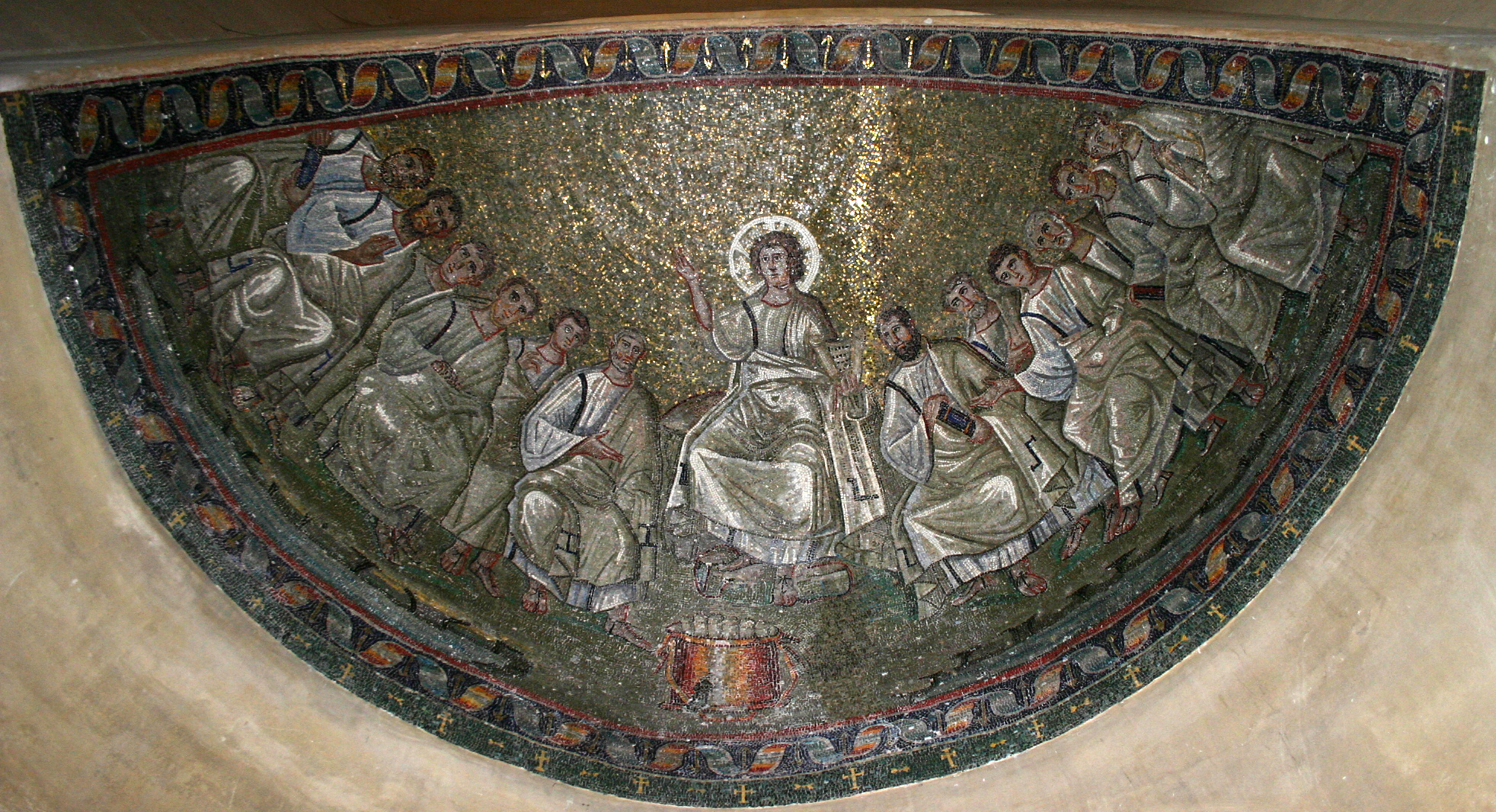
Christ traditio legis S. Lorenzo 

Posted in Uncategorized | Comments Off on The saving pain of loving the Truth

Teachers of the light yoke of Christ

On this day, 10 October OS, in 2015, I offered these thoughts on the occasion of the feast of the Fathers of Optina:

10 October OS – Holy Martyrs Evlampios and Evlampia, Venerable Fathers of Optina

Today, the tenth of October on the Orthodox calendar, is the feast of the Venerable Fathers of Optina, a golden chain of God-bearing elders who flourished in Optina Monastery in Russia from the early 19th century until the monastery was closed by the atheist revolutionaries in 1928.   They are saints newly revealed for the consolation and edification of the universal Church of the latter times, and by their prayers and holy teaching we can learn to travel the path of humility and the hidden life in Christ, in order to tread the extremely narrow way, difficult to discern, leading to salvation in these times of widespread, indeed ubiquitous, spiritual delusion.

The reading from the Holy Gospel for Matins of a monastic saint, read today in those churches celebrating services for the Optina fathers, is Matthew 11: 27-30.

The Lord said to His disciples: All things are given unto Me by My Father. And no man knoweth the Son, but the Father; neither knoweth any man the Father, save the Son, and he to whomsoever the Son willeth to reveal Him. Come unto Me, all ye that labor and are heavy laden, and I will give you rest. Take my yoke upon you, and learn from Me that I am meek and lowly in heart; and ye shall find rest unto your souls. For My yoke is easy, and My burden is light.

St. Theophylaktos of Ochrid, in his commentary on St. Matthew, answers the question, “What is the yoke of Christ?” thus:

The yoke of Christ is humility and meekness. For he who humbles himself before all men has rest and remains untroubled; but he who is vainglorious and arrogant is ever encompassed by troubles as he does not wish to be less than anyone but is always thinking how to be esteemed more highly and how to defeat his enemies. Therefore the yoke of Christ, which is humility, is light, for it is easier for our lowly nature to be humbled than to be exalted. But all the commandments of Christ are also called a yoke, and they are light because of the reward to come, even though for a time they appear heavy. The Explanation of the Holy Gospel According to St. Matthew, by Blessed Theophylact (Chrysostom Press 1992)

The yoke of Christ, then, can be understood as being humility and can also be understood as being the commandments of the Gospel.   The two, of course, are intimately related: We attempt to carry out the Gospel commands, and we find that by our own power we cannot. This realization brings on a deeper understanding of ourselves – that we are dust and ashes, that all is given by God and we have nothing of ourselves – and thereby to humility. Once we give up the heavy burden of the illusion of self-sufficiency and take on ourselves the light yoke of humility, all goes well.   There will be many external trials and temptations – indeed these normally increase for those who attempt to follow the Gospel – but within we are at peace.

When reading the counsels of the Optina elders, one is struck by the constantly recurring themes of humbling oneself, giving up one’s self-will, and total reliance on God. These men had the prophetic spirit, and they knew that terrible times lay ahead for the Church.   They knew that only the most profound humility would carry the faithful through the trials that were shortly to befall. Their entire century-long ministry can be seen as a catechesis preparing an entire people for martyrdom.

Here is one of my favorite quotes from the Optina fathers, a word of counsel from the Elder Nikon, who was a confessor for the Faith under the Bolsheviks as well as a monastic saint (he died prematurely from the sufferings of imprisonment and exile, in 1931, at the age of 43):

One must always pray that the Lord will show him the way…Let us pray to the Lord that He will save us and will come to our aid in times of sorrow and need. I see no other refuge or hope. Human solutions are vain and mistaken. When you have to endure something which is very difficult, but you know that it is not of your own will, you receive moral relief and peace of soul. May God’s will be done! May the Lord not discredit our faith and devotion to His will. Our only hope is in God. He is our firm foundation, for everything else is unsure. You absolutely do not know where it might be better, where it might be worse, or what to expect. May God’s will be done! Our work is to preserve ourselves in the faith, and to keep ourselves from every sin, and entrust everything else to God.   Living Without Hypocrisy, Spiritual Counsels of the Holy Elders of Optina (Holy Trinity Monastery 2005)

“Our work is to preserve ourselves in the faith, and to keep ourselves from every sin, and entrust everything else to God.”

Amen.

The Lives of the Elders Moses and Joseph of Optina in English are published by Holy Transfiguration Monastery.  The Lives of the other Elders are available in English from St. Herman Press.  

Posted in Uncategorized | Comments Off on Teachers of the light yoke of Christ

Orthodox Survival Course – Class 5, Orthodox Sacred Art

Orthodox Survival Course

St. Irene Orthodox Church

Rochester Hills, Michigan

2017-2018

Class 5 – The Church of the Romans: Topic 3, Sacred Art – A. Theory

Now, if the essences (ousiai) and orders above us, of which we have already made reverent mention, are without bodies, their hierarchy is intellectual and above sense. We supply by the variety of sensible symbols the visible order, which is according to our own measure. Those sensible symbols lead us naturally to intellectual conception, to God and His divine attributes. Spiritual minds form their own spiritual conceptions, but we are led to the divine vision by sensible images. – St. Dionysios the Areopagite, On the Ecclesiastical Hierarchy, quoted by St. John of Damascus in On the Divine Images

Then we went on to Greece, and the Greeks led us to the edifices where they worship their God, and we knew not whether we were in heaven or on earth. For on earth there is no such splendour or such beauty, and we are at a loss how to describe it. We know only that God dwells there among men, and their service is fairer than the ceremonies of other nations. For we cannot forget that beauty… – the words of the emissaries of Great Prince (St.) Vladimir of Kiev, describing their visit to Constantinople in the 10th century, from The Primary Chronicle

In its content as well as in its type, ideational art articulates the major premise of ideational culture that the true reality-value is God. Therefore the topic of ideational art is the supersensory kingdom of God…Its objective is not to amuse, entertain, or give pleasure, but to bring the believer into a closer union with God. It is a part of religion, and functions as a religious service. It is a communion of the human soul with itself and with God. As such it is sacred in content and form. As such it does not admit any sensualism, eroticism, satire, comedy, caricature, farce, or anything extraneous to its nature. Its emotional tone is pious, ethereal, and ascetic. – Pitirim A. Sorokin, The Crisis of Our Age, p. 31 (First Edition, E.P. Dutton, 1941)

Introduction – We all know that Orthodoxy is extremely beautiful in all of its artistic manifestations: visual art, architecture, literature, chant, liturgical movement, etc. Why is this so? It is because, in all of history, the body of Orthodox Christian art comprises the highest and most faithful artistic manifestations of the highest unseen realities: above all things God Himself, and then, after God, the sacred hierarchy of the Mother of God, the angels, and the saints, which continues in the visible world in the hierarchy of the Church on earth.

St. Dionysios the Areopagite, the disciple of St. Paul, explains, in his treatise On the Ecclesiastical Hierarchies, how our visible rituals and symbols are anagogical, that is, they lead our minds up to the invisible realities which are their prototypes. (“Anagogical” comes from the Greek ana – “up” and ago – “to carry” or “to lead” [used of living things; for inanimate objects the verb is fero]; so “anagogical” means “pertaining to leading someone upwards”). This naturally flows from what we have already discussed in regards to Orthodox spiritual life and theological language, which are human participations in the life of God Himself, synergistic operations uniting the created powers of the human organism – body and soul – to the uncreated energies of God. Orthodoxy is a completely integrated whole, and it is only natural that its art should manifest accurately and beautifully its accurate and beautiful spiritual life and theological expression.

In discussing the history of this art, let us recall the organic image of the growth of a tree, which we employed earlier to describe the Church’s maturation of Her outward characteristics, which reached their mature form by the ninth century. She took the previously existing art of the Old Testament worship and the art of the Greco-Roman culture, and transformed and synthesized them in an unsurpassed (indeed by nature unsurpassable), breathtakingly magnificent and perfectly integrated ensemble manifesting aesthetic virtue in the highest degree, in every type of art – especially the visual, auditory, and architectonic – both in their public and domestic forms, those dedicated both to official ceremony and daily life, to explicitly sacred purposes and to apparently mundane activities.

In our classes tonight and next week, we cannot possibly cover the entire history of Orthodox sacred art or fully describe it. Our purpose is to give a brief historical overview, to summarize the character of genuine sacred art, and to relate this to our previous insights about the characteristics of the Church and of Her spiritual life and theology.

Historical Development – The New Testament Church had simultaneously to preserve the teaching of the incomprehensibility of God against the temptation of idolatry while preserving, against Manicheism and other dualisms, the teaching of the inherent goodness of creation and its instrumentality in lifting man from knowledge of the creation to knowledge of the Creator, a reality underscored by, indeed completed and made fully possible by, the Incarnation. Just as She took the Old Testament faith to the Gentiles and gave birth to the New Israel of the New Testament, so She took the highest aspects of the externals of the Old Testament worship and united them to the highest aspects of the art of the ancient world (primarily the Greco-Roman but also aspects of the Persian and other Middle Eastern cultures), to give birth to the externals of the worship of this New Israel. What we call Orthodox art can only be understood entirely within the framework of Orthodox worship, life of prayer, and theology.

The Worship of the Old Testament – It is obvious that the Early Church saw Her worship as the continuation and fulfilment of the worship of the Old Testament. Thus She preserved and elevated this worship in its chant, the use of the Psalms of David, the symbolism of the priestly service – garments, movements, rituals, etc. – and symbolism of the visual arts and architecture. The Holy Fathers constantly recur to the instructions given by God to Moses on Mt. Sinai regarding the worship of Israel, and to the description of the Temple of Solomon in Kings, when discussing both the inner life of the soul as well as the outward worship of the Church, two manifestations of the one reality of the anagogical movement of man towards God.

In Christianizing the Old Testament worship, the Apostles and Fathers led this worship up from being a typos – a type, a foreshadowing – of the true worship into being the true worship, from being merely outward ritual to being the worship of God in Spirit and in Truth that Our Lord spoke of to the Samaritan Woman (John 4:23). One example of this was eliminating instrumental music, so that the chant of the Church would become more conducive to interior prayer. Another example was changing the basis of the selection of the priests from that of physical descent to spiritual fitness, as most fully explicated by St. Dionysios.

The Arts of the Greco-Roman Civilization – We must keep in mind that what we call Greco-Roman civilization was already extremely old at the time the New Testament Church came into being, and that its arts were also old and had undergone many phases and changes. But we may safely characterize the art of the late ancient world as highly developed sensate art, art that emphasized this-worldly realities, albeit in a beautiful and technically brilliant way. There was a great emphasis on sculpture, for example, whose three-dimensional character is necessarily opaque and sensual – it can convey ideas and feelings of something noble, but because it lacks transparency, because it calls attention to itself, it cannot anagogically lead the mind to the direct experience of that which is above the material. It can remind one of higher things – which are “somewhere else” – but it cannot mediate the higher things, bringing one into direct contact with them. The architecture and the use of the temple is another example of this opacity. The great temples were not built primarily to gather people for worship within but to provide magnificent backdrops for public ceremonies without. The outside of the temple was more important than the inside. This exteriority was completely appropriate to a culture in which religion was primarily a civic cult, a support to a powerful and proud this-worldly society.

The baptism of Greco-Roman art and architecture by the Church –

Visual Art – The visual art of the Early Church was for the most part either purely abstract and symbolic – as in the use of the Chi-Rho (ΧΡ, ΧΡΙΣΤΟΣ, Christ) and the Fish anagram (ΙΧΤΗΥΣ – ΙΗΣΟΥΣ ΧΡΙΣΤΟΣ ΘΕΟΥ ΥΙΟΣ ΣΩΤΗΡ – Jesus Christ Son of God Savior), or consisted of simple Scriptural images such as the basket with the bread and the fishes, etc. Prime examples include the simple, childlike art of the catacombs in Rome and the house-church at Dura-Europos in Syria, which either present abstract symbolism or Scriptural themes. There are, by contrast, a few examples of Christian-themed Late Antique sculpture. So we have either something very simple and undeveloped on the one hand, or a few isolated uses of the sophisticated Late Antique techniques on the other hand.

Architecture – In regards to church architecture, we must remember that the Church first gathered for the Liturgy in people’s homes. The earliest term known for a place of worship is o oikos tes ekklesias/domus ecclesiae – “house of the Church.” The first stage after the house-church was the titulus, a house purchased by the local Church and dedicated completely to Church use. This domestic character of the place of worship was to endure throughout the Church’s history; indeed, it is one of the enduring and distinguishing characteristics of good Church architecture – no matter how large or grand church buildings become, the best examples retain an interior and familial quality, and do not become purely official or monumental structures. Their purpose is both to gather people together for communal, familial worship and to encourage the interior worship of the heart. The genius of great Orthodox church architecture is that it can produce a very large building that is also warm, familial, and inviting, that does not crush the worshipper with its weight or grandeur, but rather simultaneously warms and elevates him, makes him feel at home while it performs its anagogical function, leading him upward to realize his higher calling.

Literature and Music – Greek and Roman literature produced language that was extraordinarily powerful, supple, and precise. Though its content, not being the direct revelation of God, obviously could not rise to the level of Holy Scripture, its form, being words, was not as opaque as pagan sculpture or temple architecture, and therefore it lent itself more easily to the use of the Apostles and Fathers. This is probably true of the pagan Greek music as well, but it is very difficult to ascertain exactly what this music sounded like, or, for that matter, what the music of the Old Testament worship sounded like. The consensus is that Christian chant was eventually a synthesis of the two, systematizing the content of the Old Testament Church’s chant (the actual melodies) by using the theory and notation of the Greek musical tradition (a process analogous to the Apologists and the Cappadocian Fathers systematizing and articulating the content of the Scriptural revelation using the “tools” of the Greek philosophical language). The roots of what today we call “Byzantine” and “Gregorian” chant are thus the same; the two are just the respective Eastern and Western developments of the original chant of the early Church, which continued the tradition of psalmodizing inherited from the Temple and synagogue worship.

The “baptism” of the inherited linguistic and musical arts during the period we are studying are both less radical and less obvious than in the visual arts, and more complicated to explain. For our purposes, it will be enough to talk about how the Church baptized the visual arts and architecture of the ancient world.

The transformation: In the realm of the visual arts, late antique portrait painting provided much better material for Christian artists to work with than did sculpture. The famous Fayum mummy portraits provide the best example of this genre. One can easily see how this school lent itself to the later, more spiritualized iconography of the Church, for though it is essentially realistic and worldly, it is at the same time formal and serene, while, being two-dimensional and providing a “window” into the soul of its subject, especially through the expressive depiction of the eyes, it also conveys an interiority that sculpture cannot.

In the realm of architecture: When the Church was free to build large public places of worship, She chose the form of the basilica, which was a secular type of building used for civic gatherings, such as political assemblies, courts, and markets. This only makes sense, since the worship of the Church consisted of the gathering (qahal, ekklesia) of the faithful for corporate praise and the Eucharistic Sacrifice. It took place on the inside, not the outside, and so what mattered was the inside, not the outside of the building. Of course, the Christians re-organized and adorned the interior of the basilicas to fit their new, spiritual function.

What we see in the course of the fifth and sixth centuries is a transition from what can be called Late Antique art to Early Byzantine art. One microcosm that illustrates this transition beautifully and accurately is the collection of sacred buildings in the northeastern Italian city of Ravenna, containing churches, baptisteries, and mausolea from the fifth and sixth centuries. Another, most famous example, is the Sinai icon of Christ, from the sixth century. What is taking place here is that the Church took the most spiritual forms of late Antique Art and gradually refined them into something completely Christian, which we today call Byzantine art.

The Characteristics of Genuine Christian Sacred Art

Recall our first class, on the Early Church, whose character we described as eschatological, otherworldly, martyric, and ascetical. The insights we discussed in our later two classes, regarding the Church’s true spiritual school and true theological method lead us in the same direction, which is to conclude that a genuine sacred art must lead the believer into purification of the senses, cleansing from the passions, and pure prayer in this life, and thus to the Heavenly Kingdom in the next life, which Kingdom he will already have experienced through mysteriological and prayerful communion with God. It is anagogical – Its purpose is not to “celebrate the world,” but to lead the soul upwards to union with God.

This anagogical function necessitates that true sacred art must be hierarchical and hieratic. The forms and images here below are part of a great hierarchy of forms which extend downward from the heavenly archetypes to their earthly representations, as explained by St. Dionysios. This art is hieratic, that is, priestly, in that it has a specific priestly function, which is to offer to the believer the sacred mystery and then transform the believer so that he may offer his heart – himself – as a spiritual sacrifice to the Father Who reigns at the height of this cosmic and super-cosmic hierarchy, He Who sacrificed the Lamb of God before the ages for us.

The techniques of this art, in all of its media, must therefore produce a certain transparency, for its function is not to call attention to itself but to lead up, beyond itself, to that which is truly real. It is also an art that is anonymous, both because the artist is working as a member of a community, not on his own, and because he is performing his work as an act of worship to God, not for personal aggrandizement.

Next week we will look at actual examples to illustrate these themes of anagogy, hierarchy, hieraticism, transparency, and anonymity, to form a clear picture of this fully developed, peculiarly Christian art.

You can listen to podcasts of our classes at 

https://www.spreaker.com/show/fr-steven-allens-show
Posted in Uncategorized | Comments Off on Orthodox Survival Course – Class 5, Orthodox Sacred Art

Building the house of our life on the Rock

5 October OS 2017 – Wednesday of the 3rd Week of St. Luke;  Holy Virgin-Martyr Charitina 

On this day in 2015, I offered these thoughts on today’s Gospel:

In today’s Gospel, the Lord exhorts us to match our actions to our confession of Faith in Him:

The Lord said: And why call ye me, Lord, Lord, and do not the things which I say? Whosoever cometh to me, and heareth my sayings, and doeth them, I will shew you to whom he is like: He is like a man which built an house, and digged deep, and laid the foundation on a rock: and when the flood arose, the stream beat vehemently upon that house, and could not shake it: for it was founded upon a rock. But he that heareth, and doeth not, is like a man that without a foundation built an house upon the earth; against which the stream did beat vehemently, and immediately it fell; and the ruin of that house was great. Now when he had ended all his sayings in the audience of the people, he entered into Capernaum. Luke 6:46-7:1

If you are a sincere Orthodox Christian trying somehow to have a conscious spiritual life, these words are always hovering around you, and there is always (at least a slight) twinge of conscience.   We know we do not fulfill Our Lord’s commandments, and yet we continue to say, “Lord, Lord.”   How can we place the house of our soul more firmly on the rock of His commandments?

The first thing to remember is that we must not stop saying, “Lord, Lord,” even if we look silly doing it. We have to keep confessing our Faith in Jesus as our Lord and God. If you say, “Well, I do not want to be a hypocrite; I cannot fulfill the Lord’s commandments and therefore I give up calling Him my Lord,” you will still be a hypocrite (who is not a hypocrite?) and will have also become a coward and traitor as well.

So here we are, still crying out “Lord, Lord,” and yet imperfectly and unsteadily fulfilling His commandments. What to do? St. Theophan the Recluse, with his unerring sense of the essential, zeroes in on the problem, which is the conversion of the heart:

“Why call ye Me, Lord, Lord, and do not the things which I say?” Why do they call Him Lord, but do not do the Lord’s will – that is, why do they not acknowledge His lordship in their works? Because they only call with their tongue, and not with their heart. If their heart were to utter, “Lord, Thou art my Lord,” then complete readiness would abide therein to submit to the One Whom they confess as their Lord. But since this is not the case, their deeds do not match their tongues; whereas, deeds always match the heart. Well, what then – is there no use in calling “Lord, Lord”? No, that’s not it. But it is necessary to make the external word match the inner word, which is the feeling and disposition of the heart. Sit and reflect upon the Lord and upon yourself; what is the Lord and what are you? Think about what the Lord has done and still does for you, why you live, and how it will end. You will immediately come to the conviction that there is no other way than steadfastly to fulfill the Lord’s entire will. There is no other path for us. This conviction gives birth to a readiness to fulfill in deed what is expressed by the word “Lord.” With such readiness a need for help from above will be awakened, and from it the prayer: “Lord, Lord! Help me and give me strength to walk in Thy will.” And this call will be pleasing to the Lord.” Thoughts for Each Day of the Year, p. 221

St. Theophan here lays out a simple plan:

  1. Sit for a bit and reflect on Who God is and who you are. Think about all that He has done for you: He brought you into existence; without Him you would not exist.   He became a man and died for you.
  1. You will realize quickly that you depend on Him for everything, that you owe Him everything, and that you must do exactly what He wants at all times, or you will perish.
  1. Cry out to Him and beg Him for help to know and to do His will.

The saint concludes, “And this call will be pleasing to the Lord.” In other words, by the very act of asking Him to help us do His will, we are already doing His will. We are acknowledging His lordship over our lives, admitting our inability to do His will, showing our utter dependence on Him, and fulfilling His commandment to pray and ask Him for that which we need. We have begun to pray from the heart, which is man’s essential function, and therefore at one stroke we have begun to do God’s will in the most essential way.

If we keep at it, then little by little our actions will match our words, because now our words will be coming from the heart and therefore our own created energies are focused on what needs to be done instead of being scattered in the pursuit of myriad inessentials, and we will simultaneously and directly be invoking the power of God, and therefore His divine and uncreated energies will accomplish what our poor strength cannot do.

Here indeed is in brief a program for the Christian life.


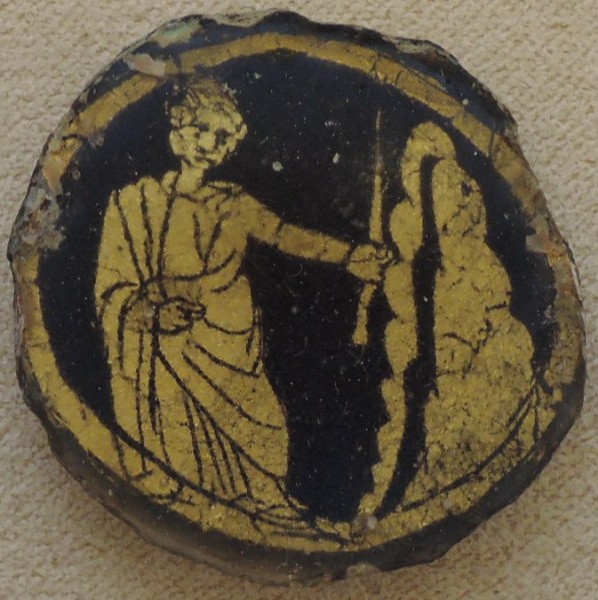
moseswaterfromtherockRomanglass

And did all drink the same spiritual drink: for they drank of that spiritual Rock that followed them: and that Rock was Christ.

I Corinthians 10:4

Posted in Uncategorized | Comments Off on Building the house of our life on the Rock

Orthodox Survival Course – Class 4

Orthodox Survival Course

St. Irene Orthodox Church

Rochester Hills, Michigan

2017-2018

Class 4 – A.D. 313 – 1054, The Church of the Romans: Topic 2, Theology

Whosoever therefore shall confess me before men, him will I confess also before my Father which is in heaven. But whosoever shall deny me before men, him will I also deny before my Father which is in heaven. – the words of Our Lord Jesus Christ, Matthew 10:32-33

As the Prophets beheld, as the Apostles taught, as the Church received, as the Teachers dogmatized, as the Oikoumene agreed, as Grace illumined, as the Truth revealed, as falsehood passed away, as Wisdom presented, as Christ awarded: Thus we declare, Thus we assert, Thus we proclaim Christ our true God and honor His saints…This is the Faith of the Apostles. This is the Faith of the Fathers. This is the Faith of the Orthodox.This is the Faith which has established the Oikoumene. – The Synodikon of Orthodoxy (A.D. 843)

The editor, however, ventures to call the attention of the reader to the fact that in this, as in every other of the Seven Ecumenical Councils, the question the Fathers considered was not what they supposed Holy Scripture might mean, nor what they, from à priori arguments, thought would be consistent with the mind of God, but something entirely different, to wit, what they had received. They understood their position to be that of witnesses, not that of exegetes. They recognized but one duty resting upon them in this respect–to hand down to other faithful men that good thing the Church had received according to the command of God. The first requirement was not learning, but honesty. The question they were called upon to answer was not, What do I think probable, or even certain, from Holy Scripture? but, What have I been taught, what has been intrusted to me to hand down to others? When the time came, in the Fourth Council, to examine the Tome of Pope St. Leo, the question was not whether it could be proved to the satisfaction of the assembled fathers from Holy Scripture, but whether it was the traditional faith of the Church. It was not the doctrine of Leo in the fifth century, but the doctrine of Peter in the first, and of the Church since then, that they desired to believe and to teach, and so, when they had studied the Tome, they cried out: “This is the faith of the Fathers! This is the faith of the Apostles!…Peter hath thus spoken by Leo! The Apostles thus taught!…” – Henry R. Percival, M.A., D.D, editor’s introduction to the Acts of the First Ecumenical Council, “Nicene and Post-Nicene Fathers,” Second Series, Volume XIV, The Seven Ecumenical Councils (T&T Clark, Edinburgh, 1892; Eerdmans, Grand Rapids, 1961).

Introduction

  In our last class, we discussed the nature of genuine, undeceived spiritual life, as taught by the Orthodox Church. This week, we will try to summarize the fundamental characteristics of genuine, undeceived teaching, called, loosely speaking, “theology.” Strictly speaking, the word “theology” refers only to the teaching about God in Himself, the inner life of the Most Holy Trinity. Over the centuries, however, the term, more loosely applied, has come to signify also all of the sacred truths about God’s acts ad extra, towards His creation, which the Holy Fathers call not “theology” but “economy.” For the sake of convenience, we will follow this less formal convention. But let us keep this distinction in mind.

Remember, in our course we are attempting to recapture and to interiorize the way that our Fathers in the Faith saw, or, rather, see, everything, to acquire their mindset, their phronema. This is not an idle academic exercise, not an “objective” examination of one view among many, but rather a process of conversion of mind, will, and feeling. We come to the Church not merely for information but for catechesis and metanoia, to become that new man that God wishes us to be. To acquire the “filter,” the “prism” through which to view history, the “meta-historical” outlook peculiar to the Church, we have to think as Her Saints and Fathers think, reason as they reason, and have the same instinctive responses they have. Our minds must be transformed.

  1. What true theology is not

To begin, we can examine what true theology is not, so as to illumine what it is. The only serious rival to Orthodox theology is the philosophia perennis, which counts among its various permutations the “high” or “classical” versions of the great world religions or philosophical systems, including Platonism, Hinduism, Taoism, Buddhism, and pre-Vatican II Roman Catholicism. It is a waste of our time, at this point in our course, to compare Orthodoxy to contemporary pseudo-philosophy and pop religion, which are simply incoherent, debased, immoral, and corrupt, and, for the most part, are merely fabricated – or at least funded – cynically by those who know better, simply to manipulate weaker people. We will examine these later on, toward the end of our course, when describing the present state of society.

The philosophia perennis is, simply put, what the greatest minds have taught about the meaning of it all, apart from revelation and grace. Of course, we know that even the best and highest of these insights are limited by the limitations of the human intellect, and, moreover, subject to demonic influence. Recall, however, that the entire human race, even outside the Church, still retains, to a greater or lesser extent, an ancestral memory of the true worship of God and the true life in Paradise, and that though man’s mind – perception, imagination, and, most important to note, reason – is fallen (contrary to Aquinas), it is not utterly corrupt or depraved (contrary to Calvin); it still apprehends fragments of truth accurately. The philosophia perennis is what the greatest minds have been able to construct from these fragments.

Fundamental assumptions of this perennial philosophy include these three “legs of the stool”: 1. All human beings have a religious instinct, which includes an instinctive yearning for ultimate meaning, for God in some sense, and for an ultimate, immortal meaning to their own lives, for some kind of overcoming of death. 2. Reality is knowable, and the human mind can know it. 3. This knowable reality and this capacity for knowing it are universally the same for all men. Thus the true philosophy is not only perennial but universal. This latter point is demonstrated by the appeal of the “classical” literature and art of all nations to members of all the other nations. What makes them “classical” is precisely that they reveal accurately and to a high degree what all men can agree to be True, Good, and Beautiful.

The perennialist approach includes also the assumption that all of the varied versions of perennialist thought have more or less equal validity; the difference in their levels of validity is a difference in degree not kind. None is radically or essentially “truer” than the others. Due to historical and cultural circumstances, the great minds of history have come up with varied versions of the perennial tradition, but these are accidental not essential. “Classical Christianity,” considered on this basis, has Jesus of Nazareth as its only or chief “avatar,” and, perhaps, will claim that He is the highest or best, incarnation of God or representative of God. But it cannot claim that He is the only and unique Incarnation of God. It can claim that its “Creation story” from Genesis is the best of various creation stories, but not the only true one. It can claim that its saints are the highest or best of saints, but not the only real saints. And so forth.

In the perennialist approach, history is necessarily cyclical, and the world has always been here and always will be here. The ascent to knowledge is the ascent to the undifferentiated One, as taught in Neo-Platonism or Brahmanism or medieval Western Christian mysticism, ultimate reality is strictly Monadic, and all distinctions, no matter how powerful, universal, and valid from a temporal point of view, are ultimately discovered to be relative and temporary, to be in fact human mental distinctions, including dialectically proposed relations of opposition, not absolute and eternal verities. The distinction between the I and Not-I is discovered to be an illusion, and salvation is absorption into the One.

Though all of this is incomparably better than modernism and post-modernism, it is still not the Truth. It is what man can perceive of truth apart from the real God telling him directly what the Truth really is.

  1. What true theology is

Orthodox theology is revealed and empirical, confessional and martyric, pastoral and soteriological, traditional and non-dialectical. Its claim to be the only Truth is radical and absolute.

A. Revealed and empirical: The living and only God, the Holy Trinity, spoke to man and revealed Himself in theophanies in the Old Testament, and in His Incarnate Word in the New Testament. The saints experienced (thus had “empirical” knowledge of) the uncreated energies of God in these theophanies and this Incarnation and, guided by the Spirit of God, spoke and wrote of what they experienced.

B. Confessional and martyric: The saints confess the Faith. They are witnesses (martyrs) to a Truth they have already been given, accurately and completely, not thinkers trying to arrive at a truth they do not yet know.

C. Pastoral and soteriological: When the teachers of the Church articulate Her theology, both when the original writers of Holy Scripture penned their writings and the prophets and apostles preached, and when their successors, the Holy Fathers, taught and wrote, it was always as ones pastoring the flock of God unto salvation, not as “thinkers” or “academics” proposing theories or discussing competing possible, relatively acceptable articulations of reality. The Fathers at times employ philosophical language borrowed from outside the Bible or a dialectical method in order to confirm or to defend the Truth, or to make it more comprehensible to those outside, but truth is never arrived at – only defended or articulated – by using sources outside revelation or using the method of dialectic.

D. Traditional and non-dialectical: The teachers of the Church are simply handing on that which they have received. “Handing over,” “handing on” is the literal meaning of παράδοσις, traditio. “Tradition” does not mean something old or something done out of habit. It certainly does not mean something that is merely reflexive or irrational or unconscious or believed in ignorance, lacking understanding. It means simply that which is handed on rather than something newly invented or something arrived at gradually through a creative process. The saints were given, handed, the whole Truth by God, and thus they did not have to arrive at it or grab it. It arrived on Its own and It grabbed them.

E. Radical and absolute: The Orthodox Faith claims to be the only absolute and ultimate truth, not one plausible variant articulation of truth relative to other plausible explanations. Jesus Christ is the only Incarnation of God, the Orthodox Faith is the only True Faith, the Orthodox Church is the only true Church, and salvation is not found outside the Church.

III. Theology and prayer

It is a patristic maxim that only those who believe the true theology can pray truly and only those who pray truly – that is, without deception – can theologize. Thus God made men saints by His grace and revealed to their pure minds and hearts His truth, and they passed on this truth to others, calling them to Faith and to the life of prayer. The confession of the True Faith ontologically changes man, and this New Man prays, constantly growing in the reception of the living Truth, of the living God, in the depths of his being, and, in the case of some men, also receives the charisma of articulating this living Truth to others, so that they can be saved and made holy.

Conclusion: This understanding of the nature and place of authentic theological articulation within the Church was common to the Church of the Greek East and the Latin West in the first millennium. We shall see later how the transformation in understanding the nature of theology, wrought by scholasticism, in tandem with the changing concepts of sanctity and spiritual method, divided the Latin West from Orthodoxy in the 11th to the 14th centuries, making the attempt at union in the 15th century a doomed effort.

You can listen to the podcasts of all of our classes at 

https://www.spreaker.com/show/fr-steven-allens-show
Posted in Uncategorized | Comments Off on Orthodox Survival Course – Class 4

Orthodox Survival Course, Class 3 – The Church of the Romans: Spiritual Life

Orthodox Survival Course

St. Irene Orthodox Church

2017-2018

Class 3 – A.D. 313 – 1054, The Church of the Romans: Topic 1, Prayer and the Spiritual Life

Adam sat before Paradise and, lamenting his nakedness, he wept: ‘Woe is me! By evil persuasion I have been deceived and led astray, and am now exiled from glory. Woe is me! lacking noetic acuity I am now naked, and in need. O Paradise, no more shall I take pleasure in thy joys; no more shall I look upon the Lord my God and Maker, for I shall return to the earth from whence I was taken. O merciful and compassionate Lord, I cry unto Thee: Have mercy upon me who hath fallen.’ – Lenten Triodion (Rev. S. Boulter trans.), Vespers of Cheesefare Sunday, Doxastikon of “Lord I have cried…”

So then the end indeed which we have set before us is, as the Apostle says, eternal life, as he declares, having indeed your fruit unto holiness, and the end eternal life; (Romans 6:22), but the immediate goal is purity of heart, which he not unfairly terms sanctification, without which the afore-mentioned end cannot be gained; as if he had said in other words, having your immediate goal in purity of heart, but the end life eternal. – S. John Cassian, Conferences, 1st Conference of Abba Moses, Chapter 5, from “The Nicene and Post-Nicene Fathers,” (Schaff ed., Eerdmans) Series Two, Volume XI.

He who was born blind does not see the light of the sun; so he who does not live in sobriety will not see in its richness the brightness of grace which comes from above. Neither will he be freed from evil deeds and words and thoughts which are hateful to God; and not being freed from them, when he departs, he will not pass unhindered by the rulers of Hell (whom he must meet). – S. Hesychius of Jerusalem (+432), Fourth Text on Sobriety and Prayer, p. 280, Writings from the Philokalia on Prayer of the Heart (Kadloubovsky and Palmer trans., Faber and Faber 1951)

These holy Fathers were of the Christian Church of the first millennium, and their teachings, instructions, and help are accessible only in the light of genuine, primordial Christianity, devoid of any human considerations, additions, and alternations, in its integrity and purity of the times of the holy Apostles. – A monk of Mt. Athos, Foreward to Writings from the Philokalia on Prayer of the Heart, (Kadloubovsky and Palmer trans., Faber and Faber 1951)

Introduction: Our goal tonight is to summarize briefly the fundamentals of prayer and the spiritual life as taught by the Fathers of the first millennium, which, as we will see later on is exactly the same teaching as the Orthodox Fathers of the second millennium, but which were distorted by the teachers of the Western confessions after the time of the schism, when there arose countless competing “spiritualities.” This fragmentation of spiritual life led to fragmentation of every aspect of life, culminating in the spiritual, intellectual, and civilizational chaos we see today.

One question a secular student might ask is, “Why are you talking about prayer and spiritual life? That is a matter of individual choice. I thought this was a history course?” Our answer is that this question reveals a bias, that history is merely an external process unrelated to the interior life. One of the basic principles of our Orthodox philosophy of history, however, of our “meta-history,” is that the externals of life, of culture, of civilization, flow from the spiritual life. They are by-products of spiritual processes which did not have them as their primary or final aim. Even a purely materialistic civilization is realizing the outcome of its spiritual assumptions.

I. The Peace of the Church and the Rise of Monasticism

With the Triumph of Christianity, the Peace of the Church, came a great opportunity but also a great temptation. The great opportunity was to convert the masses, and the great temptation was to convert the Apostolic Faith – which, as we said in our Class 1, is fundamentally eschatological, other-worldly, martyric, and ascetic – into just another mass religion to satisfy worldly aspirations, just another cultic system to placate the gods to guarantee earthly prosperity.

The Holy Fathers of this time – as we see notably expressed in the catechetical writings of St. John Chrysostom and St. Cyril of Jerusalem – expended enormous efforts in developing the catechumenate and teaching the faithful constantly about the meaning of their baptism, but inevitably fallen human considerations – economic, political, social, etc. – crept in and dulled the edge of the zeal which had so characterized the early Church. So while the Church’s outward splendor and organization grew, the spiritual zeal of the Christians was threatened. This gave rise to the great anachoresis of the ascetics during the late Antique and early Byzantine/Medieval periods, which we will date conventionally from the life of S. Antony the Great, +350.

The Life of Antony by St. Athanasius the Great was the first great vita of an ascetic saint who was not a martyr. Its publication and enormous circulation coincided with the explosion of organized monastic life in the fourth century. There had always been virgins and ascetics in the Church – because, after all, the Church is fundamentally ascetic – but the Peace of the Church gave both the impetus and the means to organize monastic life on a vast scale and to produce an enormous monastic literature.

This flowering of monastic literature coincided with the flowering of patristic theology which was the result of the confessional struggles of the period of the Ecumenical Councils. Whereas a “modern” or “Western” scholar sees these two type of literature as separate, having separate interests, the Orthodox Fathers did not separate theology from spiritual life. A true confession of faith is the necessary foundation of spiritual life, and undeceived prayer – the authentic encounter with God – is the fountainhead of undeceived theology.

The entire culture that came to be called “Byzantine” (or more accurately, simply integral Christian culture properly speaking), had its creative source in every aspect – both ecclesiastical and secular – in this specific type of spiritual life and its concomitant theology. When you read the “information,” the “data” about this period, in order to understand the people who formed this society and culture, you have to keep this in mind. They experienced it and saw it no other way.

The so-called “monastic” literature and “monastic” outlook, then, is none other than the expression of the primordial Faith of the early Church. It is agreed by most observers, including the non-Orthodox and non-Christian, that the first millennium Church was dominated by this outlook. But seen from the Orthodox point of view, this is not a “stage” in the “evolutionary development” of the Church, but simply the way the Church is.

II. Spiritual Life and the Drama of History

So this great drama of history we spoke of in our Intro Class and Class One, continues in the life of the Church. Though in a sense history “ended” with the Resurrection, which inaugurates the Kingdom of God, yet in a sense it continues in this “now but not yet,” “betwixt and between” period when we are waiting for the Lord to return. Though Satan is defeated, yet he can still capture souls until he is finally cast into hell at the end of the world. The spiritual life is the inner process by which baptized souls defeat Satan and re-attain the Paradise lost by our First Parents.

So in examining the spiritual life, we go back to the beginning of earthly history, Paradise, and the Fall of our First Parents. To understand our soul’s functioning, we re-learn the meaning of the Fall and the origin of the passions, which separate us from God and from our own spiritual health, from life itself. By Baptism, we receive the power of the Resurrection to overcome sin, death, the devil, and hell, by Chrismation we receive the power of the Spirit to overcome the consequences of our passions and sins and grow in holiness, and in the Divine Eucharist we receive the indwelling presence of the Eternal King and a foretaste of the Eternal Kingdom. Our mysteriological and spiritual journey, then, recapitulates the drama of salvation history – we advance from the Fall to the hope of eternal life, to the final triumph of Christ at the hour of our death and the hour of His Second Coming and Dread Judgement. Thus the Orthodox Christian views his spiritual life in the framework of history, and he views history through the prism of his own spiritual life. This perfectly integrated view of our outward and inner life avoids the materialist determination of evolutionism on the one hand and the morally void escapism of a falsely “spiritual” gnosticism on the other hand.

[One example of this connection between our inner and outer history is the apolytikion of the Holy Cross, which we are chanting daily now (September 2017) during the Afterfeast of the Exaltation of the Cross. The original, of course, says, “…grant victories to the kings over the barbarians…” The original in the Russian Church, before the Bolshevik Revolution, read “…grant victories to our sovereign (name) over his adversaries…” Unfortunately, this has been altered in some modern translations to the more generic “…grant victories to the Orthodox Christians (or Orthodox hierarchs)…etc.” But this practice ignores the patristic view that the “king” and the “barbarians” also have a mystical meaning: the “king” is our spiritual intellect, the nous, purified and reigning over our organism, and the “barbarians” or “adversaries” are the passions and demons. (It also eliminates the effect of the troparion as a reminder of our actual history and a prayer for the restoration of the Orthodox monarchy). ]

III. The Foundations of Authentic Spiritual Striving

This, of course, is a vast subject. Here we can only summarize:

A. Man: Man is fallen in all of his faculties, including both the dianetic and noetic intellect. Apart from the grace that comes from Faith and Baptism, he cannot overcome his fallenness and be saved and sanctified. Upon receiving grace, he must struggle by the power of grace to overcome his sins and passions, and re-attain Paradise. Before baptism, demons dwell in men and God knocks on the outside of their hearts; after baptism, God dwells within and the demons attack from the outside. Man is constituted of body and soul, and the highest faculty of the soul is the nous, or spiritual intellect, which was mortified by sin but is resurrected in baptism.

B. God: God is the Holy Trinity, Who is experienced directly in His uncreated energies through faith, the Holy Mysteries, and prayer. He “knocks on the door” of man’s heart before Baptism, and He comes to dwell in the heart after Baptism. The entire struggle of spiritual life, then, can be said to attain purity of heart, through which God continues to dwell in the soul and the baptismal grace remains energized rather than dormant, and the demons remain outside. This purity of heart is gained through the struggle for noetic attention.

C. The Life of Prayer: Spiritual life may be called also the life of prayer. As St. Theophan the Recluse famously says, “When prayer is right, everything goes right, for prayer will let nothing go wrong.” The entire struggle against sin, and therefore the main arena of the drama of history, is the struggle to destroy sinful thoughts in their first appearance (prosvoli or prilog), or, as often as necessary, to fight against sins of thought committed when this first provocation is not resisted. The inner man, then, is the chief arena of historical processes, the Orthodox Church is where victorious struggle can take place, and the monastery is the citadel of the Orthodox Church, in which the ultimate citadel of the heart is protected most strongly.

D. Delusion: Delusion occurs either through ignorance and heresy, which are forms of outward delusion, or through a person with Orthodox belief accepting false thoughts from within – inner delusion. Delusion occurs when movements of the blood – emotional excitement – accompanied by the misuse of the imagination and intellect – lead to accepting the suggestions of demons or fallen nature or the world (usually some mixture of the three). Either inner or outer delusion, if uncorrected, lead to perdition.

E. The Method of Prayer: The un-deluded method of prayer is the simple struggle for attention to the words of Scripture, the Church services, or “private” prayer. The best method to avoid delusion is to repeat a short verse or prayer constantly, with a struggle for attention. The most popular form of this prayer is the Jesus Prayer. Outside of this method, various uses of the imagination and discursive intellect almost invariably lead to delusion. Delusion leads to fragmentation of soul, then outward fragmentation of life.  This leads to fragmentation of family, church, community, nation, and civilization as a whole.  Thus the origin of our present civilizational crisis can be traced to spiritual delusion, both in the form of heresy and in the form of incorrect spiritual life. 

You can listen to an audio recording of this class at 

https://www.spreaker.com/user/youngfaithradio/survivalcourse-c3

Posted in Uncategorized | Comments Off on Orthodox Survival Course, Class 3 – The Church of the Romans: Spiritual Life

Orthodox Survival Course – Class 2: The Church of the Romans, Overview

Orthodox Survival Course

St. Irene Orthodox Church

Rochester Hills, Michigan

2017-2018

Class 2 – A.D. 313 – 1054, The Church of the Romans: Overview

the whole world is like one well-ordered and united family. For our Emperor, invested as he is with the semblance of heavenly sovereignty, directs his gaze above and frames his earthly government according to the pattern of the divine original, finding strength in its conformity to the monarchy of God.”Eusebius of Caesaria, Oration in Praise of Constantine (English translation, 1845, p. 303), quoted by Christopher Dawson, The Formation of Christendom (Ignatius Press reprint 2008, p. 140)

A [Western] Christian of the fourth or fifth century would have felt less bewildered by the forms of piety current in the 11th century than his counterpart of the 11th century in the forms of the 12th. The great break occurred in the transition period from the one to the other century. This change took place only in the West where, sometime between the end of the 11th and the end of the 12th century, everything was somehow transformed. This profound alteration of view did not take place in the East, where, in some respects, Christian matters are still today what they were then – and what they were in the West before the end of the 11th century.-Yves Congar, O.P., After Nine Hundred Years (Fordham University Press, 1959, p. 39), quoted by Hieromonk Seraphim (Rose), in the introduction to his translation of the Vita Patrum of St. Gregory of Tours (St. Herman of Alaska Brotherhood, 1988, p. 70)

Introduction: The two quotes above refer to the beginning and the end, respectively, of the period we will now study, the seven hundred years from the Triumph of the Church under St. Constantine to the eleventh century. This is sometimes called the time of the “Undivided Church,” not that the Church Herself can actually be divided, but because this was the period prior to the great schism when the entire Western Church fell away from Orthodoxy. Of course, even during this period, there were heresies and schisms, but they were always caused by very specific doctrinal disagreements or power struggles.

The significance of the West’s departure from Orthodoxy in the “middle ages” is much greater and deeper than any specific dogmatic disagreement – it was caused by the West’s abandoning the unified vision they shared with the East for the first thousand years and adopting an entirely different approach to understanding and experiencing Who God is, what spiritual life is, what sanctity is, and what the Church is. This fundamental shift in spiritual matters, in turn, created a new, distinctly non-Orthodox culture and civilization, which is the direct predecessor of the present “world culture,” to which we all now belong, to a greater or lesser extent, whether we like it or not, though we are Orthodox Christians. Thus to understand how we got to where we are today, we need to understand what Orthodoxy is, how the West fell away from Orthodoxy and created this new civilization based on non-Orthodox principles, and how this led directly to modern and post-modern society.

Our first step, then, must be to study the Orthodox life and vision that both the Greek and the Latin halves of the Roman Empire had in common, until the Latin West developed a radically different religious and philosophical outlook. Our next several classes, then, will be about the fundamental features of this life and this vision. Tonight’s class is an overview of what we will be discussing in this section of our course.

The Church of the Romans

In the doxastikon for Vespers of the Nativity, the hymnographer (St. Kassiane) writes of the providence of God in bringing “all the nations” under the rule of Caesar precisely in time for the birth of the Lord. All of the Fathers agree that the Lord worked in history (our theme again!) to bring this about, in order to facilitate the spread of the Gospel and to create a society prepared for unity in Christ. Then, with the Triumph of the Church under St. Constantine and his successors, not only did the unity of the Roman state and civilization facilitate the spread of the Gospel, but actually gave protection to the Church and proactively advanced her interests. Without deifying or idolizing Greco-Roman civilization, we have to recognize that the synthesis of Biblical Faith, Hellenic culture, and Roman rule was the will of God, and that this synthesis became the standard for all time.

It was precisely when the West began to depart from this fully formed synthesis to create radically (that is, “at root”) new expressions of Church life that the schism occurred. Then, in the centuries following the schism, adrift from its moorings in the authentically Catholic and authentically Roman Church and culture, the West fell into an endless process of creating new thought forms, cultural expressions, and modes of life farther and farther away from the authentic Faith and God-grounded philosophical outlook, and, moreover, following the “Reformation,” not in a united fashion, but with rapid and constantly increasing fragmentation.

This great era which followed the Triumph of the Church, the age of the Ecumenical Councils, was the period in which the Church and the culture it created became fully developed and articulated. This is not to say that this period was holier or “better” than the Early Church, but rather that the features of Orthodoxy can be more easily studied in this period, because the expressions of the Faith – liturgical, theological, artistic, administrative, etc. – matured and became fully developed, and we have a clear record of them. It is like the life of a tree – It grows for a time and then becomes mature, and after that there is little significant change. By the end of the ninth century, the expressions of Orthodox Faith and culture were comprehensively, intensively, and completely developed, and since then there has been little or no significant change, and there cannot be, because to make significant changes would be to derogate from organic perfection for the sake of a superfluous, spurious – and therefore pernicious – “creativity.”

The aspects under which we will study this fully articulated Orthodoxy are 1. Spiritual life and sanctity, 2. The method of theology and the place of philosophy, 3. Sacred art, 4. Ecclesiology, and 5. Church and State.

  1. Spiritual Life and Sanctity: Orthodox culture, Orthodox civilization was created by Orthodox saints. Every culture ultimately has religious roots – people shape the world around them according to their concept of the meaning and purpose of life. In the case of Orthodoxy, God’s grace, working through the saints, formed every aspect of culture: family life, social mores, the life of the state, art, architecture, etc. What authentic spiritual life, or, to put it another way, the process of becoming a saint, is, is at the very root of culture itself. We will review, briefly, the Orthodox teaching on how man is constituted to relate to God, how this happens authentically, and therefore what sanctity is.
  2. The method of theology and the place of philosophy: How did the great Fathers theologize? This flows naturally from the topic of spiritual life, because Orthodox theology is the articulation of the experience of the saints. What does it mean to have an “empirical” or “experiential” theology as opposed to an “academic” or “scholastic” theology, or, to put it another way, what does it mean to have an undeceived spiritual life that enables one to have undeceived theology? What does theology become apart from authentic experience?
  3. Sacred art: This is one of the most powerful aspects under which to study what Orthodoxy is, for the art and architecture of the Church reveal Her life in a non-verbal, direct way that has an instant impact on the whole person. We will discuss what sacred art is and what secular art is, and look at examples of the exemplary sacred art of the Church and, later, at the gradually more and more secular religious art of the post-Orthodox Western Christianity.
  4. Ecclesiology: What, after all, is the Church? Is She primarily an organism or an organization? Are these two aspects of the Church distinct? How does the vision of what the Church is affect one’s vision of what society is? This last questions leads us to the topic of Church and state.

   5. Church and State: What is the Orthodox vision? Should Church and State be completely identified? Totally separated? What is the Orthodox concept of symphonia? Of the vocation of the Emperor or King? Of the respective duties and sphere of authority of the earthly ruler and the Church’s hierarchy? How does this affect the development of society?

In our next class, we will discuss topic #1, the spiritual life and the concept of sanctity.

You can listen to an audio recording of this class at 

https://www.spreaker.com/user/youngfaithradio/survivalcourse-2_1

Posted in Uncategorized | Comments Off on Orthodox Survival Course – Class 2: The Church of the Romans, Overview

Orthodox Survival Course – Class 1: The Early Church

Orthodox Survival Course

St. Irene Orthodox Church

Rochester Hills, Michigan

2017-2018

Class 1 – A.D. 33 – A.D 313, The Early Church, The Era of the Catacombs

Evening worship do we offer Thee, the Unwaning Light, Who in the end of the ages, through the flesh as in a mirror, hast shined upon the world; and hast descended even unto Hades, and dispelled the darkness there, and hast shown the light of the Resurrection unto the nations. O Giver of light, Lord, glory be to Thee.

The Octoechos, Plagal of the First Tone,

Great Vespers of Saturday (the vigil of the Resurrection)

Preface – Where to begin?

To summarize what we discussed last week: Our “Orthodox Survival Course” will be primarily a study of an Orthodox understanding of history, how God has acted upon man in history, and especially the history of the Church as being, after God, the most important agent in human history.

But when did the Church begin? We could have begun our course before the beginning of the world, or with the beginning of the world, or with Adam and Eve in Paradise, or the formation of the Old Israel. We have chosen to begun with the New Testament Church for the sake of keeping our course a manageable size. But let us say a few words in preface, concerning what came before the New Testament Church.

A. When did the Church begin?

The Synaxarion for Pentecost in the English language Horologion from Holy Transfiguration Monastery, on p. 633, contains an important paragraph on the nature and origin of the Church. In a sense, the Church was created before the visible universe, because the angels have always been part of the Church. The Church existed in Paradise, her members being Adam and Eve. She always existed among the remnant who believed in the true God, and most clearly in the Israel of the Old Covenant, a “priestly people” set apart by God through the Law given to Moses on Mt. Sinai. So we can speak of the Angelic Church, the Paradisical Church, the Church of the Patriarchs, and the Church of Old Israel, as well as the Church of Jesus Christ, of the New Testament. The reality is one and the same, but it reaches its fulfilment in Christ.

B. History as preparation for the Messiah: The entire Old Testament is a record of history as a preparation for the coming of the Savior. This is true in the historical process itself, in the words of the Prophets, and in the types of the New Testament figures and events which occur throughout the Old Testament. Even before the history of the visible creation, there are the endless aeons of angelic “time.” These are followed by the thousands of years of human history, from Creation until the Incarnation.

C. The Kingdom of Satan, the Kingdom of God: After the Fall of our First Parents, all of the visible creation comes under the dominion of Satan and his fallen angels. This world becomes their “territory,” their “kingdom.” History, before Christ, is the progress of the ages towards their consummation, which will be the Coming of the Kingdom, the breaking in of God’s Kingdom into the world, and the destruction of the devil, death, and hell.

I. The Kingdom of God

The first words we hear the Lord Jesus Christ say in the Gospels as He begins His ministry after His Baptism and Temptation in the desert are, “Repent, for the Kingdom of Heaven is at hand (Matthew 4:17). “The time is fulfilled, and the Kingdom of God is at hand: repent ye, and believe the gospel (Mark 1:15).” The Lord has come to end the dominion of Satan and to inaugurate the Kingdom of God. Before, the Old Testament Church was on the defensive, doing a “holding action” on the territory of Satan as they awaited their deliverance. Now the Deliverer has come, and, especially after the Resurrection of Christ, His Ascension, and the Giving of the Holy Spirit, the Church goes on the offensive: She is to go forth and “…make disciples of all nations (Matthew 28: 19).”

II. The End of the Ages

Why, in the hymn we read at the beginning of the class, does St. John of Damascus write that the Lord shone upon the world “…at the end of the ages”? This world is obviously still here; in what sense did Christ come “at the end of the ages?” What this means is that mere time, time that marks the degeneration and corruption of creation, time “winding down” to the end, the old time of corruption and death, is over. The time we live in now, the time inaugurated by the Lord’s Resurrection, is not “mere time” but time redeemed by the Lord. In a sense, the New Testament Church has always lived after the end of the world. We are simply waiting for the Lord to return. In a sense, then, our Orthodox understanding of the entire history of the Christian era is an understanding that the Lord has already taken care of “history,” and we are living betwixt and between time and eternity. We live in time, but already, in virtue of our Baptism, we are living outside of time; we are not determined by time. This gives us great spiritual security and freedom.

The early Church had an intense awareness of this, and therefore we can characterize her life as intensely eschatological, bound up with the acute sense of being at the very edge of eternity. Being eschatological, the Early Church set the “tone” for the entire life of the Orthodox Church until now, which is characterized by four related traits: The life of the Church is eschatological, other-worldly, martyric, and ascetical.

The early Christians expected the Lord to return any minute. The fact that He did not return in their lifetimes, or the lives between them and us, does not dim the reality that He could return at any minute.

Thus the entire life of the Church is characterized by an other-worldly attitude. Our life is not “here” but “there.” St. Paul says that our life is “hid with Christ in God.” Since it’s not “here” but “there,” the Christian is therefore not afraid to be a martyr, to die for his faith. And while he is waiting to die, either by martyrdom or otherwise, or to “meet the Lord in the air” at the Second Coming, he lives an ascetic life, denying the flesh in order to keep vigil for the Second Coming, to live according to the laws of the Heavenly Kingdom which is not of this world, and to be prepared for martyrdom.

  1. The Catacomb Church and Us

Though we lament the destruction of Christian, especially, Orthodox, nations and cultures, we must realize that a. This is allowed by God, and He places us in this position for our salvation. b. That the Church was born in the catacombs and that She knows how to survive in the catacombs. c. Ultimately, Orthodoxy is not about anything in this world, which is passing away, but about the Kingdom which has come, comes now among us, and will come.

All of our study of history must have this as its background and foundation. What we see as historical processes, no matter how vast or grand, are really just the tiny tips of the unseen mountains of spiritual processes, of the spiritual warfare that will end only with the Second Coming.

He which testifieth these things saith, Surely I come quickly. Amen. Even so, come, Lord Jesus. – Revelation 22:20

You an listen to an audio recording of this class at 

https://www.spreaker.com/user/youngfaithradio/orthodox-survival-course-class-1

Posted in Uncategorized | Comments Off on Orthodox Survival Course – Class 1: The Early Church