Seeing things as they really are

10 February OS 2018: Friday of the First Week of Lent; S. Haralampos, Hieromartyr

The first reading at Vespers today is Genesis 2:20-3:20.

Man’s fall began when his mind accepted a lie, the lie of the devil. Up to that point, his mind had been pure and whole, a brilliant and perfect mirror perfectly reflecting reality. When he accepted the lie of the devil, he broke his mind into countless fragments, and these fragments have broken – and keep breaking – into more and more fragments more and more rapidly, as fallen, unconverted men apart from grace, apart from the Church, grow ever more sinful as the ages pass. Truly, as the psalm says, “Truths have diminished from the sons of men.”

In the Church founded by Truth Himself, Our Lord Jesus Christ, God restores the mind of man and enables him to be whole again, in spirit, soul, and body. The saints are they who by grace “…have put on the new man, which is renewed in knowledge after the image of him that created him (Colossians 3:10).” What does it mean to be “renewed in knowledge”? Simply put, it means that the saints are the only people who see things as they really are. Even the great pagan philosophers recognized that the passions distort the intellect. Who, then, has a properly functioning intellect, except the man in whom God has cured the passions?

Let us resolve that during this Great Lent, which may be our last, we will immerse our minds in Holy Scripture and some good spiritual reading from ancient or recent Holy Fathers and reliable spiritual writers. Let us cleanse the mind as we also cleanse our will and our desires through cleanly confessing our sins. Let us cleanse our bodies through fasting. Let us cleanse egotism from our souls by acts of active love. Let us partake of the Bread of Life, our Lord Jesus Christ, in Holy Communion, so that Truth Himself will unite Himself organically to our very being.

Then we may begin to see things, at least a little bit, as they really are.


Posted in Uncategorized | Comments Off on Seeing things as they really are

Thou hast restored me, the whole man

9 February OS 2018: Thursday of the First Week of Lent; Holy Martyr Nikiphoros 

The first reading at Vespers today is Genesis 2:4-19.

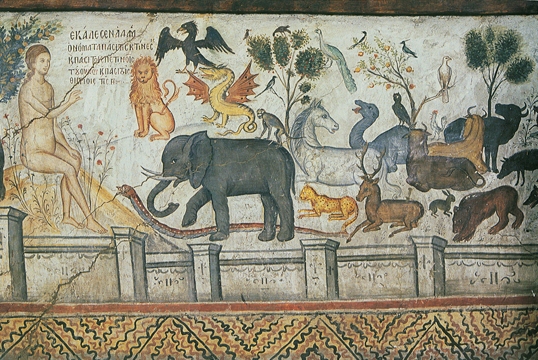
God made the animals to be a companion for man “…and brought them unto Adam to see what he would call them, and whatsoever Adam called any living creature, that was the name thereof.” Adam’s mind was a pure and unbroken mirror, perfectly reflecting all around him. His speech, the speech of Paradise, was perfect expression, and each name he gave perfectly expressed the essence of each thing he named.  Between the mind, the word coming forth from the mind, and the thing named by the word, there was no conflict, no gap, no misunderstanding.  Adam was at one with God, with himself, and with creation, in understanding, in activity, and in love.

Sin broke man’s mind into countless pieces, and each piece reflects only a tiny and disconnected fragment of what is real. Sin broke man’s activity, and his efforts always end in defeat. Sin broke man’s love, and he devotes his heart to that which is unworthy, and the object of his love devours him.

Grace heals man’s mind, his activity, and his love. Grace unites the fragmented thoughts, gives power to man’s activity, and directs his love to that which is truly lovable. Grace restores man to Paradise.

Christ, the New Adam, came to give us this grace.   Let us worship Him.

Posted in Uncategorized | Comments Off on Thou hast restored me, the whole man

Divine repose

8 February OS 2018: Wednesday of the First Week of Lent; Holy Great Martyr Theodore the Commander 

The first reading at Vespers today is Genesis 1:24-2:3.

 Since God made the human heart to hold Him, man’s first occupation was to contemplate God.   He made Adam and Eve to be His friends. He commanded them to till and to keep Paradise, but this was not work as we understand it. They did the physical work of tending the plants of Paradise and governing the animals, but this gave them pure joy and delight, for it was labor without pain. They also worked at a higher “tilling and keeping,” and this was their primary activity: tilling and keeping the mind, contemplating God in His infinite perfections. God designed this “work” to continue for all eternity, intending for their minds to rise ever higher, never ceasing, to greater and greater understanding, unto greater and greater delight in knowing and loving God.

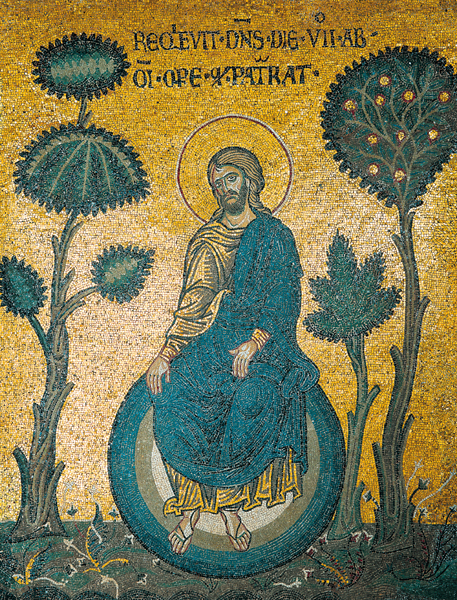
In today’s reading, the Lord Himself teaches by example what is the end of all our labors: the Seventh Day rest. “And on the sixth day God ended His works which He had made; and He ceased on the seventh day from all His works which He had made. And God blessed the seventh day, and sanctified it, because that in it He ceased from all His works which God had begun to make.” Knowing our fallen state, He gives us six days of the week to work for the food that perishes, but on the day sanctified by His own rest, God commands man to cease from labor and spend the day in his original activity, which is spending time with God.

When God became a man to save us, He completed all His labors once again on the Sixth Day and rested once again from all His labors on the Seventh Day, sleeping in the tomb according to the body but going down with His human soul into Hades, to free all those held captive from ages past. Then on the First Day, which is also the Eighth Day, He broke the bonds of death by His Resurrection and sanctified this day as the icon of eternity.   Thus Christians now rest on the Lord’s Day to honor the image of that Day that shall know no evening, and not only to honor but actually to partake by anticipation of the endless delight of that Day, even in this life.

How do we keep the Lord’s Day? How do we actually spend the 24 hours from sunset Saturday to sunset Sunday? Let us, this Lent, resolve to be honest about this, make straight that which we have made crooked, and fill up that which we lack.

Posted in Uncategorized | Comments Off on Divine repose

The light of Thy countenance, O Lord, hath shined upon us.

7 February OS 2018: Tuesday of the First Week of Lent; S. Parthenios of Lampsakos; S. Loukas of Mt. Steirion 

 The first reading at Vespers today is Genesis 1: 14-23.

 In Brothers Karamazov, the boy Smerdyakov mockingly asks the pious Grigoriy how there could have been light on the first day if God did not create the sun until the fourth day.   He grows up to be a nihilist who murders his father without remorse.

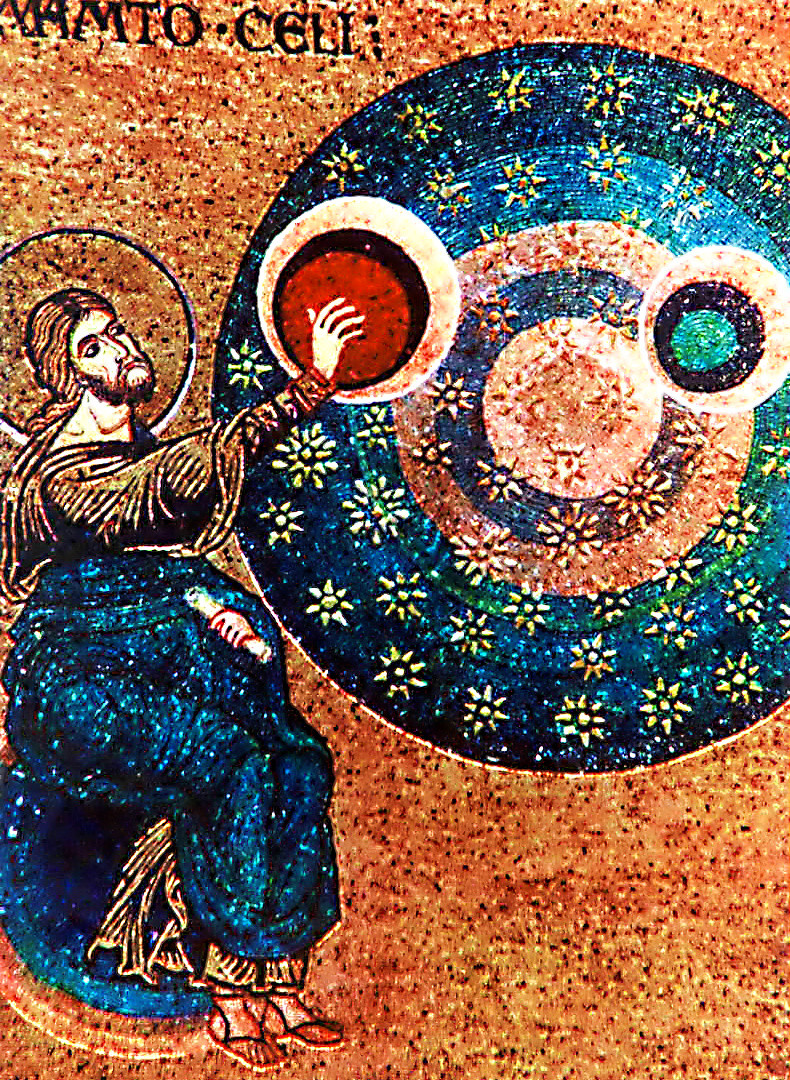
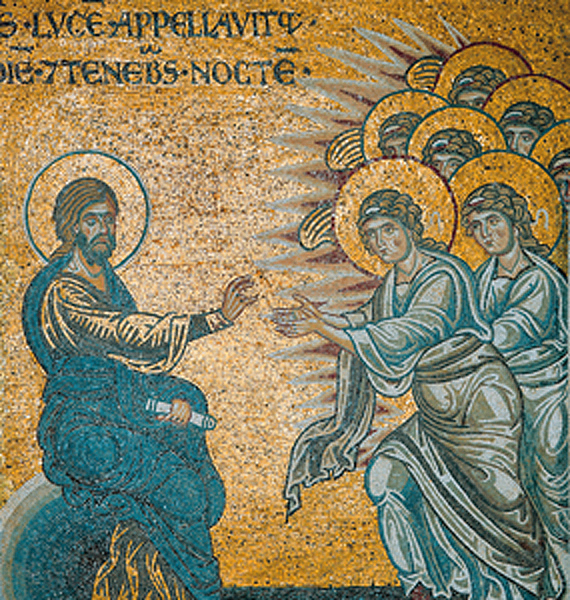
On the first day, God said, “Let there be light.” God did not need to sun to make the light. His light – both the uncreated light and the created light – illumined all that He made on the First, Second, and Third Days of Creation. He created the sun and moon and stars as servants of the light; they are not light itself. Likewise, God did not need the brain to create mind. Being the Uncreated Mind, He created countless bodiless intelligences, the Angels, before this world came to be.   Man’s physical organs of thought – both the brain and the heart – He created as servants of the mind; they are not mind itself.

To make clear that the sun, moon, and stars are not gods, God inspires Moses to state that the Lord made them “…for signs and for seasons, for days and for years.” God made all the vast physical cosmos, whose awesome grandeur and unimaginable dimensions human science has confirmed in our time, to be a calendar for man, a servant of man.   For man alone is made in the Image of God. One human heart is potentially greater than the entire physical cosmos, for into the heart of the baptized the Holy Trinity comes to dwell.

All man’s ills – of mind, heart, and body – arise when he worships creatures and not the Creator as the source of his life. All man’s ills – of mind, heart, and body – arise when he forgets the nobility of his divine calling. During Great Lent, we re-learn that God is God, and that we must worship Him alone.   We re-learn that He made us in His Image and that we must recover the primordial Likeness.   By re-learning our original nobility, we come to lament our present poverty, and we aspire to the Paradise that we lost through sin.

Posted in Uncategorized | Comments Off on The light of Thy countenance, O Lord, hath shined upon us.

The beginning

6 February OS 2018: Monday of the First Week of Lent (Clean Monday); S. Bucolos of Smyrna; S. Photios the Great 

Each weekday during Great Lent, I plan to re-post the little commentaries I wrote last year on the daily readings from Genesis.   

Today’s first reading at Vespers is Genesis 1:1-13.

As we begin Great Lent, we begin also to read the Book of Genesis at Vespers. The first words remind us of the foundation of all spiritual life, the firm conviction that God is our Creator and that we are His creatures:

In the beginning, God created the heavens and the earth.

The infinitely good and wise God, the omnipotent One, brought all things from nothing into being. This includes you and me.

My existence is contingent, not necessary. The blink of an eye separates me in time from the abyss of nothingness from which I came, and the blink of an eye separates me in time from the hour of my death. Compared to God, I am nothing.

All of our problems arise from forgetting this fundamental reality, in one way or another. If only we were actively mindful of this at every day and hour, we would always be happy. Our sorrows come from trying to be God. This is true of each of us personally as well as the entire human race.   When we remember that we are finite, sinful, and doomed to die, all of life comes into perspective, and we can attain peace of heart.

May the grace of this Great Lent, which may be our last, bring us to constant remembrance that we are creatures and therefore our Creator should be everything to us.

Posted in Uncategorized | Comments Off on The beginning

Orthodox Survival Course, Class 14

Orthodox Survival Course

St. Irene Orthodox Church

Rochester Hills, Michigan

2017-2018

Revised Notes for Class 14. Please discard the earlier version.

Class 14 – The Renaissance: Timeline Overview. Topic 1: Some Key Bad Ideas from the Start

Timeline Overview: Renaissance to Enlightenment to Revolution

Tonight we will begin our section on the Renaissance, which for convenience’s sake we will say lasts roughly from 1300 to 1600. Of course, many conventional timelines show the 14th and 15th centuries as the “late Middle Ages,” and there are reasons for this, especially if you are considering the British Isles, the Iberian Peninsula, and Scandinavia, which remained “medieval” in various ways longer than the dynamic Italian and French cultures, the seedbeds and exemplars of all future European development. But for our purposes, since we are working on acquiring an Orthodox overview of the vast sweep of Western culture, it is most useful to zero in on the 14th century, and on Italy, as the key period and key place marking the transition to the Renaissance.

In my earlier proposal for a syllabus of Part II of our course (see the end of the notes for Class 10), I put forward the Reformation and Counter-Reformation as separate topics, but after further reflection, I think we’ll treat them as sub-topics within the Renaissance period. As with our earlier sessions, I’m not sure how long we’ll take on the Renaissance: Remember, you are here with me in the initial formation of our course, and we are going to take things as they come and adjust as we see fit.

Though, as we said, the real transition in the West from Orthodoxy to something else really took place in the 12th to the 13th centuries, yet the consequences of this transition were probably not foreseen by the men who caused it, men who believed – tragically and mistakenly – that they were laying solid foundations for a “Thousand Year Reich,” so to speak, of a genuine Christian civilization under the benevolent rule of the Pope. But that was not in fact the result. In the Renaissance, we will see, with dismay, shockingly different “Consequences” of the “Ideas” of the Western High Middle Ages: the collapse of the delicate Idealistic (to use Sorokin’s term) synthesis of the High Middle Ages into an open, unapologetic, self-adulating, no holds-barred Sensate culture marked by anthropocentrism rather than theocentrism, the shift from Truth to Power as the driving force of culture and politics, Superstition replacing Faith and Reason, the glorification of carnal passions, the elevation of the individual and his quest for human glory, and the misdirection of Science from its ancient pursuit of truth in the service of man’s spiritual and intellectual telos – i.e., virtue – to the “progressive” pursuit of power over material phenomena, in the service of comfort, pleasure, and the manipulation of the masses of people by a self-serving oligarchy of occult “insiders,” with this vast technological enterprise being funded by the alchemy of a usury-based financial system. It is as if one of those vast yet delicate Gothic cathedrals, so heartbreakingly beautiful in its dynamic upward thrust to pierce the heavens, suddenly got dizzy, lost its dynamic balance and collapsed into a pile of rubble. Meanwhile, the un-dynamic and un-progressive older brother of the Gothic cathedral, that old-fashioned “boring” Byzantine church sitting solidly on the ground – i.e., the Orthodox civilization – still stands silent, still, and unchanged, “left behind” in the “march of progress,” quietly living on in the monasteries and agrarian societies in the vast backwaters at the eastern end of the Western world: the Ottoman Empire and Old Russia (i.e., Russia before Peter I).

The headlong, frenzied race into passion and fragmentation initiated by the Renaissance will be, as we will see, temporarily arrested by the attempt of the “Enlightenment” (roughly the 17th and 18th centuries) to create a new stasis by means of “reason,” but, being merely man-made, without spiritual truth and power, without repentance, still marked by great hubris, this brittle, make-believe “reasonable” world of Newtonian science and rationalist philosophy will be crushed into a thousand pieces by the demonic power of Revolution, beginning in 1789.

During these last two periods, of “Enlightenment” and Revolution, the Orthodox East will once again encounter and be greatly affected by Western European man, and the latter’s bad Ideas will begin to have Consequences for our fathers, as well. It is essential to our survival that we understand what then happened to the Orthodox, leading right up to our own time.

The Renaissance, Topic 1: Some Key Bad Ideas from the Start – Three Pancakes and Occam’s Razor

So we will see that bad ideas in High Middle Ages led to worse things in the Renaissance. I’d like to go back and review three key transitional ideas that we have alluded to or spoken about in passing, that led inevitably to the collapse of that delicate Idealistic structure of 13th century Western Christian culture into the fragmented free-for-all of the Renaissance I call them the three “Pancakes,” because each one involves “pancaking” two realities into one, smashing together and confusing distinct realities.

Pancake 1 – Man: Reason and Nous, Soul and Spirit. The Scholastics, and what became “Roman Catholic” anthropology generally, do not distinguish carefully between the logos in man regarded as dianoia – the discursive, analytical intellect – and the logos regarded as nous – the synthetic, intuitive, and, properly speaking, spiritual intellect. They “pancake” them into one reality, “reason,” ratio or intellectus. Another word for one’s nous is pneuma– spirit – regarded as the highest faculty of the psyche, the soul, and with its own distinctive function, that is, to act in the invisible realm of the angelic universe through direct, undeluded and synthetic spiritual perceptions. From this point on, this intellectual confusion creates a bad theological method – that of dialectic, with primacy given to kataphasis instead of apophasis, and to the analytic over the synthetic and tradition-based method – as well as lack of spiritual discernment: the Western “saint” cannot distinguish between that which is merely of “the soul,” psychological, and that which is genuinely of “the spirit,” spiritual. By opening the door to endless dialectic and analysis, this confusion leads to theological unraveling. By opening to the door to endless delusory psychological experiences, this confusion leads to complete lack of spiritual discernment.

Pancake 2 – The Church: Organism and Organization. The full-blown papal ideology “pancakes’ the organism of the Church – Her life – into the organization of the Church – Her outward structures, with the latter controlling and dominating, or, in worst cases, substituting for the former. How do you know you are in the Church? Well, you are under the Pope. How do you know you won’t spend more time in Purgatory? Well, the Pope has granted you an indulgence. How do you know someone is really a saint? Well, the Roman Curia has gone through a specific legal process and declared it so. As we know, the Orthodox respect the ancient administrative structures, ancient sees, territorial synods, etc. (which is why we are fighting about them all the time!), but the Orthodox have never identified the structures with the Church. They are in service to the Church; they are not the Church. This confusion in the West will lead to the Church being cynically regarded as just another competitor for earthly power in the race to see who will create the new, “progressive” bright future of a New World Order, Heaven on Earth. In the Renaissance, we will see the spectacle of the popes marching at the head of armies to kill Christian men and sponsoring adventures in astrology, alchemy, and usury to bring about a “better life” on earth.

Pancake 3 – God: Absolute Divine Simplicity

We do not have time, given the broad scope of our course, to give adequate treatment to the so-called Palamite controversy of the 14th century, but we need to summarize at least the points that make up its outcome. Remember how we spoke earlier of Anselm of Bec and the famous slogan of his Proslogion: “fides quarens intellectum”. The idea here is that faith is a “leap in the dark” without evidence and without logic, and that we have to correct this defect in faith with the more sure knowledge coming from experience and reason. This, in germ, is the basic idea of the “Anti-Hesychasts” who opposed St. Gregory Palamas. St. Gregory summarized centuries of the teaching of the Orthodox Fathers when he taught that

1. Theology is grounded in the direct experience of the saints, whose nous has direct contact with the uncreated energies of God.

2. Therefore, a prerequisite assumption is that God’s essence and energies are distinct, because the nous must simultaneously experience God in reality, to avoid agnosticism, without experiencing the divine essence, which would result in pantheism.

3. This knowledge is more, not less, sure than the results of the empirical experience and analytical reasoning of the scientists and philosophers.

The “Latinophrones,” or “Anti-Hesychasts” taught the opposite, that theology is the result of applying philosophical reasoning to natural and supernatural revelation, that God is Absolutely Simple, actus purus – His essence and His energies are “pancaked” into absolute identity – and that scientific and philosophical knowledge is more certain than the knowledge gained from spiritual experience. This “leap” from trusting the Saints and Tradition to trusting “reason” will result in the humanism and worldliness that will characterize the Renaissance, which, we will see, will be an age not of reason but superstition, because…

…by undercutting the basis for undeceived spiritual knowledge, the Anti-Hesychasts undercut the basis for the functioning of reason itself, which is known to exist only by Divine Revelation. This is where the Orthodox parted ways with the Scholastics. But at the same time, over in England, William of Ockham is parting ways with the Orthodox and the Scholastics, and the Great Race to the Bottom of Western thought is off and running!

Occam’s “Razor” and Nominalism – Finally, we are coming around to the great villain in Richard Weaver’s narrative of the fall of the West: Nominalism. And we have to agree with Weaver: It’s a huge problem. Like “Anti-Palamism,” Nominalism, though one finds it before in various authors, really “takes off” in the 14th century, with the teachings of an English Franciscan friar, William of Ockham (or “Occam”). While Anti-Palamism undercuts human knowledge indirectly, by undercutting the divine-human mechanism of Revelation, Nominalism undercuts the possibility of human knowledge directly, by denying the existence of the “universals.”

Occam’s “Razor” is the nickname for an epistemological axiom attributed to the friar William: ” Entities are not to be multiplied without necessity.” As a methodological assumption for scientific work, that’s a pretty good rule: Keep it simple; throw out whatever is actually extraneous to your hypothesis. The problem is that Occam, and later many other thinkers, applied this rule to the age-old “problem of the universals,” and came up with what came to be called “Nominalism,” that is, “Name-ism,” the idea that when we call two horses by the same name – horse – it’s not because there’s such a thing as horse-ness that the horses have in common, but simply because we noticed that these two things are kind of the same and so we’ll call them both “horse” for convenience.

So what is this “problem of the universals?” A “universal” is anything predicated of more than one individual: “Man,” for example, as predicated of Peter and Paul. The “problem” is this: Does the word “man” signify something that really exists or is it just a notion, a tag, we apply to the two individuals pragmatically, for convenience’s sake? Is there such a thing as human nature, or is that a notion, a linguistic convention we can change at will? Is there such a thing as a “nature” of anything? There are three possible answers:

Nominalism – Nominalism is the idea that the universals are just names (nomina) that we give to individual substances that seem to be kind of the same. There is no such “thing out there” as human nature, horse nature, house nature, star nature, etc.

Extreme Realism – Plato combats this idea, which obviously leads to skepticism, cynicism, and the abuse of power, and which he associates with Socrates’ opponents, the sophists, with a radically opposite idea: the universals are so real that they have a separate existence in the World of Forms (τα είδη). When we perceive “humanness,” our mind is experiencing anamnesis (remembering again) of the “true world” in which our souls pre-existed before being “imprisoned” in the flesh and the delusory world of matter. There is a soteriological problem here, however: When you leave the body and re-enter the world of the forms, how does your “humanness” encounter Humanness Itself and not get absorbed by it? Thus Platonic soteriology is ultimately not different from the Hindu idea of the absorption of the individual into the One.

Moderate Realism – this is the solution of Aristotle, which in modified form is taught by the Holy Fathers.. The universals do exist, but they exist only as instantiated in individual instances. “Humanness” does exist, but we see it only in examples like Peter and Paul, not in itself. But where did our minds get these ideas? Why are we able to perceive the universals? The answer is most beautiful and satisfying: Our minds are made according to the image of the Logos, the Primordial Word of the Primordial Mind, in which, according to His energies, are found the logoi, archetypes or patterns, of all created things. The universals are created natures made after the image of the logoi, and our mind, created after the image of the Logos, can naturally perceive them. When a Christian attains theoria (the second stage of spiritual life, in which the passions are healed and the mind perceives reality accurately), he starts to perceive the logoi of all things as well as the created natures made after the pattern of the logoi.

The Scholastics, with their beloved Absolute Divine Simplicity, have a hard time explaining why the universals are not created or eternal archetypes with an existence separate from individual created instances and from God, which would throw them back into some kind of Platonism or even (if the archetypes are uncreated) polytheism, or, if the universals really do belong in the mind of God considered as pure essence, are not therefore necessarily merely notions in our own minds, since all distinctions within the divine essence are notional, not real, and this throws them back into some kind of Nominalism. The Holy Fathers, by contrast, most notably St. Maximos the Confessor, can explain the universals, as being created natures made after the pattern of the uncreated logoi, which are uncreated energies of the Logos.

But both the Orthodox and the Scholastics oppose Nominalism.

We will see how the skepticism engendered by Nominalism will infect every aspect of religion, philosophy, politics, and culture in the Renaissance and succeeding ages. If you cannot know the natures of things as they really are, then real knowledge is impossible, and the pursuit of science is not to conform the mind to reality, and the passions to the mind, but to conform reality to the demands of the will dominated by the passions. This Satanic inversion is the basis of all modern culture, a sobering thought that should really motivate us to stay “out of the mainstream” and “off the radar screen,” and really stay close to the Church.

You can listen to recordings of our classes here:

https://www.spreaker.com/show/fr-steven-allens-show
Posted in Uncategorized | Comments Off on Orthodox Survival Course, Class 14

The task before us

3 February OS 2018 – Friday of Cheesefare Week; Afterfeast of the Meeting of the Lord;  Ss. Symeon the God-receiver and Anna the Prophetess; Holy New Martyrs John, Stamatios, and Nicholas of Chios; S. Nicholas, Enlightener of Japan

A little known feature of our Cheesefare Week services – little known because most parish churches do not have weekday services outside of feast days – is that the Wednesday and Friday of this week are a-liturgical – i.e., the Divine Liturgy is not celebrated – and instead of the two daily readings at the Divine Liturgy from the New Testament, we have readings at the Sixth Hour and Vespers from the prophets of the Old Testament.

The two Old Testament readings in the services today are from the Prophet Zacharias – at the Sixth Hour, chapter eight, verses seven to seventeen, and at Vespers, chapter eight, verses nineteen to 23.   The Lord speaks to the prophet telling him to announce God’s mercy to those who repent. Not only will God forgive and bless His people, but other nations will come and turn to the Lord, as well.

Commenting on these passages, St. Theophan the Recluse has this to say:

“So will I save you, and ye shall be a blessing,” promises the Lord through the prophet Zachariah (Zach. 8:13). But under what condition? Under the condition that every man will speak the truth to his neighbor, that men will righteously sort out their affairs amongst themselves, that men will not remember wrongs in their hearts against their neighbor, that they will love no false oath, and will love truth and peace. If these conditions are met, says the Lord, “they shall be to me a people, and I will be to them a God, in truth and in righteousness (Zach 8:8),” and His blessing shall spread among them. Then all strangers shall hear and say, “Let us go speedily to them to pray before the Lord, for we have heard that the Lord is with them (cf. Zach. 8: 21-23). “And many peoples and many nations shall come to seek earnestly the face of the Lord Almighty (Zach. 8:22).”

 Thus did the high moral purity of the first Christians attract people and nations to the Lord. Those who live always according to the spirit of Christ are, without the use of words, the best preachers of Christ and the most convincing apostles of Christianity. – Thoughts for Each Day of the Year, p. 52

“Thus did the high moral purity of the first Christians attract people and nations to the Lord.” God had prepared the pagan world of that time to accept the Gospel, and the pagan world was exhausted spiritually, looking for answers. They were ready for the new Faith. And when they not only heard the divinely inspired preaching of the Apostles and other holy teachers of the Faith, and beheld so many healings and other miracles, but also saw how differently the Christians lived from everyone else – the extreme purity and stability of their family lives, their generosity to the poor, their forgiveness and meekness in the face of persecution – they were overwhelmed: this, in deed, as well as in word, was the Truth.

Our situation is different today, in that we are not dealing with pre-Christians who are hungering and thirsting for the truth but with post-Christians who do not care about truth or who say that the only truth is that there is no truth and cannot even see that such a position is senseless. We are dealing with people who already think they know who Christ is and what the Church is, and either overtly reject both, or embrace some distorted version of the Faith, or – which is most common – are indifferent, satisfied with a vague religious feeling and satisfied with themselves.   To get people to admit there is One, True Faith, much less that Orthodoxy is that Faith, is a tall order. Our task, however, remains the same, which is repentance, with constant re-commitment, daily renewed efforts to lead our lives according to the Orthodox Faith. Great Lent, which we will begin in three days,  is the pre-eminent time to do this.

Because we live in this post-Christian age, however, we must be content to labor in isolation, not expecting great outward results.   This is our cross, the particular struggle the Lord has assigned to us, in His wisdom and providence from all eternity. We will gain courage to go on with this struggle if we do two things: if we have an intense life of prayer and if we constantly strive to communicate with like-minded fellow Orthodox. The life of prayer, nourished by spiritual reading, will console us from within, and talking to spiritual friends will console us from without. Conversely, two great dangers that threaten us are giving up on the life of prayer and isolating ourselves from our priest, our parish, and our Orthodox friends.

As we plan for Lent, then, let us look honestly at our practice of daily prayer and spiritual reading, and re-dedicate ourselves to a daily discipline. Let us plan to go to confession as soon as possible, and also to re-connect with fellow parishioners or other Orthodox friends whose encouragement has helped us in the past, and remember, too, that they need us, as we need them.

“A brother helped by a brother is a strong city.”

A blessed Great Lent to all!
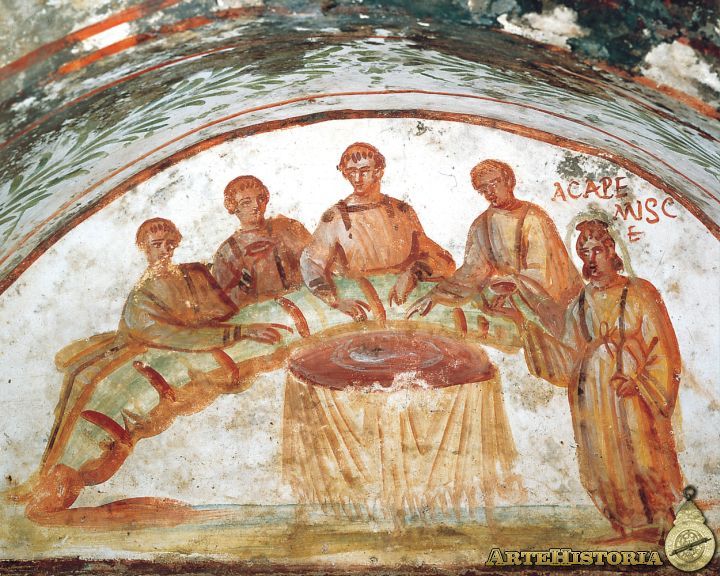
agapecatacombpainting

Posted in Uncategorized | Comments Off on The task before us

The Perfect Offering

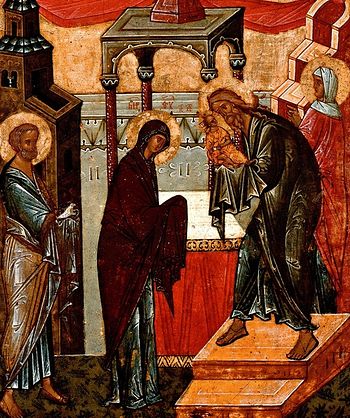
2 February 2018 OS – The Meeting of the Lord 

The Meeting of the Lord is a quiet, much-neglected feast, and yet the Holy Fathers saw fit to rank it among the Twelve Great Feasts of the Church, for it is a holy mystery integral to the great mysteries that form the one great mystery of our salvation. It is the Fortieth Day of Our Lord’s Nativity, the end of the great cycle begun on the Entry of the Theotokos (November 21st OS), when we began chanting “Christ is Born,” and continuing through the Forefeast of the Nativity, through the Nativity itself, the Theophany, and all the wonderful season which celebrates the Incarnation. Observance of the Meeting is integral to truly observing Christ’s Birth and Baptism, to keeping Christmas as it should be kept.

On this day the Lord Who gave the Law to Moses on Mt. Sinai – the Lord Who decreed that every first-born of the Hebrew race, the Old Testament Church, be ransomed in the Temple, in remembrance of the Lord’s sparing their first born in Egypt – this same Lord now comes as a little babe, as a man and in place of sinful man, to fulfill perfectly the Law He Himself gave as God. The paradoxical wonder: He that is to be the Ransom for our salvation condescends to being ransomed by the offering of two young doves. That which we could not do for ourselves, He did for us. He fulfills the Law in two senses: 1. He alone could completely obey God’s command, because He alone of all the race of man, being the New Adam, had an uncorrupted human mind to receive the Law and an uncorrupted human will to obey it, and 2. He brings an end to the Old Law and ushers in the New.

This day is also the Purification of the Holy Virgin, a paradoxical name, for she alone of all mothers on earth needed no purification, having conceived without the aid of a man, without seed and without passion, and having given birth without corruption and with the seal of Her virginity intact. Before, during, and after birth She remains, in time and in eternity, the incorrupt, most-pure, and most holy Ever-Virgin Mother. Yet in obedience to the Law she submits to the prayers of the 40th Day, read by the priest to purify an ordinary human mother from the stain of corruption incurred by the passionate union of the flesh and the bloody parturition of the womb. The above-supreme honor of being God’s own mother does not lift her estimation of herself above all other women (much less above men!), but rather casts her into the abyss of utmost humility, that complete knowledge of one’s nothingness before God, the only possible appropriate response to Who God Is and who we are. For this obedience, this humility, this complete reversal of Eve’s anarchy that marked the beginning of all our woes, She is rightly ranked “More honorable than the cherubim and beyond compare more glorious than the seraphim.” Having made herself most low, she has been exalted most high, not simply above all other men, but above all the heavenly hosts, above all the visible and invisible creation, and she has become the very border of the created and uncreated realms.

O Lord Jesus Christ our God, presented in the Temple as a babe for our sakes, glory be to Thee!

O Most Holy Theotokos, save us!

Posted in Uncategorized | Comments Off on The Perfect Offering

Purity of intention

12 January OS 2018 – Thursday of the Sixteenth Week of St. Luke; Afterfeast of the Theophany; Holy Martyr Tatiana

Today’s Gospel reading in the daily cycle is Mark 12: 38-44.

The Lord said, Beware of the scribes, which love to go in long clothing, and love salutations in the marketplaces, And the chief seats in the synagogues, and the uppermost rooms at feasts: Which devour widows’ houses, and for a pretence make long prayers: these shall receive greater damnation. And Jesus sat over against the treasury, and beheld how the people cast money into the treasury: and many that were rich cast in much. And there came a certain poor widow, and she threw in two mites, which make a farthing. And he called unto him his disciples, and saith unto them, Verily I say unto you, That this poor widow hath cast more in, than all they which have cast into the treasury: For all they did cast in of their abundance; but she of her want did cast in all that she had, even all her living.

We all claim to hate hypocrisy and simultaneously imagine ourselves to be the widows whose houses are being devoured and our adversaries to be the hypocrites who are devouring them. But this only goes to show that we also are hypocrites, does it not? We profess to be Christians but blame others for our problems, which is quintessential hypocrisy, since a Christian knows that his only problem is sin, and that the only person that can really prevent his salvation is himself.

How do we acquire complete integrity of intention and a clear vision of ourselves, so that we may inherit the poor widow’s blessing? How shall we be able to offer to the Lord all that we really can, whether it is great or small, from a pure heart? Well, that is the work of a lifetime, and most people only really get there on their deathbeds, if they get there. But today let’s start with three activities:

1. Pray to see yourself as you really are. Tell God that you are so deluded that you don’t even know how deluded you are. Since this is the truth, it is pleasing to Him, and He will answer your prayer.

2. Usually, bad things will happen to you as a result of doing the above. This is because we rarely benefit from direct illumination, not appreciating it or not even seeing it for what it is, and God knows we have to learn the hard way. Most days it is little bad things, like the children misbehaving or our boss being unhappy with us. Some days it may be something much larger. Either way, Activity 2 is to thank God when bad things – great or small – happen to us, and to observe our instinctive response to these things. This will reveal a great deal about where we really “are at.”

3. Make a careful examination of conscience tonight, going over all of your thoughts, feelings, words, and actions of the day. Ask God’s forgiveness for your failings and thank Him for the good He enabled you to do and for the good things that came your way.

Tomorrow, do 1, 2, and 3 all over again. Purity of heart is on its way!

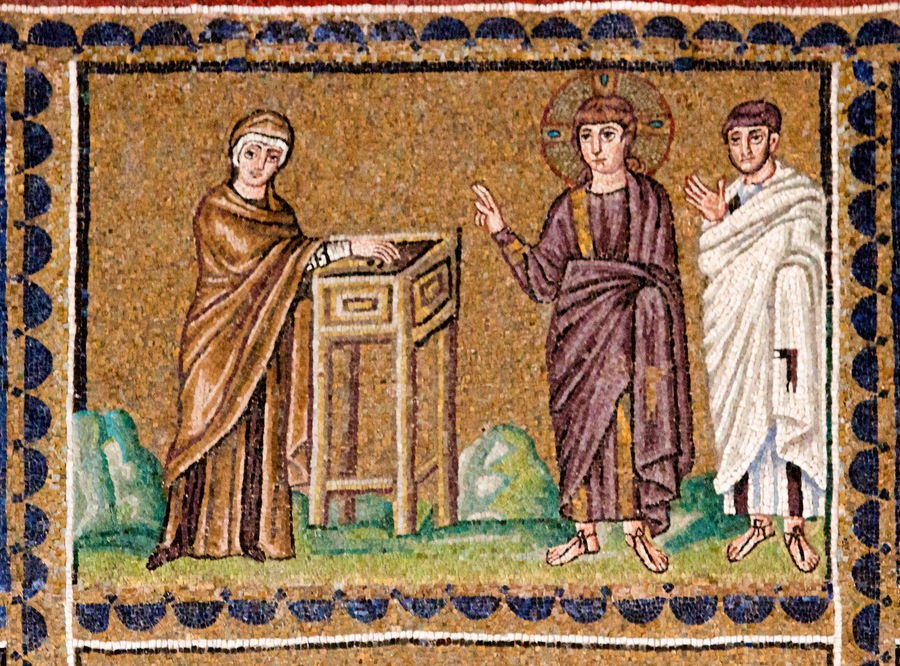
22.4.2010: Sant’Apollinare Nuovo, Ravenna

Posted in Uncategorized | Comments Off on Purity of intention

Orthodox Survival Course, Class 11

Orthodox Survival Course

St. Irene Orthodox Church

Rochester Hills, Michigan

2017-2018

The notes below are just a brief summary of everything that we talk about.  For the most benefit, listen to the audio! (See below).  

Class 11 – The Latin High Middle Ages

A [Western]Christian of the fourth or fifth century would have felt less bewildered by the forms of piety current in the 11th century than his counterpart of the 11th century in the forms of the 12th. The great break occurred in the transition period from the one to the other century. This change took place only in the West where, sometime between the end of the 11th and the end of the 12th century, everything was somehow transformed. This profound alteration of view did not take place in the East, where, in some respects, Christian matters are still today what they were then – and what they were in the West before the end of the 11th century.-Yves Congar, O.P., After Nine Hundred Years (Fordham University Press, 1959, p. 39), quoted by Hieromonk Seraphim (Rose), in the introduction to his translation of the Vita Patrum of St. Gregory of Tours (St. Herman of Alaska Brotherhood, 1988, p. 70)

Introduction – We are now beginning Part II of our course, in which we hope to trace the development of Western European thought and culture from the time in which the Western Church left the unity of Orthodoxy until now. Necessarily, this will be a sad story. You might say that the first part of our course was the really enjoyable part, in which we reviewed what Orthodoxy is. Now we will do the hard work of understanding what it is not, and how the subtle change from Orthodoxy to what can be called “papism” or “Latinism” in the 12th and 13th centuries began a process that became an avalanche of change that led to the drastic secularism and apostasy of today. One could summarize this entire process by saying that at the beginning, Western European Christians made a subtle shift from trusting in Holy Tradition to trusting in reason, and now, nearly a thousand years later, reason having made many twists and turns, and finally proving inadequate to deal with the greater questions of life, they have plunged into suicidal irrationality of all kinds. They fell from that which is above nature to nature, and now what we see today is hatred of nature itself, a demonic hatred and destruction of everything. Tonight we will examine how this started.

We are now entering the part of our course which is dealt with in Fr. Seraphim Rose’s lectures. Tonight’s subject is dealt with in Lecture 2, “The Middle Ages,” for those of you who want to study the transcripts of his lectures in tandem with our discussions. Fr. Seraphim divides his talk into an Introduction and four topics: Scholasticism, Romance, New Concept of Sanctity, Joachim of Floris (a teacher of a kind of chiliast utopian eschatology), Art, and Politics. We will follow his outline, and tonight we will try to cover three topics: Scholasticism, Romance, and the New Concept of Sanctity.

In his introduction, Fr. Seraphim quotes from two writers, the 19th century Russian Orthodox Ivan Kireyevsky, who with Alexei Khomiakov can be said to be the founder of the “Slavophile” movement, and the Dominican modernist theologian, Yves Congar. Kireyevsky traces the beginnings of the problems with the medieval schismatic papal church to a tendency in the [West] Roman mind from the beginning, to trust overmuch in logical deduction and to value the external aspect of the church over the interior, spiritual aspect. Congar, though his conclusion is not that the West should return to Orthodoxy but somehow create a “new theology” created by people like him, did accurately identify what happened in the transition of the 12th and 13th centuries, a transition from theology based on “…a predominantly essentialist and exemplarist outlook to a naturalistic one, an interest in existence,” and “…[a] transition from a culture where tradition reigned and the habit of synthesis became ingrained, to an academic milieu in where continual questioning and research was the norm, and analysis the normal result of study.”

A. Scholasticism – Scholasticism is the name given to the philosophical and theological thought of men like Albertus Magnus and, pre-eminently, Thomas Aquinas, in the period of the 12th through the 14th centuries, who applied the philosophy of Aristotle and the tools of dialectic to explaining and defending theological and philosophical positions acceptable to the Western church of that time. We have to realize that at the time, many Church authorities in the West were against the Scholastics, because they could see that they were overemphasizing the use of reason, and that this could lead to a break with Tradition. Finally, however, the Scholastics, having come close to being anathematized by the popes, were approved, and finally their method became the only one accepted by the Western church.

Even before the “classic” period of scholasticism, in the 12th and 13th centuries, we have the key figure of Anselm of Bec, or of Canterbury, (+1109) who in his famous Proslogion redefined the goal of theological thought as fides quaerens intellectum– “faith seeking understanding.” In other words, instead of the mind (the intellectus) seeking to know through faith, through being transformed by God’s Word and by spiritual life, faith is seen as somehow defective, lacking knowledge, and seeking more certain truth through intellectual effort. This is really the basis of the whole modern error of “faith vs. reason,” as if faith is “blind” and “fundamentalistic” and “reason” is real knowledge. We already see this error in the East with Barlaam of Calabria, the famous opponent of St. Gregory Palamas in the 14th century.

Fr. Seraphim, in his lecture, goes into detail about one of Thomas Aquinas’s (+1274) demonstrations, but we don’t need to spend time on that now. The important thing to understand is that, for the Holy Fathers, Aristotle, Plato, and all philosophical method, are auxiliary to theology. The Church’s theology is revealed by God and testified to by the Apostles, Fathers, and saints. At the Ecumenical Councils, the Holy Fathers testified to what they had received, and they worked with the language of the philosophers strictly, in a limited way, as a tool, to bring out more precisely and beautifully the Tradition that everyone already believed in. The schoolmen would accept this basic idea, but in their efforts to defend the Faith they began to enclose the Faith in their syllogisms and arguments, and finally the popes began to dictate that only their explanations and definitions were the legitimate interpretation of Tradition. The problem here is that once you enter this process of dialectic, there is nothing to stop it – for every thesis there is an antithesis, and so forth, and you’ve let the horse out of the barn.

So Richard Weaver’s idea, in Ideas Have Consequences, that the degeneration of the West starts in the 14th century with nominalism, does not go deeply enough into the problem. The problem is that the scholastics invited Ockham’s critique by leaving the security of Holy Tradition and the authority of the Fathers for the uncertain project of dialectical criticism of all the Church’s teachings.

B. Romance – The high middle ages see the beginnings of romantic literature, and the romantic ideal. We see this in secular literature such as the French chansons, Arthurian literature, the mystery plays, and the highly romanticized ideas about chivalric love and so forth. But it also finds its way into church literature and, ultimately, into spiritual life. In Church literature, a pre-eminent example Fr. Seraphim talks about is The Golden Legend, and in spiritual life, the first and greatest example is the life of Francis of Assisi.

C. New Concept of Sanctity – This romanticism is exemplified in the career of Francis of Assisi (+1225), who is a key figure in the whole development of non-Orthodox Western Christian life and thought. Francis claimed to have received a revelation which commanded him to create an entirely new kind of monastic life which was not bound by the monastic tradition witnessed to in the Desert Fathers, St. Basil, St. Benedict, and so forth, a life of wandering “troubadours for Christ” who would go around and amaze everybody by their lyric, emotional, enthusiastic “love” for everyone and everything. Francis was the ultimate example, and he certainly thought he was something special. He had the hubris to ask to receive the physical wounds of Our Lord on his body, and, in a bizarre vision of extreme delusion, he did! Here we see the beginning of the whole Western church getting unmoored from the safe harbor of the teachings of the Fathers about sobriety and true prayer, and launching out into the uncharted and dangerous sea of emotionalism and fantastic, imaginative, and, frankly, carnal experiences taken as spiritual experiences.

So by the end of this period we have a “new church” of dialectical theology instead of traditional theology, and romantic, imaginative spiritual life instead of the authentic teaching of the Fathers on spiritual life. It is already really a new religion.

Listen to recordings of our classes here:

https://www.spreaker.com/show/fr-steven-allens-show
 

Posted in Uncategorized | Comments Off on Orthodox Survival Course, Class 11